top of page

Follow on Social Media

  • Facebook
  • Twitter
  • Screenshot 2022-09-18 at 5.20.40 PM

M'sia Developments
[on SubStack]

  • Screenshot 2022-09-18 at 5.20.40 PM

KUALA LUMPUR, Malaysia, Mar 24 2026 (IPS) - In mid-1971, US President Nixon ended the dollar’s gold peg at $35 per ounce, triggering de-dollarisation. The 2025 gold and silver rush followed private speculators trying to profit from central banks hedging against perceived new risks.


De-dollarisation

Some believed that flexible exchange rates, replacing earlier fixed rates, would resolve the ‘Triffin dilemma’ of the ‘dollar system’, due to its role as world reserve currency.

Many believe OPEC was allowed to raise oil prices from 1972, on condition petroleum purchases would be settled in dollars. ‘Petrodollars’ were thus believed to be the ‘black gold’ underlying the dollar system’s survival after 1971.

Although still the dominant world reserve currency, the dollar’s role has gradually declined over the decades. Trump 2.0’s rhetoric and actions appear to have accelerated de-dollarisation.

Trump’s 2 April 2025 ‘Liberation Day’ tariffs announcement triggered even greater uncertainty and volatility in foreign exchange and other markets worldwide.

Greater policy unpredictability has caused governments and investors to explore new options. Authorities worldwide are considering and developing alternatives to the dollar system.

Besides higher inflation, Trump’s threats and actions, particularly his tariffs, sanctions and wars, have pushed investors to sell dollar assets and seek alternatives.

Various factors have significantly accelerated de-dollarisation. In the first half of 2025, the dollar fell by over 10%, its sharpest fall since the 1973 oil crisis.


Many countries in the Global South have been purchasing gold rather than dollar-denominated assets for reserve accumulation.


Geopolitical economy commentator Ben Norton highlighted an April 2025 note by the Deutsche Bank foreign exchange research head, noting:

“We are witnessing a simultaneous collapse in the price of all US assets [including stocks, foreign exchange, and bonds] … we are entering uncharted territory in the global financial system…

“The market is rapidly de-dollarising. In a typical crisis environment, the market would be hoarding dollar liquidity…The market has lost faith in US assets. They are actively selling down their US assets.

“US administration policy is encouraging a trend toward de-dollarisation to safeguard international investors from a weaponisation of dollar liquidity.”


Western confiscations

The weaponisation of central banks by the US, Europe, and their allies has caused other central banks to seek ‘safety’ by switching from dollar assets to gold.


Increased weaponisation of the dollar and Western confiscation of others’ assets under various pretexts have accelerated this trend.


Billions of dollars’ worth of Venezuelan central bank gold, held at the Bank of England, was confiscated by the UK government during the 2019 Washington-instigated Caracas coup attempt.


After the coup failed, the Bank of England refused to return the gold to Venezuela. Trust in Western governments and central banks thus continued to erode.


Similarly, the US Fed and European Central Bank confiscated over $300 billion worth of Russian dollar-, euro- and sterling-denominated assets after it invaded Ukraine.


European authorities have since pledged to transfer these Russian assets to Ukraine rather than return them to their owners.


Western confiscations of the central bank reserves of Iran, Venezuela, Afghanistan, Russia and others have alarmed authorities and publics worldwide.


Central banks’ reserve managers have increasingly viewed gold as safe despite greater volatility. Besides serving as a hedge, the precious metal also offered lucrative speculative gains.


Mitigating risk

Many monetary authorities have reversed their earlier accumulation of dollar-denominated US Treasury bills and bonds in their official reserves.


While US government debt has continued growing, inflationary pressures have mounted, albeit episodically. Gold and silver holdings are believed to help hedge against inflation and fiat currency debasement.


Gold holdings in central bank reserves increased significantly after the 2008-09 global, actually Western, financial crisis, followed by the Western turn to ‘quantitative easing’.


For the first time in three decades, central banks’ total gold holdings in their international reserves exceeded their US Treasury bond holdings in 2025.


About 36,200 tons, or a fifth of all gold holdings, is now held by central banks, rising rapidly over two years from 15% at the end of 2023!


Meanwhile, rising gold prices drew more speculative investments for profit. But such price spikes are not sustainable indefinitely.


Once gold was seen as overpriced, investors turned to other precious metals, notably silver, and other financial assets.


BRICS’ golden hedge?

After Lord Jim O’Neill identified Brazil, Russia, India and China as significant new financial powers outside the Western sphere of influence, BRICS was formed in 2009 by adding South Africa.


BRICS now has ten members and ten partners. Together, they account for 44% of world income, measured by purchasing power parity, and 56% of its people.


Russia, China, and India have been among the largest recent buyers of gold. Other major purchasers include Uzbekistan and Thailand, both BRICS partners.


Trump 2.0 has generated significant apprehension internationally. Without BRICS’ help, his weaponisation of economic policies and agreements has accelerated de-dollarisation.


Although Trump accuses the BRICS of conspiring to accelerate de-dollarisation, their precious metal purchases make sense as a hedge for their reserves.


Related IPS Articles


KUALA LUMPUR, Malaysia, Mar 11 2026 (IPS) - US Secretary of State Marco Rubio’s Munich speech last month seemed to seduce the European elite behind President Trump, against the ‘Rest’, especially the resource-rich Global South.


New international order?

Recognising the deliberate ‘wrecking-ball’ demolition of the post-1945 world order, February’s 62nd Munich Security Conference theme was ‘Under Destruction’.


Billed as the world’s leading forum for international security, the conference programme made clear whose interests and security were prioritised.

In its first year, Trump 2.0 bombed ten nations, besides threatening aggression against four other Latin American nations, but none were represented at Munich!

The Munich conference shed all pretence of objectivity and diplomacy on Iran, applauding Israeli-led military intervention to overthrow the Islamic Republic.

German Chancellor Friedrich Merz emphasised the world’s return to great power competition after the post-Cold War ‘unipolar moment’, making his loyalty clear.

At Davos in January, Canadian Prime Minister Mark Carney noted that Trump 2.0’s geopolitical “rupture” had forced many to abandon earlier illusions.

Dangerous new trends have been emerging, hardly any ‘order’. Trump insists US supremacy must be even more dominant, isolating rather than confronting rivals.


In January 2026, the US withdrew from dozens of mainly multilateral organisations. Old rules, even those revised during his first term, are out, alarming many accustomed to them.


Trump’s predecessors’ ‘rules-based order’ had offered a legal and diplomatic fig leaf to subordinate other states to US supremacy.

Now, Washington repudiates the very framework it demanded others accept, instead of the ostensibly universal but sometimes inconvenient ‘rule of law’.

Instead of diplomatic and commercial negotiations, economic and military threats prevail. Without velvet gloves of soft power, the mailed fists of military force and economic weaponry are exposed.

Reuniting the West

Rubio welcomed this “new era in geopolitics”, urging better transatlantic relations while reiterating Trump 2.0’s demands for Europe to pay more, albeit more gently.


After the end of the Cold War, Samuel Huntington’s Clash of Civilizations urged defending the ‘Judaeo-Christian’ West against the ‘Rest’, including Catholic Latin America.


In Munich, Cuban-American Rubio reinvented himself as a White Christian European, warning his European audience that the West is under threat.


For Rubio, “the West had been expanding” to “settle new continents, build vast empires extending out across the globe” over the last five centuries.


His history obscured Western imperialism’s dispossession, exploitation and slaughter of indigenous peoples worldwide, especially in the Global South.


Praising the superiority of European civilisation and values, he lamented setbacks to these “great Western empires” due to “godless communist” and “anti-colonial” uprisings after the Second World War.


Rather than progress inspired by the 1776 US Declaration and War of Independence, for Rubio, national self-determination was a civilisational setback.


“We in America have no interest in being polite and orderly caretakers of the West’s managed decline”. For Rubio, no more ‘liberal’ human rights, freedom and democracy rhetoric.


He did not hesitate to invoke racist, white supremacist mythology and crusader ideology to demand stronger militaries to defend Western civilisation.


The renewed Western alliance will share their common civilisational identity, bound by “Christian faith, culture, heritage, language, ancestry”.


Ethno-chauvinistic beliefs about race, religion and culture are the new bases for solidarity and authority. ‘Defending Christians’ became the pretext for the US 2025 Christmas Day bombing of Nigeria.


Another Western century?

Rubio appealed for pan-European Western unity against multilateralism and other threats, calling for increased military spending and immigration controls.


He urged Europe to “take back control” of ‘Western’ industries and supply chains. After all, NATO allies have joined the US in seizing foreign assets at will.


Vassal-like and desperate for reassurance after a year of Trump’s blatant contempt and threats, the audience welcomed his speech with a standing ovation.


Fearing Washington might negotiate with Moscow over Ukraine without them, European leaders have intensified demands for all-out war against Russia.


Rubio is working to secure critical minerals supplies against “extortion from other powers”, including Europe, through opaque bilateral agreements secured with threats.


Trump 2.0 is making military threats for profit, including post-war ownership, mining and other rights. For many, NATO’s US-Europe divide is not over peace, but rather sharing Ukraine war costs and spoils.


While funding for European welfare states and other ‘social’ purposes continues to fall, military budgets continue to spike, as demanded by Trump.


Meanwhile, Merz has invoked military Keynesianism to justify Germany’s largest-ever military budget since the Cold War, aimed at strengthening NATO.


Ostensibly to strengthen national security, the Trump administration has cut social programmes. Instead, US military spending is being prioritised.


Meanwhile, the US Congress has shown support by approving a larger War Department budget than the Pentagon requested.


Armaments contracts have mainly benefited established companies, while the ‘tech bros’ increasingly supply newer weapons and related systems using artificial intelligence.


Following Trump, the European elites are strengthening their already powerful militaries and securing commercial deals for their own advantage, rather than defending the peaceful multilateral cooperation they once advocated.


Related IPS Articles


Latest Videos

All Videos

All Videos

AN URGENT CALL: A PEOPLE"S VACCINE AGAINST COVID-19

00:00
9 June 2020: IHD-ILO-ISLE Virtual Conference - Day 2

9 June 2020: IHD-ILO-ISLE Virtual Conference - Day 2

05:08:34
Learning in Governance in times of COVID-19

Learning in Governance in times of COVID-19

46:30
Beyond the Lockdown: Towards the ‘New Normal’

Beyond the Lockdown: Towards the ‘New Normal’

59:10

About Jomo

Jomo Kwame Sundaram is Research Adviser, Khazanah Research Institute, Fellow, Academy of Science, Malaysia, and Emeritus Professor, University of Malaya. Previously, he was UN Assistant Secretary-General for Economic Development, Assistant Director General, Food and Agriculture Organization (FAO), Founder-Chair, International Development Economics Associates (IDEAs) and President, Malaysian Social Science Association. 

In The Media

TheStar 26 June 2020

TheStar 26 June 2020

The Star 20 Sept 2019

The Star 20 Sept 2019

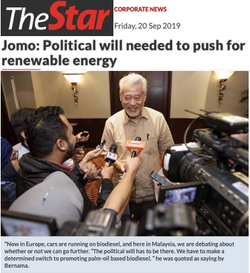
Political will needed to push for renewable energy

The Star 10July 2019

The Star 10July 2019

Malaysian businesses need boost

The Star 9 Oct 2019

The Star 9 Oct 2019

Subsidise public transport for bottom 40%

The Edge 26 Sept 2019

The Edge 26 Sept 2019

Call for measures to counteract global headwinds

The Edge 9 Oct 2019

The Edge 9 Oct 2019

Subsidise public transportation, not fuel

The Star 8 Oct 2019

The Star 8 Oct 2019

Subsidise public transportation for bottom 70%

TheEdge 2Oct 2019

TheEdge 2Oct 2019

"We need to counteract downward forces"

Fake News

PLEASE BEWARE OF MISREPRESENTATIONS OF IMAGES OF JOMO

Commercial and political misrepresentation of his image attributing to him to things which he never said or misrepresenting things he may have said is being circulated on websites such as those posted here. 


You should also be warned, in case you are not already aware, of ‘click bait’ i.e. using such images simply to attract your interest, and then to download your online information for abuse for a variety of ends.

Please inform us and provide a screenshot and weblink to enable further action, which is incredibly difficult. 

Thank you for reading this and for your help and cooperation.

This has also been flagged on his official Facebook page


JKS image ad2.jpg
JKS image Bitcoin ad on  Facebook.jpg
JKS - Fake News 2.jpg
Contact Me
JKS - Fake News 3.jpg
JKS fake news 1.jpg

Contact Me

  • Facebook Social Icon
  • Twitter Social Icon

Thank you for reaching out!

bottom of page