top of page

Follow on Social Media

  • Facebook
  • Twitter
  • Screenshot 2022-09-18 at 5.20.40 PM

M'sia Developments
[on SubStack]

  • Screenshot 2022-09-18 at 5.20.40 PM

KUALA LUMPUR, Malaysia, Jun 19 2026 (IPS) - US President Trump’s policies are supposed to make America great again (MAGA), which means different things to various parties. Some of its consequences are inadvertent, including undermining dollar dominance and inducing stagflation worldwide.


Bretton Woods

In July 1944, delegates from some 44 countries met in Bretton Woods, New Hampshire, to create a new multilateral monetary and financial system.


The US held 70% of the world’s gold reserves at the time, with gold priced at $35 per ounce. Other central banks bought and held US Treasury bonds and similar dollar assets as liquidity reserves.


This effectively made the US dollar the primary means of payment in the post-war international monetary system. The exchange rates of other national currencies were all set against the dollar.

As other economies recovered post-war, the US current account and trade surplus declined. Until 1971, the International Monetary Fund (IMF) occasionally adjusted fixed exchange rates for ‘structural’ balance-of-payments deficits or surpluses.


Exorbitant privilege

This dollar-based international monetary system gave the US what France’s Gaullist leadership called an ‘exorbitant [economic] privilege’.


Under the Bretton Woods arrangements, the US would never face balance-of-payments problems, as it paid for imports with its own currency, which it could print at will.


The US federal government could fund its large and growing budget deficits by selling Treasury bills. This debt is now around $39 trillion, over 125% of annual GDP!

Foreign central banks soon became accustomed to holding US Treasury bonds as official reserves, effectively funding the large and growing federal debt.

Such foreign central bank demand kept the dollar strong in foreign exchange markets. Persistent capital inflows into the US have kept the dollar overvalued.

The strong dollar has boosted domestic consumption of imports, depressed exports, widened trade deficits, and kept consumer price inflation in check.

In 1960, Robert Triffin warned the US Congress about the inevitable problems that arise when a national currency is also used as an international reserve currency.

He urged the US Federal Reserve Bank (Fed) to consider the dollar’s international role when making domestic monetary policy.

In August 1971, President Richard Nixon unilaterally ended the US Bretton Woods commitment to redeem dollars with gold. Thus, the dollar clearly became a fiat currency, with exchange rates shaped by market confidence.


Protection through diversification

After the 2009 Great Recession, Western central banks kept nominal interest rates low for over a decade through coordinated ‘quantitative easing’ (QE).


Low interest rates were maintained for over a decade through the 2020-21 Covid-19 recession before the Fed raised interest rates from 2022, ostensibly to address inflationary pressures.


Borrowers worldwide were thus induced to take on more debt. Governments, corporations, and households borrowed more, increasing accumulated debt.


International payment obligations are increasingly being settled by other means. Gradually, dollar-based arrangements are co-existing with euro- and renminbi-based arrangements and BRICS-initiated alternatives.


Thus, US indebtedness and stagnation have been growing with inflationary pressures. Unsurprisingly, other monetary authorities’ previous preference for holding US Treasury bills as official reserves has declined.


Instead, official reserves have been increasingly diversified to include more gold holdings ostensibly to help hedge against inflation and currency debasement.


About 36,200 tonnes, a fifth of all gold holdings, are now held by central banks, up from 15% at the end of 2023. By 2025, non-US central bank gold holdings exceeded their US Treasury bonds for the first time this century!


Trump 2.0

Criticism of the dollar system has resurfaced from time to time, especially as Washington weaponises more financial instruments and arrangements.


The second Trump administration has threatened major US federal government creditors, including China and longtime allies such as Japan and the Gulf monarchies.


As loyal allies are bullied, many are quietly moving away from prevailing dollar-based international monetary and financial arrangements, which have long been preferred for convenience.


After bombing ten nations in the first year of Trump 2.0, US military spending has been rising rapidly, especially with the Iran war and many of its consequences likely to be protracted despite the promise of a ceasefire.


With international confidence in the US consistently undermined by unexpected unilateral White House initiatives, governments are trying to reduce their vulnerabilities, especially by diversifying their reserve assets.


But unlike early in his first term, Trump now welcomes a weaker dollar as “great”. His ongoing efforts to lower Fed interest rates also reflect successive US presidents’ refusal to address ever-larger federal fiscal deficits over the decades.


With inflation rising, market premiums over Fed interest rates are pushing up commercial rates. These hurt the real economy, employment, and banks, many struggling with rising defaults.


All this exacerbates financial ‘market corrections’ in the US and beyond. Trump-induced international disruptions are worsening instability and slowing economies worldwide.


Trump’s policies have slowed the world economy, including the US. With efforts to address the Hormuz crisis undermined by Israel, his legacy will now surely include having induced the first major stagflation in almost half a century.


Related IPS Articles


What does the 1997 East Asian Financial Crisis tell us about capitalism and crisis more generally? Should we include it alongside the 1930s, 1970s and 2008 as a major crisis in the history of capitalism? Or does it simply an early symptom of the conditions that eventually gave rise to 2008?


Jomo Kwame Sundaram is a Malaysian economist holding such positions including Visiting Senior Fellow at Khazanah Research Institute, Visiting Fellow at the Initiative for Policy Dialogue, Columbia University, and Adjunct Professor at the International Islamic University in Malaysia. He joins Chris Saltmarsh and Dillon Wamsley to discuss the 1997 Asian Financial Crisis including the role of the IMF in causing it; its experience in Thailand, Malaysia and South Korea respectively; and how we should understand it in relation to the 2008 financial crisis.


Crisis Point is a limited series introducing the political economy of capitalist crises, providing historical and theoretical rigour to discourses around crisis in the present.


Recommended reading for this episode:


Also available on Spotify and Apple Music


Anis Chowdhury and Jomo Kwame Sundaram

SYDNEY & KUALA LUMPUR: Developing country debt has continued to grow rapidly since the 2008-2009 global financial crisis (GFC). Warnings against debt have been reiterated by familiar prophets of debt doom such as new World Bank chief economist, Carmen Reinhart, once dubbed the ‘godmother of austerity’.


Growing debt burden


Falling commodity prices, dwindling foreign reserves, slower global growth and weakening currencies have made it harder for developing countries to meet external debt payments.


This has involved economies of all income categories, reaching historical highs even before the pandemic. By early May, more than 100 countries had asked the International Monetary Fund (IMF) for help.


Developing countries’ government debt is likely to worsen with the pandemic induced recessions, triggering appeals for urgent debt standstills, cancellations and restructuring. While accumulated debt is undoubtedly problematic, debt phobia is now limiting fiscal options for coping with the worst economic downturn since the Great Depression.

In March, the United Nations called for a US$2.5 trillion package for developing countries to cope. By May, IMF Managing Director Kristalina Georgieva warned that the need is far greater.


While the Trump administration blocked the latest IMF Special Drawing Rights (SDRs) initiative, other debt relief initiatives, e.g., by the G20 and the IMF, are quite inadequate. Even David Malpass, the Trump nominated World Bank president, has criticised the G20 for falling short on debt relief, insisting “more needs to be done”.

Debt buybacks hardly novel


Surprisingly, rather than seeking to finance stronger fiscal responses to Covid-19 recessions, Joseph Stiglitz and Hamid Rashid have joined the chorus to address “catastrophic debt crises”, offering no evidence they are “impending”.


They discuss various options for debt relief and restructuring, and offer guidelines for bond buybacks, without mentioning April proposals by the UN, UNCTAD, the African Union and the UN Economic Commission for Africa.

While recognizing some limitations, the duo insist “bond buy-backs present a highly attractive solution, offering substantial debt relief at a relatively low cost”, which “has not received sufficient attention”.


They urge the IMF to use its New Arrangements to Borrow to buy debt at a discount, supplemented by funds from donors and multilateral institutions, but offer no convincing evidence why debt buybacks should now be prioritised over fiscal resources for recovery.

Brady debt buybacks


Under a US-led debt buyback initiative, named after then Treasury Secretary Nicholas Brady, indebted developing countries purchased US Treasury bonds to collateralize more than US$160 billion in replacement ‘Brady bonds’ from 1989.


The scheme restructured the debt of 18 developing countries long after sovereign debt crises began in 1981, following the US Fed’s sharp increase of interest rates to kill inflation. Thus, governments helped banks take defaulted loans, trading for small fractions of their face value on illiquid secondary markets, off their books.


Some banks took ‘haircuts’, but still got much more than what was available in secondary markets. Unlike in the current era, US interest rates were high, and thus, countries bought the Treasury zero-coupon bonds at an attractive discount.


Bloomberg’s Sydney Maki argued on 5 May that a second Brady plan is unlikely to work. The Brady plan transformed commercial bank loans, many in default, into collateralized bonds, but government debt today is owed to more diverse creditors including New York hedge funds, Gulf sovereign wealth funds and Asian pension funds.


Maki doubts that fund managers’ fiduciary duties would allow them to be lenient, even if so inclined. Terms of many deals cannot be legally changed without approval from most bondholders.

Debt buybacks for whom?


As some have noted, the plan undoubtedly relieved “pressure on Wall Street”, saving large US commercial banks which had pushed loans to developing countries in the 1970s. Stock prices of US commercial banks with significant developing country loan exposure rose 35% by US$13 billion after countries accepted the deal.


Jeremy Bulow and Kenneth Rogoff noted that “when highly indebted countries retire their deeply discounted debt, either through buy-backs or ‘debt-equity’ swaps, they may simply be using their scarce resources to subsidize their creditors”.


For them, buybacks and debt-equity swaps “are by themselves a boondoggle benefiting … creditors”. Stiglitz and Rashid dismiss this as just a “possibility”, citing the 1988 Bolivian debt buyback and the 2012 Greek bond buyback as two “good examples” of success stories.


In fact, when Bolivia bought back US$308 million in debt at face value in 1988, the price rose to 11 cents from 6 cents on the dollar, lowering the market value of the remaining debt (US$362 million at face value) to US$39.8 million.

As the earlier market value of its total bonds (US$670 million at face value) was US$40.2 million, the buyback only reduced its debt by US$400,000. This miniscule reduction cost donors US$34 million, which Bolivia would have been better off investing otherwise.


Furthermore, debtor countries participating in the Brady plan were required to deregulate, liberalize and privatize, i.e., implement structural adjustment, to qualify for Fund-Bank money to supplement their own foreign currency reserves for buybacks.

Greek tragedy


Financed by European taxpayers, the Greek buyback experience was no better. The price of 10-year benchmark Greek bonds also rose, as yield fell 147 basis points following announcement of the buyback.


Former Greek Finance Minister Yanis Varoufakis observed, “rumours of a debt buyback have pushed these bond prices to above 43%”; “its effect will be a net debt reduction 40% less than the Eurogroup’s stated target”, constituting “a reward to hedge funds and a ruthless,… massive involuntary haircut for Greece’s embattled banks”.


The New York Times agreed that the “bigger winners were hedge funds, which pocketed higher profits than many had expected”, while Moody’s Analytics correctly predicted that the “bond buyback will not end Greece’s debt woes”.

Greece was forced into excruciating austerity, plunging it into economic depression. As the economy contracted by 24%, unemployment hit 26%, the highest in the euro zone, by September 2009, less than a year later. Thus, debt buybacks may well help financial markets, litigious funds and global finance, rather than indebted countries.

Bond buybacks no panacea


Undoubtedly, debt buybacks may sometimes work in favourable circumstances when well planned as part of a broader financing strategy. Ecuador’s 2008-2009 bond buybacks were part of its external debt restructuring to secure relief from illegitimate ‘odious debt’.


With no pressure from acute financial stress, Ecuador repurchased over 90% through financial intermediaries, at 35 cents on the dollar, as its bond prices fell during the GFC.


Jeffrey Sachs agreed with Bulow and Rogoff that debt buybacks are “not necessarily a panacea for heavily indebted countries” unless “part of a comprehensive arrangement” for reduction of all debt with the full participation of all creditors involved.


Writing before Brady, he doubted the feasibility of such debt reduction as the US had previously blocked such arrangements in the interest of US banks. The political influence of US financial lobbies has only grown in recent decades. And, as Maki notes, a comprehensive arrangement involving all creditors is an even taller order now as they are more heterogenous.


Furthermore, it was reasonable then to assume that debtors only had a certain amount to repay, with other prices adjusting accordingly. However, bond market prices today easily ‘overshoot’, while debt restructurings are rarely sufficient, often delayed and very costly.


Promoting buybacks, backed by institutions like the IMF, also runs the risk of encouraging holdouts in future debt restructurings.


Instead of using scarce financial resources to buy back bonds, multilateral institutions and donors should help developing countries retrieve fiscal space to urgently prevent Covid-19 recessions becoming depressions.


Latest Videos

All Videos

All Videos

AN URGENT CALL: A PEOPLE"S VACCINE AGAINST COVID-19

00:00
9 June 2020: IHD-ILO-ISLE Virtual Conference - Day 2

9 June 2020: IHD-ILO-ISLE Virtual Conference - Day 2

05:08:34
Learning in Governance in times of COVID-19

Learning in Governance in times of COVID-19

46:30
Beyond the Lockdown: Towards the ‘New Normal’

Beyond the Lockdown: Towards the ‘New Normal’

59:10

About Jomo

Jomo Kwame Sundaram is Research Adviser, Khazanah Research Institute, Fellow, Academy of Science, Malaysia, and Emeritus Professor, University of Malaya. Previously, he was UN Assistant Secretary-General for Economic Development, Assistant Director General, Food and Agriculture Organization (FAO), Founder-Chair, International Development Economics Associates (IDEAs) and President, Malaysian Social Science Association. 

In The Media

TheStar 26 June 2020

TheStar 26 June 2020

The Star 20 Sept 2019

The Star 20 Sept 2019

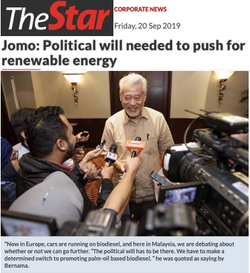
Political will needed to push for renewable energy

The Star 10July 2019

The Star 10July 2019

Malaysian businesses need boost

The Star 9 Oct 2019

The Star 9 Oct 2019

Subsidise public transport for bottom 40%

The Edge 26 Sept 2019

The Edge 26 Sept 2019

Call for measures to counteract global headwinds

The Edge 9 Oct 2019

The Edge 9 Oct 2019

Subsidise public transportation, not fuel

The Star 8 Oct 2019

The Star 8 Oct 2019

Subsidise public transportation for bottom 70%

TheEdge 2Oct 2019

TheEdge 2Oct 2019

"We need to counteract downward forces"

Fake News

PLEASE BEWARE OF MISREPRESENTATIONS OF IMAGES OF JOMO

Commercial and political misrepresentation of his image attributing to him to things which he never said or misrepresenting things he may have said is being circulated on websites such as those posted here. 


You should also be warned, in case you are not already aware, of ‘click bait’ i.e. using such images simply to attract your interest, and then to download your online information for abuse for a variety of ends.

Please inform us and provide a screenshot and weblink to enable further action, which is incredibly difficult. 

Thank you for reading this and for your help and cooperation.

This has also been flagged on his official Facebook page


JKS image ad2.jpg
JKS image Bitcoin ad on  Facebook.jpg
JKS - Fake News 2.jpg
Contact Me
JKS - Fake News 3.jpg
JKS fake news 1.jpg

Nadi Insan by the People's History Centre

Read all editions of #NadiInsan from 1979 to 1983 free of charge at the Peoples History Center website.


Containing writings on socio-political issues, film and cultural commentary, as well as in-depth interviews, Nadi Insan is motivated by community activists and intellectuals in Malaysia.

Happy reading!

Dapatkan kesemua siri majalah #NadiInsan dari tahun 1979 hingga 1983 secara percuma di laman Pusat Sejarah Rakyat.


Berisi tulisan memperihal sosio-politik, ulasan filem dan budaya sehinggalah wawancara yang rencam, Nadi Insan digerakkan oleh aktivis masyarakat dan intelektual di Malaysia.


Selamat membaca!

Contact Me

  • Facebook Social Icon
  • Twitter Social Icon

Thank you for reaching out!

bottom of page