top of page

Follow on Social Media

  • Facebook
  • Twitter
  • Screenshot 2022-09-18 at 5.20.40 PM

M'sia Developments
[on SubStack]

  • Screenshot 2022-09-18 at 5.20.40 PM

KUALA LUMPUR, Malaysia, Jul 23 2026 (IPS) - Sunday’s World Cup final focused world attention on the stench of corruption, past and current, surrounding some of its main protagonists, including Argentina, and the presidents of FIFA, Argentina and the main host nation.


Messi football

Nick Corbishley has exposed the corruption of World Cup football and Argentina’s Milei government, enthusiastically supported by US President Trump’s ‘Donroe Doctrine’.


In the run-up, Argentina committed the most fouls — largely in midfield to disrupt their opponents’ play — but only received a controversial red card in the final. It had the most opponents’ goals disallowed but never conceded a penalty.

Of course, there are always subjective elements in applying football rules, and it is difficult to prove foul play. But it is suspicious when referees refuse to use a video-assisted referee (VAR) to check for fouls.

In Argentina’s first game, Messi stepped on an Algerian opponent’s Achilles tendon with his studs up. Such an offence would typically get a red card, but in this case, there was no card or VAR check.

As many presume, FIFA would not allow the biggest star of world football, now playing in the US league, to get a match ban at the start of the tournament; it would have been a business disaster.

Many believe the ‘inconsistent’ use of rules and VAR checks helped Argentina reach yet another World Cup final. With VAR, the inconsistent application of rules and procedures, such as awarding cards, can tip games with narrow margins in a team’s favour.


Considering the history of FIFA corruption and its willingness to bend rules at President Trump’s behest, such suspicions are rife. Worse, the Argentine Football Association is reportedly under Federal Bureau of Investigation (FBI) investigation for fraud and money laundering.


While controversial refereeing and VAR decisions were common in this tournament, Argentina has been accused more than any other team. Many believe the level football field was tilted to favour Argentina and its superstar, Messi.

Such advantages only work at the World Cup level if the team is highly competent and competitive, which Argentina certainly is. The latest World Cup has seriously tarnished the reputation of FIFA and football itself.


Billionaire haven

Meanwhile, Argentine President Javier Milei is trying to remove most remaining restrictions on foreign ownership of Argentine land.


A day after the England semi-final, the Argentine Senate began debating Milei’s bill on the “inviolability of private property”. If passed, it would repeal a 2011 law limiting the acquisition and ownership of rural land by foreigners.


As foreign purchases of Argentine land surged after its late 20th century crisis, its Congress limited sales to foreigners.

Already, 13.2 million hectares, or 5% of Argentina, are foreign owned. The Milei government now wants to eliminate remaining restrictions on land sales to foreigners.


Foreign ownership of Argentine land is concentrated in specific areas such as Patagonia, rich in energy and mineral resources. Once approved, the bill will allow foreigners to own such strategic areas with water, minerals and foreign borders.


Peter Thiel, famous for arguing ‘competition is for losers’, is promoting the privatisation of public land by creating charter cities such as Prospera Inc in Honduras.


Thiel recently moved to Buenos Aires, where he is believed to be advising the Milei government. Apparently, he envisions Argentina as an economic haven cum ‘laboratory’ for his investments.


Forbes reports Milei is trying to attract billionaires like Thiel to his “new land of freedom” with a full-citizenship-by-investment scheme and by eliminating property ownership restrictions.


Milei scolded Argentina’s footballers and fans for protesting Britain’s ongoing rule of the Falkland Islands at the England semi-final as his government tries to sell off the most valuable rural Argentine land.


As the dispute between Honduras and Prospera Inc. has shown, once sovereign land is transferred into foreign hands protected by international investment treaties, getting that land back is nearly impossible.


From Nazi to Zionist refuge

Milei enjoys Netanyahu’s and Trump’s support, both of whom want him to stay in power.

Asked why he supported Argentina in the World Cup, Netanyahu made clear it had more to do with Milei than Messi.


“Milei is a huge friend of Israel”, recently calling himself the “most Zionist president on the planet”.


Patagonia was identified as a possible site for the establishment of a Jewish State by Theodor Herzl, the father of political Zionism, in the late 19th century. After World War Two, the southern cone of South America became a haven for fascist war criminals fleeing Europe.


Milei’s government has cut public spending and welfare benefits for Argentine citizens. During the last Argentine summer from December to February, vast Patagonian forests went up in flames after Milei cut Argentina’s fire-fighting budget by 80%!


Many believe the government has agreed to allow Israeli settlement on the scorched earth after an Israeli was caught setting fire to 17,000 acres in Chilean Patagonia over a decade ago.


Milei has already signed agreements with the Netanyahu government to grant Israeli citizens living in Argentina access to all government benefits, including pensions, maternity leave and disability allowance.


In the final, Argentina went down to Spain, one of a few European countries to oppose Israel’s genocide in Gaza and the US-Israeli war against Iran, despite repeated threats by Trump.


Despite Spain’s conquistador and fascist past, much of the world supported Spain today against the land of Maradona and Messi, two of the most popular icons of the beautiful game.


Iggy Rodriguez is a Filipino artist and football enthusiast. His solo exhibition in Kuala Lumpur, ‘Under a Borrowed Sun’, runs till mid-August.


KUALA LUMPUR, Malaysia, Nov 26 2025 (IPS) - Although inequality among countries still accounts for a far greater share of income inequality worldwide than national-level inequalities, discussions of inequality continue to focus on the latter.


South African initiative

The G20 Extraordinary Committee of Independent Experts on Global Inequality, chaired by Nobel laureate Joseph Stiglitz, was commissioned by South Africa’s 2025 presidency of the G20, the group of the world’s twenty largest national economies.


South Africa (SA) and Brazil, the previous G20 host, have long had the world’s highest national-level inequalities. However, their current governments have led progressive initiatives for the Global South.

Although due to take over the G20 presidency next year, US President Trump refused to participate in this year’s summit, inter alia, because of alleged SA oppression of its White minority.

Inequality growing faster

The G20 report utilises various measures to show the widening gap between the rich and the poor.

National-level inequality is widespread: 83% of countries, with 90% of the world’s population, have high Gini coefficients of income inequality above 40%.

While income inequality worldwide is very high, with a Gini coefficient of 61%, it has declined slightly since 2000, primarily due to China’s economic growth.


Meanwhile, wealth concentration has continued. Wealth inequality is even greater than income inequality, with the richest 10% owning 74% of the world’s assets.


The average wealth of the richest 1% grew by $1.3 million from 2000, accounting for 41% of new wealth by 2024! Private wealth has risen sharply since 2000, while public assets have declined.


Besides income and wealth, the report reviews other inequalities, including health, education, employment, housing, environmental vulnerability, and even political voice.


Such inequalities, involving class, gender, ethnicity, and geography, often ‘intersect’. The promise of equal opportunity is rarely meaningful, as most enjoy limited social mobility options.


The report thus serves as the most comprehensive and accessible review of various dimensions of economic inequality available.


Harmful effects

The G20 report condemns ‘extreme inequality’ for its adverse economic, political, and social consequences.


Inadequate income typically means hunger, poor nutrition and healthcare. Economies underperform, unable to realise their actual potential.


Inequality, including power imbalances, influences resource allocation. Such disparities enhance the incomes of the rich, often at the expense of working people.


Natural resources typically enrich owners while undermining environmental sustainability and social well-being.

The report argues that economic inequality inevitably involves political disparities, as the rich are better able to buy influence.


New rules and policies favour the rich and powerful, increasing inequalities and undermining national and worldwide economic performance.


High inequality, due to rules favouring the wealthy, also undermines public trust in institutions. The declining influence of the middle class threatens both economic and political stability, especially in the West.


Drivers of inequality

The report argues that public policy can address inequalities by influencing how market incomes are initially distributed and how taxes and transfers redistribute them.


Market income distribution is determined by asset distribution (mediated by finance, skills, and social networks) and among labour, capital, and rents. Returns to shareholders are prioritised over other claims.


Increased inequality in recent decades is attributed to weakened equalising policies, or ‘equilibrating forces’, and stronger ‘disequilibrating forces’, including wealth inheritance.


New economic policies over recent decades have favoured the wealthy by weakening labour via market deregulation and restricting trade unions.


Tax systems have become less progressive with the shift from direct to indirect taxes, lowering taxes paid by large corporations and the wealthy. Fiscal austerity has exacerbated the situation, especially for the vulnerable.


Financial deregulation has also generated more instability, triggering crises, with ‘resolution’ usually favouring the influential.


Privatisation of public services has also favoured the well-connected, at the expense of the public, consumers, and labour.


International governance

International economic and legal institutions have also shaped inequality.


More international trade and capital mobility have lowered wages, increased income disparities and job insecurity, and weakened workers’ bargaining power.


Liberalising financial flows has favoured wealthy creditors over debtors, worsening financial volatility and sovereign debt crises.

International inequalities have adverse cross-border effects, especially for the environment and public health.


Overconsumption and higher greenhouse gas emissions by the rich significantly worsen planetary heating.

International health inequalities have been worsened by stronger transnational intellectual property rights and increased profits at the expense of poorer countries.


International tax agreements have enabled the wealthy, including transnational corporations, to pay less than those less fortunate. Meanwhile, Oxfam reported that the top one per cent in the Global North drained the South at a rate of $30 million per hour.


Inaction despite consensus?

The report claims a new analytical consensus that inequality is detrimental to economic progress, and reducing inequality is better for the economy.


Inequality is attributed to policy choices reflecting moral choices and economic trade-offs. It argues that combating inequality is both desirable and feasible.


Recent research from the International Monetary Fund (IMF) and the Organisation for Economic Co-operation and Development (OECD) has criticised growing national inequalities.


However, there is no evidence of serious efforts by the G20, IMF, and OECD to reduce inequalities, especially inter-country, particularly between North and South.


Related IPS Articles


Latest Videos

All Videos

All Videos

AN URGENT CALL: A PEOPLE"S VACCINE AGAINST COVID-19

00:00
9 June 2020: IHD-ILO-ISLE Virtual Conference - Day 2

9 June 2020: IHD-ILO-ISLE Virtual Conference - Day 2

05:08:34
Learning in Governance in times of COVID-19

Learning in Governance in times of COVID-19

46:30
Beyond the Lockdown: Towards the ‘New Normal’

Beyond the Lockdown: Towards the ‘New Normal’

59:10

About Jomo

Jomo Kwame Sundaram is Research Adviser, Khazanah Research Institute, Fellow, Academy of Science, Malaysia, and Emeritus Professor, University of Malaya. Previously, he was UN Assistant Secretary-General for Economic Development, Assistant Director General, Food and Agriculture Organization (FAO), Founder-Chair, International Development Economics Associates (IDEAs) and President, Malaysian Social Science Association. 

In The Media

TheStar 26 June 2020

TheStar 26 June 2020

The Star 20 Sept 2019

The Star 20 Sept 2019

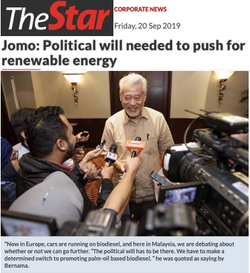
Political will needed to push for renewable energy

The Star 10July 2019

The Star 10July 2019

Malaysian businesses need boost

The Star 9 Oct 2019

The Star 9 Oct 2019

Subsidise public transport for bottom 40%

The Edge 26 Sept 2019

The Edge 26 Sept 2019

Call for measures to counteract global headwinds

The Edge 9 Oct 2019

The Edge 9 Oct 2019

Subsidise public transportation, not fuel

The Star 8 Oct 2019

The Star 8 Oct 2019

Subsidise public transportation for bottom 70%

TheEdge 2Oct 2019

TheEdge 2Oct 2019

"We need to counteract downward forces"

Fake News

PLEASE BEWARE OF MISREPRESENTATIONS OF IMAGES OF JOMO

Commercial and political misrepresentation of his image attributing to him to things which he never said or misrepresenting things he may have said is being circulated on websites such as those posted here. 


You should also be warned, in case you are not already aware, of ‘click bait’ i.e. using such images simply to attract your interest, and then to download your online information for abuse for a variety of ends.

Please inform us and provide a screenshot and weblink to enable further action, which is incredibly difficult. 

Thank you for reading this and for your help and cooperation.

This has also been flagged on his official Facebook page


JKS image ad2.jpg
JKS image Bitcoin ad on  Facebook.jpg
JKS - Fake News 2.jpg
Contact Me
JKS - Fake News 3.jpg
JKS fake news 1.jpg

Nadi Insan by the People's History Centre

Read all editions of #NadiInsan from 1979 to 1983 free of charge at the Peoples History Center website.


Containing writings on socio-political issues, film and cultural commentary, as well as in-depth interviews, Nadi Insan is motivated by community activists and intellectuals in Malaysia.

Happy reading!

Dapatkan kesemua siri majalah #NadiInsan dari tahun 1979 hingga 1983 secara percuma di laman Pusat Sejarah Rakyat.


Berisi tulisan memperihal sosio-politik, ulasan filem dan budaya sehinggalah wawancara yang rencam, Nadi Insan digerakkan oleh aktivis masyarakat dan intelektual di Malaysia.


Selamat membaca!

Contact Me

  • Facebook Social Icon
  • Twitter Social Icon

Thank you for reaching out!

bottom of page