top of page

Follow on Social Media

  • Facebook
  • Twitter
  • Screenshot 2022-09-18 at 5.20.40 PM

M'sia Developments
[on SubStack]

  • Screenshot 2022-09-18 at 5.20.40 PM

KUALA LUMPUR, Malaysia, Feb 27 2026 (IPS) - As US President Donald Trump pushes the world to war, arms spending has been rising worldwide. Wars secure more budgetary allocations, mainly benefiting the US-dominated military-industrial complex.


US military spending increases

After bombing Venezuela, the Trump administration raised its war budget from $1.0 trillion, 47% of discretionary government spending in 2024, to $1.5 trillion!


In 2024, the US accounted for over 36% of the world’s military spending of $2.7 trillion! This exceeded the total expenditure of the next nine biggest spenders – China, Russia, Germany, India, UK, Saudi Arabia, Ukraine, France, and Japan!

China’s military budget for 2025 was $250-300 billion. Most others are US allies who have pledged to increase war spending from under 2% of GDP to 5%!

The US and its allies will be even further ahead despite pushing friends and foes to spend more. Fortune magazine projects that US spending will exceed that of the next 35 highest-spending countries combined!

Despite its huge economic costs, the hike is being justified as helping to achieve ‘peace through strength’. After all, bombing ten nations in Trump 2.0’s first year did not incur any significant American military casualties.


Borrowing for war

Early this year, Dean Baker warned that President Trump was planning to increase annual military spending by $600 billion. Just under 2% of GDP, the spending increase would be massive.


As Trump is more committed to cutting taxes than the US federal public debt, the “$600 billion increase in annual taxes would come to $6 trillion, roughly $45,000 per household” over the next decade.


The independent Committee for a Responsible Federal Budget projects federal debt for military spending will increase by $5.8 trillion over the next decade!


Trump has long promised to cut US public debt, which is already equivalent to 120% of annual output, and not to increase the deficit! But this would require massive tax increases, impossible to raise with tariffs alone.


Worse, federal government debt, which Trump promised to cut, will rise. Meanwhile, 94% of his Big Beautiful Bill (BBB) tax cuts benefit the top 60%, with only 1% trickling down to the poorest fifth.


The top fifth nominally gets 69%, but only the top 5% will actually pay less! The bottom 95% will pay more tax, with low-income households paying relatively more for tariffs!


Trump’s Department of Government Efficiency (DOGE), led by Elon Musk, was supposed to cut federal government fraud, waste, and debt, but instead cut US growth in 2025’s last quarter.


While the BBB cut $186 billion of food aid for poorer Americans, rising war spending will mainly benefit US military-industrial complex cronies.


US consumers will pay more

Increased tariff rates would have to be impossibly high. And these would need to be even higher if exemptions are granted. Imports would fall sharply with such high tariffs.


Trump claimed additional tariff revenue would cover half a trillion dollars of additional military spending. He has long claimed other countries pay for tariffs.


With deindustrialisation over the past half-century, consumers have been buying more imports, paying for most tariff revenue.


Imports would fall sharply with such high tariffs. As many imports are intermediate goods used in manufacturing, high tariffs would hurt the industries Trump is claiming to promote.


High tariffs will raise consumer prices sharply. Cost-of-living increases would be unaffordable to many, including in Trump’s political base.


Before the 20 February Supreme Court decision declaring them unconstitutional, the tariffs were only expected to raise $300 billion in the first year.


Revenue was expected to fall as consumers bought more domestically produced goods instead of imports.


As many intermediate goods for manufacturing are imported, higher tariffs would hurt the very industries Trump claims to be helping. Thus, high tariffs will sharply raise consumer prices for both imports and US-made substitutes.


Also, massively increasing military spending will divert resources, including labour, away from more productive uses.


Military industrial cronies

US military contracts mainly went to five corporate groups even before Trump 2.0. While projects are worth more, beneficiaries are fewer, reflecting lobbying efforts.


More government military spending is unlikely to increase jobs in the long run, as jobs have decreased drastically since the 1980s due to greater automation.


Military contractors pass the costs of R&D and capital expenditures onto taxpayers, freeing revenue to pay for cash dividends and stock buybacks.


In 2024, the Pentagon’s leading contractor, Lockheed Martin paid out $7 billion for stock buybacks and dividends.


Although Trump once offered to work with China and Russia to cut the trio’s military spending by half, it was difficult to take his offer seriously given his other pronouncements and actions.


US military spending will continue to rise, driven by the same interests and impulses behind the recent massive hikes.


Military expenditure needs wars to secure yet more allocations for buying more military equipment, to the beat of war drums.


The actual political and business relationships are complex and ever-changing. As Walter Scott observed in 1808:

Oh, what a tangled web we weave,

When first we practice to deceive


Related IPS Articles


KUALA LUMPUR, Malaysia, Dec 16 2025 (IPS) - The new US National Security Strategy (NSS) repositions the superpower’s role in the world. Hence, foreign policy will be mainly driven by considerations of ‘making America great again’ (MAGA).


Changing course

The new NSS no longer presumes US world leadership and alliances based on values. It breaks with earlier post-Cold War foreign policy, upsetting those committed to its sovereigntist unipolar world.


Quietly released on December 4, it is certainly not an easily forgettable update of long-established positions, cloaked in obscure bureaucratic and diplomatic parlance.

Mainly drafted under the leadership of ‘neo-con’ Secretary of State and National Security Adviser Marco Rubio, it is already seen as the most significant document of Trump 2.0.

It asserts, “The days of the United States propping up the entire world order like Atlas are over.” Instead, foreign policy should now prioritise advancing US interests.


New priorities

The NSS implies the US will no longer be the world’s policeman. Instead, it will exercise power selectively, prioritising transactional rather than strategic considerations.


It emphasises economic strength as key to national security, rebuilding industrial capacity, securing supply chains and ensuring the US never relies on others for critical materials.


Even if the Supreme Court overrules the President’s tariffs, the US has already secured many concessions from governments fearful of their likely adverse impacts.


The NSS is ostensibly based on MAGA considerations involving immigration control, hemispheric dominance, and cultural ethno-chauvinism.

Mainstream commentators complain it lacks the supposedly enlightened values underlying foreign policy in the US-dominated world order after the Second World War.

They complain the new NSS is narrow in focus, redefining interests, and sharing power. Its stance and tone are said to be more 19th-century than 21st-century.

Besides pragmatic imperatives, mixed messages may be due to unsatisfactory compromises among rival factions in Trump’s administration.


MAGA foreign policy

Long-term observers see the NSS as unprecedented and blatantly ideological.


White supremacist ideology influences not only national cultural politics but also foreign policy. The NSS unapologetically promotes Judaeo-Christian chauvinism despite the constitutional separation of church from state.


MAGA’s ‘America First’ priority is evident throughout. Border security is crucial as immigration is deemed the primary national security concern.


For Samuel Huntington, immigration threatens the US by making it less WASP (White Anglo-Saxon Protestant).


The NSS blames social and economic breakdown on immigration. Inflows into the Western Hemisphere, not just the US, must be urgently stopped by all available means.


Ironically, the US has long been a nation of immigrants, with relatively more immigrants than any European country. Its non-white numbers are almost equal to whites.


Trump’s neocolonial interpretation of the 1823 Monroe Doctrine emphasises the Americas as the new foreign policy priority.


Foreign rivals must not be allowed to acquire strategic assets, ports, mines, or infrastructure in Latin America and the Caribbean, mainly to keep China out.


Trump’s NSS prioritises the Western Hemisphere, with Asia second. Africa receives three paragraphs, primarily for its minerals.


Europe is downgraded to third, due to its ostensible immigration-induced civilizational decline. Surprisingly, the NSS urges halting North Atlantic Treaty Organisation (NATO) expansion.


China near peer!

The NSS policy on China is widely viewed as unexpectedly restrained. China remains a priority, but is no longer its primary antagonist; it is now a peer competitor.


Now, the US must rebalance its economic relationship with China based on mutually beneficial reciprocity, fairness, and the resurgence of US manufacturing.


The US will continue to work with allies to limit China’s growth and technological progress. However, China is allowed to develop green technologies due to US disinterest.


Meanwhile, US hawks have ensured a military ‘overmatch’ for Taiwan. The NSS emphasises Taiwan’s centrality to Indo-Pacific security and world chip production.


The NSS warns China would gain access to the Second Island Chain if it captured Taiwan, reshaping regional power and threatening vital US trade routes.


With allied support, the US military will seek to contain China within the First Island Chain. However, Taiwan fears US support will wane after TSMC chip production moves to the US.


The NSS expects the ‘Quad’ of the US, Australia, Japan and India to enhance Indo-Pacific security. For Washington, only India can balance China in Asia, and is hence crucial to contain China in the long term.


Regional reordering

The NSS also downgrades the Middle East (ME). Conditions that once made the region important have changed.


The ME’s importance stemmed from its petroleum and Western guilt over Israel. Now, the US has become a significant oil and gas exporter.


Critically, the US strike on Iran in mid-2025 is believed to have set back Tehran’s nuclear programme.


The ME seems unlikely to continue to drive US strategic planning as it has over the last half-century. For the US, the region is now expected to be a major investor.


As US foreign policy is redefined, the world worries. The ME has been downgraded as Latin America has become the new frontline region.


Much has happened in less than a year of Trump 2.0, with little clear or consistent pattern of continuity or change from his first term. But policies have also been quickly reversed or revised.


While the NSS is undoubtedly important and indicative, it would be presumptuous to think it will actually determine policy over the next three years, or even in the very near future.


Related IPS Articles


Latest Videos

All Videos

All Videos

AN URGENT CALL: A PEOPLE"S VACCINE AGAINST COVID-19

00:00
9 June 2020: IHD-ILO-ISLE Virtual Conference - Day 2

9 June 2020: IHD-ILO-ISLE Virtual Conference - Day 2

05:08:34
Learning in Governance in times of COVID-19

Learning in Governance in times of COVID-19

46:30
Beyond the Lockdown: Towards the ‘New Normal’

Beyond the Lockdown: Towards the ‘New Normal’

59:10

About Jomo

Jomo Kwame Sundaram is Research Adviser, Khazanah Research Institute, Fellow, Academy of Science, Malaysia, and Emeritus Professor, University of Malaya. Previously, he was UN Assistant Secretary-General for Economic Development, Assistant Director General, Food and Agriculture Organization (FAO), Founder-Chair, International Development Economics Associates (IDEAs) and President, Malaysian Social Science Association. 

In The Media

TheStar 26 June 2020

TheStar 26 June 2020

The Star 20 Sept 2019

The Star 20 Sept 2019

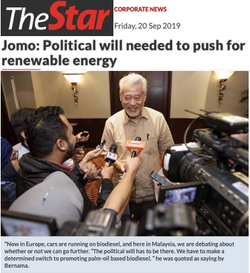
Political will needed to push for renewable energy

The Star 10July 2019

The Star 10July 2019

Malaysian businesses need boost

The Star 9 Oct 2019

The Star 9 Oct 2019

Subsidise public transport for bottom 40%

The Edge 26 Sept 2019

The Edge 26 Sept 2019

Call for measures to counteract global headwinds

The Edge 9 Oct 2019

The Edge 9 Oct 2019

Subsidise public transportation, not fuel

The Star 8 Oct 2019

The Star 8 Oct 2019

Subsidise public transportation for bottom 70%

TheEdge 2Oct 2019

TheEdge 2Oct 2019

"We need to counteract downward forces"

Fake News

PLEASE BEWARE OF MISREPRESENTATIONS OF IMAGES OF JOMO

Commercial and political misrepresentation of his image attributing to him to things which he never said or misrepresenting things he may have said is being circulated on websites such as those posted here. 


You should also be warned, in case you are not already aware, of ‘click bait’ i.e. using such images simply to attract your interest, and then to download your online information for abuse for a variety of ends.

Please inform us and provide a screenshot and weblink to enable further action, which is incredibly difficult. 

Thank you for reading this and for your help and cooperation.

This has also been flagged on his official Facebook page


JKS image ad2.jpg
JKS image Bitcoin ad on  Facebook.jpg
JKS - Fake News 2.jpg
Contact Me
JKS - Fake News 3.jpg
JKS fake news 1.jpg

Contact Me

  • Facebook Social Icon
  • Twitter Social Icon

Thank you for reaching out!

bottom of page