top of page

Follow on Social Media

  • Facebook
  • Twitter
  • Screenshot 2022-09-18 at 5.20.40 PM

M'sia Developments
[on SubStack]

  • Screenshot 2022-09-18 at 5.20.40 PM

KUALA LUMPUR, Malaysia, Jul 14 2026 (IPS) - Trump insists the West must unite on his terms against the Rest, particularly China and Iran. Europe, however, wants greater Trump support for Ukraine’s Zelensky regime to replace Putin’s leadership of Russia.


Europe v China?

In June 2026, European officials accused China of training Russian military personnel to fight in Ukraine.


After Secretary of State Marco Rubio’s Munich appeal for Western unity based on shared race, culture and imperial history, this appears to have been a European effort to strengthen its alliance with the US.

The unsubstantiated charge of Chinese military support to Russia against Ukraine, a claim never corroborated by Kyiv, is expected to worsen relations between Europe and China.

Portraying China as a strategic threat to Europe justifies greater belligerence against Beijing. It no longer seems to matter that China has never endorsed Russia’s invasion of Ukraine.

However, China retains strong ties with Kyiv, calling for a ceasefire and political settlement, while repeatedly offering to mediate between the warring neighbours.

The G7summit of the seven largest rich economies in late June followed the EU in trying to consolidate Western strategic solidarity against Russia, China and Iran.

With financial crises from 1997 threatening G7 legitimacy, then US Treasury Secretary Larry Summers initiated the G20. But the recently expanded G7 role marginalises the more inclusive but less amenable G20.


Neoliberalism over

Since the 2008 global – actually Western – financial crisis, Europe has become even more protectionist.


More Chinese goods have entered European markets, with prices and quality that most others cannot match. For years, Western leaders happily enabled this by liberalising trade, appreciating cheap Chinese imports, for keeping inflation low.

After decades of state-encouraged investment, China’s still growing industrial capacity now supplies the world, enabled by Western-drafted WTO rules.

Before Trump 2.0, Washington had imposed investment restrictions, Section 301 measures, sanctions, tariffs and more following Obama’s ‘pivot to Asia’. Facing less US market access, more Chinese exports have gone elsewhere.

European industry can no longer compete, even where it once led. Instead of neoliberal WTO trade liberalisation, EU protectionism supposedly ‘levels the playing field’.

US advisers increasingly warn European officials that China’s industrial ‘overcapacity’ will soon scale up the ‘China shock’ in most industrially significant supply chains.

China now refines and processes most of the world’s ‘rare earth’ minerals, exercising near-monopsonistic leverage over suppliers by processing at scale at much lower cost.


With China successfully countering Trump’s trade policies, Western leaders worry Beijing will abuse its near-monopolistic control of rare earth elements, which downstream industries need.


Jeffrey Sachs argues that New York and London rare earth market reactions indicate major institutional investors view recent developments as significant.


G7 vs China

Protecting European industry, labour and  economic sovereignty is now constrained by the rules Western leaders put in place over decades, often coordinated by the OECD.


Splits inside the EU soon extended beyond commercial faultlines to ostensible strategic interests defined by the fluid geopolitics after the first Cold War.


German car exports to China have been superseded by Chancellor Metz’s military Keynesianism, in line with Trump’s demand for NATO allies to spend much more on the military to greatly strengthen Western military power and global dominance.


French President Emmanuel Macron’s earlier push for unaligned European ‘strategic autonomy’ has given way to a NATO+ strategic view embracing Western imperialism.


Meanwhile, smaller EU member states remain cautious, fearing the collateral effects of new Western ambitions, such as Chinese restrictions on imports that Europe depends on.


Great power rivalry

With the Iran war refusing to fade from daily headlines despite Trump’s on-off-on ceasefire, other myths are also evaporating. Few still believe Israel will accept a ‘two-state solution’ or that peace will prevail between trading partners.


NATO, OECD, G7, EU and other such arrangements have become variable links in the hegemonic US-led bloc. Such coalitions – including Europe, Canada, Australia, and Japan – were never seamless together or fully fit-for-purpose.


Trump expects unilateral US aggression against Washington’s chosen enemies must be fully supported and subsidised by NATO allies, with reluctance deemed disloyal, even antagonistic.


Countries not aligned with the major poles may be alternatively courted and coerced by rival poles, especially by the affluent West. Cooperation among others may be seen and portrayed as proof of the existence of an antagonistic bloc.


Multiple poles are likely to coalesce into the West versus the Rest, competing for support and influence, as those courted try to gain from their suitors.


With reduced  government engagement and less sustained inter-state cooperation and order, disruptions in an increasingly anarchic world economy have required governments to prioritise resilience as businesses, consumers and labour face rising costs.


As the US and its allies weaponise economic rules and arrangements to discipline both friends and foes, the world economy is slowing unevenly as prices rise sporadically.


The US-Israel war on Iran underscores how current conflicts can develop in unpredictable ways as states and other significant non-state ‘actors’ innovate strategically in unexpected conditions.


Related IPS Articles


KUALA LUMPUR, Malaysia, Nov 26 2025 (IPS) - Although inequality among countries still accounts for a far greater share of income inequality worldwide than national-level inequalities, discussions of inequality continue to focus on the latter.


South African initiative

The G20 Extraordinary Committee of Independent Experts on Global Inequality, chaired by Nobel laureate Joseph Stiglitz, was commissioned by South Africa’s 2025 presidency of the G20, the group of the world’s twenty largest national economies.


South Africa (SA) and Brazil, the previous G20 host, have long had the world’s highest national-level inequalities. However, their current governments have led progressive initiatives for the Global South.

Although due to take over the G20 presidency next year, US President Trump refused to participate in this year’s summit, inter alia, because of alleged SA oppression of its White minority.

Inequality growing faster

The G20 report utilises various measures to show the widening gap between the rich and the poor.

National-level inequality is widespread: 83% of countries, with 90% of the world’s population, have high Gini coefficients of income inequality above 40%.

While income inequality worldwide is very high, with a Gini coefficient of 61%, it has declined slightly since 2000, primarily due to China’s economic growth.


Meanwhile, wealth concentration has continued. Wealth inequality is even greater than income inequality, with the richest 10% owning 74% of the world’s assets.


The average wealth of the richest 1% grew by $1.3 million from 2000, accounting for 41% of new wealth by 2024! Private wealth has risen sharply since 2000, while public assets have declined.


Besides income and wealth, the report reviews other inequalities, including health, education, employment, housing, environmental vulnerability, and even political voice.


Such inequalities, involving class, gender, ethnicity, and geography, often ‘intersect’. The promise of equal opportunity is rarely meaningful, as most enjoy limited social mobility options.


The report thus serves as the most comprehensive and accessible review of various dimensions of economic inequality available.


Harmful effects

The G20 report condemns ‘extreme inequality’ for its adverse economic, political, and social consequences.


Inadequate income typically means hunger, poor nutrition and healthcare. Economies underperform, unable to realise their actual potential.


Inequality, including power imbalances, influences resource allocation. Such disparities enhance the incomes of the rich, often at the expense of working people.


Natural resources typically enrich owners while undermining environmental sustainability and social well-being.

The report argues that economic inequality inevitably involves political disparities, as the rich are better able to buy influence.


New rules and policies favour the rich and powerful, increasing inequalities and undermining national and worldwide economic performance.


High inequality, due to rules favouring the wealthy, also undermines public trust in institutions. The declining influence of the middle class threatens both economic and political stability, especially in the West.


Drivers of inequality

The report argues that public policy can address inequalities by influencing how market incomes are initially distributed and how taxes and transfers redistribute them.


Market income distribution is determined by asset distribution (mediated by finance, skills, and social networks) and among labour, capital, and rents. Returns to shareholders are prioritised over other claims.


Increased inequality in recent decades is attributed to weakened equalising policies, or ‘equilibrating forces’, and stronger ‘disequilibrating forces’, including wealth inheritance.


New economic policies over recent decades have favoured the wealthy by weakening labour via market deregulation and restricting trade unions.


Tax systems have become less progressive with the shift from direct to indirect taxes, lowering taxes paid by large corporations and the wealthy. Fiscal austerity has exacerbated the situation, especially for the vulnerable.


Financial deregulation has also generated more instability, triggering crises, with ‘resolution’ usually favouring the influential.


Privatisation of public services has also favoured the well-connected, at the expense of the public, consumers, and labour.


International governance

International economic and legal institutions have also shaped inequality.


More international trade and capital mobility have lowered wages, increased income disparities and job insecurity, and weakened workers’ bargaining power.


Liberalising financial flows has favoured wealthy creditors over debtors, worsening financial volatility and sovereign debt crises.

International inequalities have adverse cross-border effects, especially for the environment and public health.


Overconsumption and higher greenhouse gas emissions by the rich significantly worsen planetary heating.

International health inequalities have been worsened by stronger transnational intellectual property rights and increased profits at the expense of poorer countries.


International tax agreements have enabled the wealthy, including transnational corporations, to pay less than those less fortunate. Meanwhile, Oxfam reported that the top one per cent in the Global North drained the South at a rate of $30 million per hour.


Inaction despite consensus?

The report claims a new analytical consensus that inequality is detrimental to economic progress, and reducing inequality is better for the economy.


Inequality is attributed to policy choices reflecting moral choices and economic trade-offs. It argues that combating inequality is both desirable and feasible.


Recent research from the International Monetary Fund (IMF) and the Organisation for Economic Co-operation and Development (OECD) has criticised growing national inequalities.


However, there is no evidence of serious efforts by the G20, IMF, and OECD to reduce inequalities, especially inter-country, particularly between North and South.


Related IPS Articles


Latest Videos

All Videos

All Videos

AN URGENT CALL: A PEOPLE"S VACCINE AGAINST COVID-19

00:00
9 June 2020: IHD-ILO-ISLE Virtual Conference - Day 2

9 June 2020: IHD-ILO-ISLE Virtual Conference - Day 2

05:08:34
Learning in Governance in times of COVID-19

Learning in Governance in times of COVID-19

46:30
Beyond the Lockdown: Towards the ‘New Normal’

Beyond the Lockdown: Towards the ‘New Normal’

59:10

About Jomo

Jomo Kwame Sundaram is Research Adviser, Khazanah Research Institute, Fellow, Academy of Science, Malaysia, and Emeritus Professor, University of Malaya. Previously, he was UN Assistant Secretary-General for Economic Development, Assistant Director General, Food and Agriculture Organization (FAO), Founder-Chair, International Development Economics Associates (IDEAs) and President, Malaysian Social Science Association. 

In The Media

TheStar 26 June 2020

TheStar 26 June 2020

The Star 20 Sept 2019

The Star 20 Sept 2019

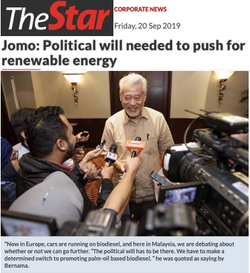
Political will needed to push for renewable energy

The Star 10July 2019

The Star 10July 2019

Malaysian businesses need boost

The Star 9 Oct 2019

The Star 9 Oct 2019

Subsidise public transport for bottom 40%

The Edge 26 Sept 2019

The Edge 26 Sept 2019

Call for measures to counteract global headwinds

The Edge 9 Oct 2019

The Edge 9 Oct 2019

Subsidise public transportation, not fuel

The Star 8 Oct 2019

The Star 8 Oct 2019

Subsidise public transportation for bottom 70%

TheEdge 2Oct 2019

TheEdge 2Oct 2019

"We need to counteract downward forces"

Fake News

PLEASE BEWARE OF MISREPRESENTATIONS OF IMAGES OF JOMO

Commercial and political misrepresentation of his image attributing to him to things which he never said or misrepresenting things he may have said is being circulated on websites such as those posted here. 


You should also be warned, in case you are not already aware, of ‘click bait’ i.e. using such images simply to attract your interest, and then to download your online information for abuse for a variety of ends.

Please inform us and provide a screenshot and weblink to enable further action, which is incredibly difficult. 

Thank you for reading this and for your help and cooperation.

This has also been flagged on his official Facebook page


JKS image ad2.jpg
JKS image Bitcoin ad on  Facebook.jpg
JKS - Fake News 2.jpg
Contact Me
JKS - Fake News 3.jpg
JKS fake news 1.jpg

Nadi Insan by the People's History Centre

Read all editions of #NadiInsan from 1979 to 1983 free of charge at the Peoples History Center website.


Containing writings on socio-political issues, film and cultural commentary, as well as in-depth interviews, Nadi Insan is motivated by community activists and intellectuals in Malaysia.

Happy reading!

Dapatkan kesemua siri majalah #NadiInsan dari tahun 1979 hingga 1983 secara percuma di laman Pusat Sejarah Rakyat.


Berisi tulisan memperihal sosio-politik, ulasan filem dan budaya sehinggalah wawancara yang rencam, Nadi Insan digerakkan oleh aktivis masyarakat dan intelektual di Malaysia.


Selamat membaca!

Contact Me

  • Facebook Social Icon
  • Twitter Social Icon

Thank you for reaching out!

bottom of page