top of page

Follow on Social Media

  • Facebook
  • Twitter
  • Screenshot 2022-09-18 at 5.20.40 PM

M'sia Developments
[on SubStack]

  • Screenshot 2022-09-18 at 5.20.40 PM

KUALA LUMPUR, Malaysia, May 12 2026 (IPS) - Transnational agribusinesses increasingly shape food policies worldwide. Claiming to best address recent food security concerns, they seek to profit more from innovations in food production, processing, and distribution.


Post-war food security

Food policies in the Global South have evolved significantly since World War Two (WWII), especially after nations in Asia and Africa gained independence, often after experiencing wartime food deprivations.

The early post-WWII and post-colonial eras saw new emphases on food security, especially following severe food shortages before, during, and after the war.

Many starved as millions experienced acute malnutrition. The wartime Bengal famine in India claimed over three million lives as Churchill prioritised British imperial interests and military priorities.

After WWII, colonial powers weaponised food supplies for counterinsurgency and population control purposes, especially to overcome popular anti-imperialist resistance.

Many who died were not military casualties but victims of deliberate counter-insurgency food deprivation. Unsurprisingly, food security efforts became a popular policy priority after WWII.

Western-controlled research organisations, including the United Nations Food and Agriculture Organisation (FAO), became highly influential, shaping and even developing post-colonial food security policies.


Green Revolution

Public research institutions were established in developing countries, many of which are affiliated with the Consultative Group on International Agricultural Research (CGIAR).

The Green Revolution initially focused on increasing yields of wheat, maize, and rice. These efforts increased cereal production unevenly during the 1960s and 1970s.

Malthusian logic held that rising life expectancies meant population growth outstripped the increase in food supply, constrained by limited agricultural land.

As government funding from wealthy nations declined, powerful corporate interests and philanthropies became even more influential. They often promoted their own interests at the expense of farmers, consumers, and the environment.

The International Fund for Agricultural Development (IFAD) was established in the 1970s, channelling a small share of windfall petroleum incomes into food and agricultural development.


Soon after, the US transformed its Public Law (PL) 480 program into the World Food Programme (WFP). Thus, some FAO functions were ceded to donor-controlled UN funds and programmes also set up in Rome.


Embarrassingly, an FAO report found WFP food supplies were withheld from Somalia to avoid being taken by the ‘Islamist’ As-Shabaab militia. Chatham House also estimated two to three hundred thousand deaths as a consequence.


Neoliberalism

The counter-revolution against national development efforts in the 1980s undermined government fiscal capacities, import-substituting industrialisation, and food security efforts.


Neoliberal structural adjustment policies involving economic liberalisation were imposed on heavily indebted developing countries, mainly in Latin America and Sub-Saharan Africa.


The Global North promoted trade liberalisation, undermining earlier protection of and support for food and industrial production.


Powerful food conglomerates sponsored and promoted import-friendly food security indicators, undermining FAO and other civil society research and advocacy efforts.


Countries hardly producing any food were highly ranked, as civil society organisations tried to counter with their own indicators, mainly focused on food sovereignty.


Trump 2.0

A new phase has begun with Donald Trump’s re-election as US president.


Trump 2.0’s weaponisation of economic policies and agreements, including food supplies, has ominous implications for countries trying to assert some independence.


Economic and military threats have been used for diverse ends, including economic, political, and other ‘strategic’ goals. Tariffs and sanctions are now part of a diverse arsenal of such weapons deployed for various purposes.


Governments have even been threatened with tariffs and sanctions for personal reasons. Trump has demanded Brazilian ex-President Jair Bolsonaro’s freedom following his failed coup after losing the last presidential election.


Deploying such economic weapons has worsened the deepening worldwide economic stagflation, as various Trump economic and military policy threats exacerbate contractionary and inflationary pressures.


The US-controlled WFP was long used to provide food aid selectively. But there is little sympathy left in Washington for other nations’ food security concerns.


To cut federal government spending, Trump has ended official development and humanitarian assistance, including food aid, while the US remains the world’s leading food exporter.


Nevertheless, Trump may take unexpected new steps to boost farmers’ earnings to recover electoral support before the November mid-term election.


Weaponisation of food aid took an ominous turn during the Israeli siege of Gaza, by calibrating food access to enable selective ethnic cleansing.


The Gaza Humanitarian Foundation attracted hungry residents to its food centres, causing hungry families desperately seeking food to be shot while seeking food.


Poverty is primarily defined by inadequate access to food, while the FAO considers income the main determinant of food insecurity.


Although World Bank poverty measures have generally continued to decline, FAO indicators suggest a reversal of earlier progress in food security over the last decade.


These contradictory trends not only reflect problems in estimating and understanding poverty and food security but also suggest that resulting policies are poorly informed, if not worse.


Related IPS Articles


Professor Felice Noelle Rodriguez is Director of the Centre for Local History and Culture, Universidad de Zamboanga, Philippines.


KUALA LUMPUR, Malaysia, Jul 15 2025 (IPS) - Trump’s billionaire cronies want more monopoly profits, not competition. With more policies crafted for them, wealth concentration is set to become greater than ever.


Neoliberalism?

There is no clear consensus on what neoliberal economics stands for now. Many who claim to be liberal economists have different, even contradictory views.

Some demand market competition and oppose monopolies and oligopolies. For others, property rights are crucial, typically strengthening monopoly rights.

Many avowed neoliberals deemphasise competition and hesitate to insist on antitrust action or opposition to abuses of market power.

Property rights confer monopoly or exclusive ownership rights to an asset, typically denying access to others except for payment. Many such rights are recent.

While UK Prime Minister from 1979, Margaret Thatcher triggered a worldwide neoliberal economic counter-revolution, especially in the Anglosphere.

With generally more limited public ownership, the US economy has long been more ‘private’, offering little scope for privatisation.


Tech Big Bro

PayPal and Palantir founder Peter Thiel is the most influential of the so-called ‘tech bros’ supporting re-elected US President Donald Trump.


Thiel was the two-term president’s biggest funder for his unexpectedly successful 2016 campaign. As former boss, funder and mentor, he is now Vice President JD Vance’s godfather.


In 2014, Thiel’s ‘Competition is for Losers’ established him as the lead apologist for lucrative rentier monopolies, especially those invoking intellectual property rights (IPRs).


Thiel noted ‘perfect competition’ is “both the ideal and the default state in Economics 101”. In textbooks, firms in competitive markets are presumed to be similar, selling the same goods.


Hence, they have no ‘market power’ and must sell at market-determined prices. When demand rises, firms invest to increase supply, reducing prices and profits.


In mainstream economics, there can be no economic rent under perfect competition. But prices can be raised more easily in cornered markets.


Buyers will then have no other source to buy from. Without competition, monopolies can maximise profits by controlling market supplies and prices.


Hence, profit maximisation involves capturing more rents in monopolistic conditions. To become richer, firms eschew competition in favour of monopoly.


Government role contradictory

Tech ‘Big Brother’ Thiel notes, “To an economist, every monopoly looks the same, whether it deviously eliminates rivals, secures a license from the state or innovates its way to the top.”


The state’s role is contradictory as government “works hard to create monopolies (by granting patents to new inventions)” while enforcing antitrust law to undermine them.


Thiel claims to be uninterested in “illegal bullies or government favorites”, but surely knows governments create and sustain the monopolies he so cherishes.


He notes that “Americans mythologize competition and credit it with saving us from socialist bread lines”. But for him, “capitalism and competition are opposites”.


“Capitalism is premised on the accumulation of capital, but under perfect competition, all profits get competed away.”


The advocate of monopoly claims monopolists are “incentivized to bend the truth” and to “lie to protect themselves … [from] … being audited, scrutinized and attacked”.


Thiel unabashedly acknowledges that rentiers have every incentive to protect, disguise and “conceal their monopoly” and incomes.


Instead, the billionaire rentier wants monopoly powers and profits to grow faster without being taxed or having to share.


Monopoly best for capitalism?

Thiel acknowledges that monopolists accumulate rents in a static world.


But he insists they “invent new and better things … Creative monopolies aren’t just good for the rest of society; they’re powerful engines for making it better.”


He insists a monopoly is “so good at what it does that no other firm can offer a close substitute”. For him, “the history of progress is a history of better monopoly businesses replacing incumbents”.


The tech billionaire insists decades of monopoly profits provide a powerful incentive to innovate. Thus, monopolies continue to drive progress.


He denounces mainstream neoliberal economists as “obsessed with competition as an ideal state? It is a relic of history … Their theories describe … perfect competition because that is what’s easy to model.”


“In the real world outside economic theory, every business is successful exactly to the extent that it does something others cannot … Monopoly is the condition of every successful business.”


Monopolies thrive under Trump

Unsurprisingly, many supposed neoliberals today stress property rights while ignoring liberal economics’ claim to promote competition.


Competition is dismissed as 19th-century economic liberalism. Meanwhile, contemporary monopoly capitalism accelerates wealth and income concentration.


But Thiel exaggerates monopolies’ contribution to human progress, capitalist dynamism and innovation, while understating their considerable harms.


With the tech bros increasingly supporting the president, Trump 2.0 promises to further enrich rentiers, especially those of their ilk.


His selective Liberation Day tariffs and other policies, especially his new ‘big beautiful bill’, will significantly increase, not reduce, US government debt while deepening American fiscal inequities.


As US tariffs, wars and other distractions preoccupy the world, unwitting MAGA loyalists remain loyal to Trump and his billionaire rentiers’ ‘counter-revolution’.


Latest Videos

All Videos

All Videos

AN URGENT CALL: A PEOPLE"S VACCINE AGAINST COVID-19

00:00
9 June 2020: IHD-ILO-ISLE Virtual Conference - Day 2

9 June 2020: IHD-ILO-ISLE Virtual Conference - Day 2

05:08:34
Learning in Governance in times of COVID-19

Learning in Governance in times of COVID-19

46:30
Beyond the Lockdown: Towards the ‘New Normal’

Beyond the Lockdown: Towards the ‘New Normal’

59:10

About Jomo

Jomo Kwame Sundaram is Research Adviser, Khazanah Research Institute, Fellow, Academy of Science, Malaysia, and Emeritus Professor, University of Malaya. Previously, he was UN Assistant Secretary-General for Economic Development, Assistant Director General, Food and Agriculture Organization (FAO), Founder-Chair, International Development Economics Associates (IDEAs) and President, Malaysian Social Science Association. 

In The Media

TheStar 26 June 2020

TheStar 26 June 2020

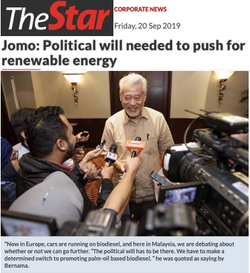
The Star 20 Sept 2019

The Star 20 Sept 2019

Political will needed to push for renewable energy

The Star 10July 2019

The Star 10July 2019

Malaysian businesses need boost

The Star 9 Oct 2019

The Star 9 Oct 2019

Subsidise public transport for bottom 40%

The Edge 26 Sept 2019

The Edge 26 Sept 2019

Call for measures to counteract global headwinds

The Edge 9 Oct 2019

The Edge 9 Oct 2019

Subsidise public transportation, not fuel

The Star 8 Oct 2019

The Star 8 Oct 2019

Subsidise public transportation for bottom 70%

TheEdge 2Oct 2019

TheEdge 2Oct 2019

"We need to counteract downward forces"

Fake News

PLEASE BEWARE OF MISREPRESENTATIONS OF IMAGES OF JOMO

Commercial and political misrepresentation of his image attributing to him to things which he never said or misrepresenting things he may have said is being circulated on websites such as those posted here. 


You should also be warned, in case you are not already aware, of ‘click bait’ i.e. using such images simply to attract your interest, and then to download your online information for abuse for a variety of ends.

Please inform us and provide a screenshot and weblink to enable further action, which is incredibly difficult. 

Thank you for reading this and for your help and cooperation.

This has also been flagged on his official Facebook page


JKS image ad2.jpg
JKS image Bitcoin ad on  Facebook.jpg
JKS - Fake News 2.jpg
Contact Me
JKS - Fake News 3.jpg
JKS fake news 1.jpg

Contact Me

  • Facebook Social Icon
  • Twitter Social Icon

Thank you for reaching out!

bottom of page