top of page

Follow on Social Media

  • Facebook
  • Twitter
  • Screenshot 2022-09-18 at 5.20.40 PM

M'sia Developments
[on SubStack]

  • Screenshot 2022-09-18 at 5.20.40 PM

KUALA LUMPUR, Malaysia, Dec 16 2025 (IPS) - The new US National Security Strategy (NSS) repositions the superpower’s role in the world. Hence, foreign policy will be mainly driven by considerations of ‘making America great again’ (MAGA).


Changing course

The new NSS no longer presumes US world leadership and alliances based on values. It breaks with earlier post-Cold War foreign policy, upsetting those committed to its sovereigntist unipolar world.


Quietly released on December 4, it is certainly not an easily forgettable update of long-established positions, cloaked in obscure bureaucratic and diplomatic parlance.

Mainly drafted under the leadership of ‘neo-con’ Secretary of State and National Security Adviser Marco Rubio, it is already seen as the most significant document of Trump 2.0.

It asserts, “The days of the United States propping up the entire world order like Atlas are over.” Instead, foreign policy should now prioritise advancing US interests.


New priorities

The NSS implies the US will no longer be the world’s policeman. Instead, it will exercise power selectively, prioritising transactional rather than strategic considerations.


It emphasises economic strength as key to national security, rebuilding industrial capacity, securing supply chains and ensuring the US never relies on others for critical materials.


Even if the Supreme Court overrules the President’s tariffs, the US has already secured many concessions from governments fearful of their likely adverse impacts.


The NSS is ostensibly based on MAGA considerations involving immigration control, hemispheric dominance, and cultural ethno-chauvinism.

Mainstream commentators complain it lacks the supposedly enlightened values underlying foreign policy in the US-dominated world order after the Second World War.

They complain the new NSS is narrow in focus, redefining interests, and sharing power. Its stance and tone are said to be more 19th-century than 21st-century.

Besides pragmatic imperatives, mixed messages may be due to unsatisfactory compromises among rival factions in Trump’s administration.


MAGA foreign policy

Long-term observers see the NSS as unprecedented and blatantly ideological.


White supremacist ideology influences not only national cultural politics but also foreign policy. The NSS unapologetically promotes Judaeo-Christian chauvinism despite the constitutional separation of church from state.


MAGA’s ‘America First’ priority is evident throughout. Border security is crucial as immigration is deemed the primary national security concern.


For Samuel Huntington, immigration threatens the US by making it less WASP (White Anglo-Saxon Protestant).


The NSS blames social and economic breakdown on immigration. Inflows into the Western Hemisphere, not just the US, must be urgently stopped by all available means.


Ironically, the US has long been a nation of immigrants, with relatively more immigrants than any European country. Its non-white numbers are almost equal to whites.


Trump’s neocolonial interpretation of the 1823 Monroe Doctrine emphasises the Americas as the new foreign policy priority.


Foreign rivals must not be allowed to acquire strategic assets, ports, mines, or infrastructure in Latin America and the Caribbean, mainly to keep China out.


Trump’s NSS prioritises the Western Hemisphere, with Asia second. Africa receives three paragraphs, primarily for its minerals.


Europe is downgraded to third, due to its ostensible immigration-induced civilizational decline. Surprisingly, the NSS urges halting North Atlantic Treaty Organisation (NATO) expansion.


China near peer!

The NSS policy on China is widely viewed as unexpectedly restrained. China remains a priority, but is no longer its primary antagonist; it is now a peer competitor.


Now, the US must rebalance its economic relationship with China based on mutually beneficial reciprocity, fairness, and the resurgence of US manufacturing.


The US will continue to work with allies to limit China’s growth and technological progress. However, China is allowed to develop green technologies due to US disinterest.


Meanwhile, US hawks have ensured a military ‘overmatch’ for Taiwan. The NSS emphasises Taiwan’s centrality to Indo-Pacific security and world chip production.


The NSS warns China would gain access to the Second Island Chain if it captured Taiwan, reshaping regional power and threatening vital US trade routes.


With allied support, the US military will seek to contain China within the First Island Chain. However, Taiwan fears US support will wane after TSMC chip production moves to the US.


The NSS expects the ‘Quad’ of the US, Australia, Japan and India to enhance Indo-Pacific security. For Washington, only India can balance China in Asia, and is hence crucial to contain China in the long term.


Regional reordering

The NSS also downgrades the Middle East (ME). Conditions that once made the region important have changed.


The ME’s importance stemmed from its petroleum and Western guilt over Israel. Now, the US has become a significant oil and gas exporter.


Critically, the US strike on Iran in mid-2025 is believed to have set back Tehran’s nuclear programme.


The ME seems unlikely to continue to drive US strategic planning as it has over the last half-century. For the US, the region is now expected to be a major investor.


As US foreign policy is redefined, the world worries. The ME has been downgraded as Latin America has become the new frontline region.


Much has happened in less than a year of Trump 2.0, with little clear or consistent pattern of continuity or change from his first term. But policies have also been quickly reversed or revised.


While the NSS is undoubtedly important and indicative, it would be presumptuous to think it will actually determine policy over the next three years, or even in the very near future.


Related IPS Articles


MANILA, Philippines, Nov 11 2025 (IPS) - US President Trump’s economic strategy for his second term aims to get the rest of the world, especially its wealthy allies with greater means, to pay more to help strengthen the US economy.


Recent US initiatives have undoubtedly accelerated de-dollarisation but these have largely been unavoidable consequences of its own actions rather than due to any conspiracy by others to that end.

De-dollarisation distraction

Harvard economist Kenneth Rogoff recently observed, “We are absolutely at the biggest inflection point in the global currency system since the Nixon shock to end the last vestige of the gold standard.”

After the Bretton Woods Conference in 1944, the gold price was set at $35 per ounce. In August 1971, US President Richard Nixon ended this gold-dollar parity.

De-dollarisation has gradually continued since, with occasional brief spurts and reversals. For example, capital flows abroad rose following the 2008-09 global financial crisis.

Growing weaponisation of economic relations has probably accelerated de-dollarisation. Rogoff observed, “this was happening for a decade before Trump. Trump is an accelerant.”

Governments, central banks and BRICS countries have been de-dollarising. Even US dollar hegemony advocates no longer deny alternatives to the dollar’s role as global reserve currency.

Meanwhile, private foreign investors, including foreign asset managers, investment banks and pension funds, do not want to be left behind.

Investment fund managers are increasingly ‘de-risking’ by cutting exposure to dollar-denominated assets.

Mar-a-Lago plan

Economist Stephen Miran has proposed a new Trump initiative to require other governments to pay the US for services purportedly rendered.

First appointed chair of Trump’s Council of Economic Advisers, Miran has since been appointed to the US Federal Reserve Board.

A few days after Trump announced his Liberation Day tariffs on April 2, Miran articulated five expectations. These expect other nations to pay the US for ‘public goods’ services it ostensibly provides the world.

Allies will be expected to pay the US more for the ‘security umbrella’ it provides to NATO and other allies. The US also expects those buying Treasury bonds to pay more for the ‘privilege’

In November 2024, Miran’s A User’s Guide to Restructuring the Global Trading System proposed the Mar-A-Lago accord, named for Trump’s exclusive Florida island resort and residence.

He also referred to the Plaza Accord, which the Reagan administration imposed on its G5 allies in September 1985. Then, the US forced Japan and Germany to appreciate their currencies against the dollar.

The yen’s appreciation fuelled a massive Japanese asset price bubble that burst with devastating consequences in 1989, ending its post-war boom.

Trump now seeks the appreciation of other major currencies. Already, he has succeeded in getting his European allies to agree.

However, it seems unlikely that Trump will get China and other BRICS economies to do so, as they are aware of how the Plaza Accord affected Japan.

Century bonds

Other national monetary authorities buying US Treasury bonds to stabilise their own currencies have long caused dollar appreciation.

They are now expected to help depreciate the dollar. Miran has proposed that the US issue century, i.e., 100-year bonds, at very low interest rates, well below the current rates for US Treasury securities.

Miran wants foreign central bank reserve currency managers to sell off their dollar-denominated assets. They should “term out” their “remaining reserve holdings” and refinance short-term debt with long-term borrowings.

Miran is explicit: “The US Treasury can effectively buy duration back from the market and replace that borrowing with century bonds sold to the foreign official sector.”

His plan thus intends to force foreign holders of US government debt (‘Treasuries’) to extend the duration of their loans.

Very low interest rates for century bonds will ensure that foreign bondholders effectively pay the US more for the ‘privilege’ of borrowing dollars.

For Miran, the appreciation of other currencies against the dollar will also strengthen the American economy. US manufacturing will strengthen as its exports become more competitive.

Thus, his Mar-A-Lago accord plan expects other nations to pay more to strengthen the world’s largest and richest economy.

Miran’s Mar-A-Lago plan is not yet official US policy. However, this can change with Miran’s likely appointment as the next Fed chair, replacing Trump 1.0 appointee Jerome Powell.

BRICS de-dollarisation?

However, Miran’s declared plan to strengthen the US economy by depreciating the dollar against other major currencies has also accelerated de-dollarisation.

In recent years, the BRICS have been accused of conspiring to accelerate de-dollarisation worldwide, but this is certainly not a shared ambition.

Lacking significant trade surpluses, Brazil and South Africa have long advocated de-dollarisation. But Russia’s complaints have more to do with recent NATO weaponisation of financial instruments against it.

There is no comparable enthusiasm among other BRICS member states, which have much healthier trade surpluses and more dollar assets.

Its recent membership expansion will make an official BRICS de-dollarisation stance even more unlikely.

Nevertheless, Trump’s leadership relies on the American public believing the rest of the world is conspiring against them.


  • Sep 23, 2025
  • 4 min read

JOHANNESBURG, South Africa, Sep 23 2025 (IPS) - US President Trump’s snide barbs against his appointee, US Federal Reserve Bank Chairman Jerome Powell, have revived support for central bank independence – long abused by powerful finance interests against growth and equity.


Independent central banks are supposed to improve the quality, equity, and growth impact of monetary policy. Instead, they have primarily served powerful financial interests, with contractionary and regressive effects leading to slower, unequal growth.


Independent of whom?

Central banks were established to determine monetary policy to shape financial conditions to achieve national economic objectives.


In recent decades, the new conventional policy wisdom has been that independent central banks should set monetary policy. Thus, they have been influenced by powerful financial interests, typically foreign, in smaller, open developing countries.


In the last half-century, many governments have changed laws under the influence of international finance to legislate central bank independence from governments of the day, especially the executive and legislative branches.


Meanwhile, most central banks have come to equate financial stability with price stability as ‘inflation targeting’ became the leading policy fetish.


When inflation rises, central banks raise interest rates, which reduces economic activity. However, some central banks of open economies, especially those pegging to major international currencies, target the exchange rate.


Thus, reducing inflation by conventional means worsens contractionary pressures. Many governments now face the threat of ‘stagflation’, i.e., recession with inflation. Central banks recognise this trade-off regarding how much growth has to decline for inflation to fall.


With interest rate management as their primary policy tool, central banks may raise interest rates in anticipation of inflation, despite its adverse consequences for growth, income and employment.


Such contractionary effects have reduced wages and jobs worldwide. Only a few, mainly large developed economies, have had other priorities, such as growth or employment.


Ironically, the end of the Bretton Woods fixed exchange rates regime and the counter-revolution against Keynesian economics from the late 1970s ensured the irrelevance of Milton Friedman’s monetarist emphasis on central banks’ money supply targeting.


Worsening inequity

Central banks worldwide respond to and anticipate inflation by raising interest rates to curb inflation.


‘Inflation targeting’ causes significant collateral damage, typically reducing growth, income and employment. Poor households’ incomes are likelier to fall, especially with labour-displacing technological change, such as mechanisation, automation, and artificial intelligence (AI) applications.


As unemployment increases, poor workers are more likely to lose jobs, especially hurting poorer families. Banks have typically profited handsomely from such situations, although most people are worse off.


With lending rates rising, banks get even more interest as borrowing rates lag, not increasing as much. Max Lawson cites an IMF study finding that the adverse effects of higher interest rates are “not counterbalanced by the positive effects of lower interest rates.”


The US Fed strongly influences central banks worldwide. Higher Fed interest rates from 2023, in response to minor inflationary pressures, have hurt developing countries, especially the poorest.


As most Global South companies and governments have incurred dollar-denominated debt, countries’ central banks raised interest rates to deter capital outflows.


Quantitative easing

‘Quantitative easing’ (QE) refers to central bank interventions buying financial assets. Such interventions were sought as it is difficult for central banks to cut interest rates below zero to revive economies. QE seemed to fit the bill.


Commercial banks typically get more for their deposits with the central bank when it raises interest rates. Thus, they receive considerable additional windfall interest payments from the central bank risk-free.


QE programmes seek to raise asset prices. Central banks buy assets such as government debt, inducing private investors to acquire riskier assets. US government debt is still the most important financial asset in the international monetary system.


Thus, QE tries to induce growth, presuming earlier contractionary policies will continue to curb or ‘moderate’ inflation.

This has even been justified as prudent, as inflation rates were below target despite interest rates near zero.


Major Western central banks adopted QE following the 2008-09 global financial crisis. Many governments spent even more in response to the COVID-19 pandemic from 2020.


Such efforts sought to counter the downward spiral of falling financial asset prices. The US Fed’s QE intervention involved ‘portfolio rebalancing’. It bought over $600 billion in US Treasury bonds and almost $300 billion in mortgage-backed securities.


Wealth is concentrated in relatively few hands in most societies. Jordi Bosch showed the top ten per cent holding 11 times more wealth than the bottom half in the euro zone, while the bottom fifth had more debt than assets.


QE interventions increase financial asset prices, enriching owners, especially the rich, who have more assets. As prices rise, their worth generally increases. Hence, such central bank interventions further enrich the already wealthy.


As the world struggles to cope with challenges posed by the current conjuncture, we must not jump out of the frying pan back into the fire kindled by central bank independence.


Related IPS Articles:


Latest Videos

All Videos

All Videos

AN URGENT CALL: A PEOPLE"S VACCINE AGAINST COVID-19

00:00
9 June 2020: IHD-ILO-ISLE Virtual Conference - Day 2

9 June 2020: IHD-ILO-ISLE Virtual Conference - Day 2

05:08:34
Learning in Governance in times of COVID-19

Learning in Governance in times of COVID-19

46:30
Beyond the Lockdown: Towards the ‘New Normal’

Beyond the Lockdown: Towards the ‘New Normal’

59:10

About Jomo

Jomo Kwame Sundaram is Research Adviser, Khazanah Research Institute, Fellow, Academy of Science, Malaysia, and Emeritus Professor, University of Malaya. Previously, he was UN Assistant Secretary-General for Economic Development, Assistant Director General, Food and Agriculture Organization (FAO), Founder-Chair, International Development Economics Associates (IDEAs) and President, Malaysian Social Science Association. 

In The Media

TheStar 26 June 2020

TheStar 26 June 2020

The Star 20 Sept 2019

The Star 20 Sept 2019

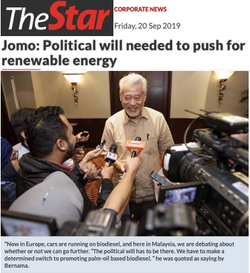
Political will needed to push for renewable energy

The Star 10July 2019

The Star 10July 2019

Malaysian businesses need boost

The Star 9 Oct 2019

The Star 9 Oct 2019

Subsidise public transport for bottom 40%

The Edge 26 Sept 2019

The Edge 26 Sept 2019

Call for measures to counteract global headwinds

The Edge 9 Oct 2019

The Edge 9 Oct 2019

Subsidise public transportation, not fuel

The Star 8 Oct 2019

The Star 8 Oct 2019

Subsidise public transportation for bottom 70%

TheEdge 2Oct 2019

TheEdge 2Oct 2019

"We need to counteract downward forces"

Fake News

PLEASE BEWARE OF MISREPRESENTATIONS OF IMAGES OF JOMO

Commercial and political misrepresentation of his image attributing to him to things which he never said or misrepresenting things he may have said is being circulated on websites such as those posted here. 


You should also be warned, in case you are not already aware, of ‘click bait’ i.e. using such images simply to attract your interest, and then to download your online information for abuse for a variety of ends.

Please inform us and provide a screenshot and weblink to enable further action, which is incredibly difficult. 

Thank you for reading this and for your help and cooperation.

This has also been flagged on his official Facebook page


JKS image ad2.jpg
JKS image Bitcoin ad on  Facebook.jpg
JKS - Fake News 2.jpg
Contact Me
JKS - Fake News 3.jpg
JKS fake news 1.jpg

Contact Me

  • Facebook Social Icon
  • Twitter Social Icon

Thank you for reaching out!

bottom of page