top of page

Follow on Social Media

  • Facebook
  • Twitter
  • Screenshot 2022-09-18 at 5.20.40 PM

M'sia Developments
[on SubStack]

  • Screenshot 2022-09-18 at 5.20.40 PM

KUALA LUMPUR, Malaysia, Jan 19 2026 (IPS) - After condemning pragmatic responses to the 1997-98 Asian financial crises, the West pursued similar policies in response to the 2008 global financial crisis without acknowledging its own mistakes.


Politicised exchange rates

After US Federal Reserve Chairman Paul Volcker sharply raised interest rates from late 1979 to curb inflation, the dollar’s value strengthened despite deepening stagnation.


US exports could barely compete internationally, particularly with Germany and Japan. During his first term, Trump initially pursued a strong dollar policy, which undermined exports and encouraged imports.

The September 1985 ‘Plaza Accord’ among the G7 grouping of the world’s largest economies, held at New York’s Plaza Hotel, agreed that the Japanese yen and the Deutsche mark must both appreciate sharply against the US dollar.

The ‘strong yen’ period, or endaka in Japanese, ensued for a decade until mid-1995. This made Japanese imports less competitive, enabling the Reagan era boom.

By accelerating reunification with the East and the new euro currency, German Chancellor Helmut Kohl prevented the mark strengthening as much as the yen.

Thus, Germany avoided the Japanese catastrophe after its decades-long post-war miracle ended abruptly with the disastrous 1989 Big Bang financial reforms.


Liberalising capital flows

As the IMF urged national authorities to abandon capital controls, East Asians borrowed dollars, expecting to repay later on better terms.


Meanwhile, the dollar only stopped weakening after the US allowed Japan to reverse yen appreciation in mid-1995.


Under Managing Director Michel Camdessus, the IMF began pushing capital account liberalisation. This contradicted the intent of the Fund’s sixth Article of Agreement, affirming national authorities’ right to manage their capital accounts.


Despite considerable evidence to the contrary, Camdessus’ IMF preached the ostensible virtues of capital account liberalisation.


East Asian emerging financial markets were initially delighted by the significant capital inflows before mid-1997. After the strong yen decade, the US dollar appreciated from mid-1995.


When financial inflows reversed after mid-1997, some East Asian monetary authorities were unable to cope and turned to the IMF for emergency funding.


Many paths to crises

The Asian financial crisis is typically dated from 2 July 1997, when the Thai baht was ‘floated’ and its value quickly fell without central bank support. The ensuing panic quickly spread like contagion across national boundaries via financial markets.


Financial investors – in Bangkok, Singapore, Hong Kong, Tokyo, London and New York – hastily withdrew their funds, often mindlessly following perceived ‘market leaders’ without knowing why, like animal herds in panic.


Funds fled economies in the region, like frightened audiences in a dark theatre hearing a fire alarm. Capital even fled the Philippines, which had received little finance, because it was in Southeast Asia, the ‘wrong neighbourhood’.


After earlier celebrating Malaysia, Indonesia, and Thailand as ‘East Asian miracle’ economies, confidence in Southeast Asian investments fell suddenly.


Central banks in the region were sceptical of IMF prescriptions but believed they had little choice but to comply.

Press photographs showed Camdessus standing sternly, with arms folded like a displeased schoolmaster, over the Indonesian President bowing deeply to sign the IMF agreement.


This humiliating image probably expedited Soeharto’s shock resignation soon after, in mid-1998, over three decades after he seized power in a brutal military putsch in September 1965.


Following an earlier financial crisis, a 1989 Malaysian law had prohibited some risky banking and financial practices, but the authorities sought to attract foreign investments into its stock market.


Thailand had become vulnerable by allowing borrowers direct access to foreign banks through the Bangkok International Banking Facility and its provincial counterpart.


Debtors could thus bypass central bank regulation and supervision. The Thai currency float prompted massive funds outflows from the country.


As market confidence waned, funds fled Malaysia’s bourse, triggering a massive collapse in the currency’s value against the dollar, which had steadily weakened against the yen between 1985 and 1995.


Following massive capital outflows, Malaysia finally introduced capital controls on outflows from September 1998, fourteen months after the crisis began!


The controls enabled Malaysia to stabilise its currency and the economy temporarily, but also ended the earlier decade of accelerated industrialisation and growth.


Learning from experience

Rather than acknowledge and address the worsening problem due to earlier capital account liberalisation, the Fund made things worse with its prescriptions.


It insisted on keeping capital accounts open and raising interest rates to reverse outflows. This slowed economic growth as borrowing – and hence, both spending and investing – became more costly.


As investment and spending are necessary for economic growth, IMF prescriptions exacerbated the problems instead of providing a solution.


The East Asian financial crisis was undoubtedly avoidable. Experience has shown that financial markets and capital flows do not function as mainstream theories claim.


Thus, financial dogma and its influence on economic theory and policy obscured more realistic understanding of how markets actually operate and the ability to develop more pragmatic and appropriate policy alternatives.


History never fully repeats itself. But better policymaking for financial crisis avoidance and recovery will only emerge from more informed, historically grounded analysis.


Related IPS Articles


KUALA LUMPUR, Malaysia, Jan 6 2026 (IPS) - While US President Donald Trump has blamed the BRICS and foreign investors for de-dollarisation, his rhetoric, actions and policy measures are mainly responsible for the trend’s recent acceleration.


Threats and reactions

Although Trump is not the sole cause of de-dollarisation, which began much earlier, well before he became president, his recent initiatives have accelerated the trend.


Despite some temporary reversals, the dollar’s post-World War II role as world reserve currency has gradually declined over the decades, especially since the 1970s. Ben Norton has argued that several Trump measures have accelerated this trend.

Trump claims his supposedly ‘reciprocal tariffs’ will reduce the US trade or current account deficit with the rest of the world. But if countries cannot export to the US, they cannot earn dollars to meet their trade and investment needs.

Many believe Trump’s tariffs and other threats are enhancing US leverage vis-à-vis others, but their reactions, including defensive countermeasures, are accelerating de-dollarisation.

Trump’s measures, such as his insistence on bilateral negotiations, have alarmed most nations, including long-time allies. As nations, including allies, rethink their economic relations with and vulnerability to the US, de-dollarisation inadvertently accelerates.


Trump vs the Fed

The US Federal Reserve Bank’s overnight lending or funds rate has been higher since 2022, responding to higher consumer price inflation following the pandemic and the Russian invasion of Ukraine.


As the Fed raised interest rates, yields on US government debt rose. But Trump now wants the Fed to cut interest rates to reduce the high debt servicing costs of both the government and private corporations.


In 2024, the US federal government paid about 3% of GDP in debt interest alone. Although such debt exceeds 120% of GDP, debt service costs are deemed manageable as long as interest rates remain low.


Trump’s pressures on the Fed to cut interest rates have inadvertently undermined investor confidence and prompted ‘flights [from dollar assets] to safety’.


Trump’s recent campaign against his earlier Fed chair appointee, Jerome Powell, has inadvertently raised investor concerns about his espoused monetary policy priorities.


Inflation fears persist

Investors now worry that Trump is pressuring the Fed to cut interest rates. They believe this will stoke inflation and cause the dollar to fall against other major currencies. As Trump is seen forcing down interest rates, he risks being blamed for persistent inflation.


If the Fed buys US Treasuries to reduce yields, for a new round of ‘quantitative easing’ (QE), dollar asset investments will realise lower, if not negative, real yields.


Although inflation hawks’ worst fears of higher inflation have not materialised so far, few believe tariffs will not raise inflation.


Expecting Trump 2.0 to impose more tariffs, many US companies stockpiled imports before April 2. As tariffs took effect and stocks declined, prices rose.


Many investors have sold their dollar assets as monetary authorities worldwide seek alternatives to the greenback. Such sell-offs lower the dollar’s value, further spurring de-dollarisation.


Trump now wants to lower US Treasury bond yields as foreign governments and investors seek alternatives to holding dollar assets.


Many are considering switching to non-dollar assets despite stagnation tendencies elsewhere in the Global North, especially in Europe and Japan. If investors stop buying dollar assets or sell them to purchase non-dollar assets, de-dollarisation will gain momentum.


Foreign demand falling

Washington is understandably worried that foreign investors will dump Treasury securities. In 2015, a third was held by foreigners, but this has since fallen to under a quarter.


The ‘Mar-A-Lago Accord’ proposal, which requires foreign governments to hold US Treasury ‘century bonds’ for 100 years despite assured losses, will compound resentment.


Lowering Treasury bond yields is both risky and difficult due to the highly financialised US economy. Past bond market turmoil has triggered stock market selloffs, lowering Treasury yields, share prices and tax revenue.


Government and corporate borrowing costs rise together. As trillions of dollars’ worth of corporate bonds mature over the next two years, high interest rates will raise corporations’ borrowing costs. Many want to refinance at lower interest rates.


These efforts to bring down interest rates are apparent to all. But lower interest rates and negative ‘actual yields’ for Treasury securities will ensure high inflation persists.


De-dollarisation accelerating?

Trump’s actions, especially threats of tariffs and sanctions, have elicited diverse reactions, often undermining dollar hegemony and accelerating de-dollarisation.


Many recent developments have undermined public confidence in the US government and the rule of law, accelerating de-dollarisation.


As investors sold US assets in mid-2025, the dollar saw its biggest fall since the 1973 oil price hike. It fell by over 10% against other major currencies, triggering temporary falls in the prices of many financial assets, including equities and bonds.


Since then, there has been increased capital market uncertainty and volatility, as in the US bond market, although a strong rally followed the ensuing stock market crash.


In many recent episodes of financial volatility, dollar liquidity was considered the safe option. But in 2025, confidence in dollar assets fell, prompting selloffs and de-dollarisation.


Thus far, Trump has been adept at managing short-term volatility, but his style implies no one knows when the music will stop.


Related IPS Articles


Available online here: Trump De-dollarisation Accelerant


Latest Videos

All Videos

All Videos

AN URGENT CALL: A PEOPLE"S VACCINE AGAINST COVID-19

00:00
9 June 2020: IHD-ILO-ISLE Virtual Conference - Day 2

9 June 2020: IHD-ILO-ISLE Virtual Conference - Day 2

05:08:34
Learning in Governance in times of COVID-19

Learning in Governance in times of COVID-19

46:30
Beyond the Lockdown: Towards the ‘New Normal’

Beyond the Lockdown: Towards the ‘New Normal’

59:10

About Jomo

Jomo Kwame Sundaram is Research Adviser, Khazanah Research Institute, Fellow, Academy of Science, Malaysia, and Emeritus Professor, University of Malaya. Previously, he was UN Assistant Secretary-General for Economic Development, Assistant Director General, Food and Agriculture Organization (FAO), Founder-Chair, International Development Economics Associates (IDEAs) and President, Malaysian Social Science Association. 

In The Media

TheStar 26 June 2020

TheStar 26 June 2020

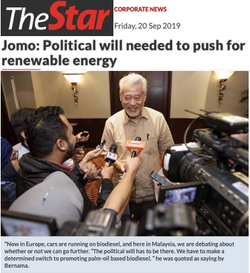
The Star 20 Sept 2019

The Star 20 Sept 2019

Political will needed to push for renewable energy

The Star 10July 2019

The Star 10July 2019

Malaysian businesses need boost

The Star 9 Oct 2019

The Star 9 Oct 2019

Subsidise public transport for bottom 40%

The Edge 26 Sept 2019

The Edge 26 Sept 2019

Call for measures to counteract global headwinds

The Edge 9 Oct 2019

The Edge 9 Oct 2019

Subsidise public transportation, not fuel

The Star 8 Oct 2019

The Star 8 Oct 2019

Subsidise public transportation for bottom 70%

TheEdge 2Oct 2019

TheEdge 2Oct 2019

"We need to counteract downward forces"

Fake News

PLEASE BEWARE OF MISREPRESENTATIONS OF IMAGES OF JOMO

Commercial and political misrepresentation of his image attributing to him to things which he never said or misrepresenting things he may have said is being circulated on websites such as those posted here. 


You should also be warned, in case you are not already aware, of ‘click bait’ i.e. using such images simply to attract your interest, and then to download your online information for abuse for a variety of ends.

Please inform us and provide a screenshot and weblink to enable further action, which is incredibly difficult. 

Thank you for reading this and for your help and cooperation.

This has also been flagged on his official Facebook page


JKS image ad2.jpg
JKS image Bitcoin ad on  Facebook.jpg
JKS - Fake News 2.jpg
Contact Me
JKS - Fake News 3.jpg
JKS fake news 1.jpg

Contact Me

  • Facebook Social Icon
  • Twitter Social Icon

Thank you for reaching out!

bottom of page