top of page

Follow on Social Media

  • Facebook
  • Twitter
  • Screenshot 2022-09-18 at 5.20.40 PM

M'sia Developments
[on SubStack]

  • Screenshot 2022-09-18 at 5.20.40 PM

KUALA LUMPUR, Malaysia, Apr 28 2026 (IPS) - The January 2026 US National Defense Strategy (NDS) departs significantly from those preceding it, including from Trump’s first term. Is it deliberately misleading? Or is actual policy, including war, being driven by other considerations?


National Defense Strategy

The 34-page NDS begins by asserting: “For too long, the US Government neglected – even rejected – putting Americans and their concrete interests first”.


Much like the latest National Security Strategy (NSS), released by Secretary of State and National Security Adviser Marco Rubio in December 2025, the NDS claims to be about putting ‘America First’.

Both documents promise ‘no more business as usual’. They claim to change decades of strategy, supposedly in the national interest. Unlike earlier US military blueprints, the NDS is filled with vague rhetoric and eschews interventions abroad.

But in Trump 2.0’s first year alone, the US bombed ten countries, threatening at least four more, all in the Americas. Despite scant mention in both documents, the US-Israel war on Iran resumed on 28 February!

Europe

The NDS claims the US is reducing its direct military role in Europe but still wants to be influential.

It pledges to remain central to NATO “even as we calibrate US force posture and activities in the European theater” to meet US priorities.


Noting “Russia will remain a persistent but manageable threat to NATO’s eastern members for the foreseeable future”, the NDS insists NATO allies must “take primary responsibility for Europe’s conventional defense”.


The NDS blows hot and cold on Europe’s aggressive support for Ukraine’s Zelensky, envisaging a reduced troop presence on NATO’s borders with Ukraine.

Many European allies complain the Trump administration has created a ‘security vacuum’ by leaving Europe to confront Russia with uncertain US support.

They also complain about Secretary Pete Hegseth’s insistence on “credible options to guarantee US military and commercial access to key terrain”. The NDS insists on more than access to Greenland and the Panama Canal.

Issued days after Trump claimed he had a “framework of a future deal” on Arctic security with NATO chief Mark Rutte, he insisted it ensured the US “total access” to Greenland, long a territory of NATO ally, Denmark.

However, Danish officials insisted formal negotiations had not yet begun. Trump also threatened European nations opposing his Greenland plan with tariffs.


Western Hemisphere

The NDS supports the NSS and Trump’s ‘Donroe doctrine’ focus on the Western Hemisphere, envisaging the Americas as the US backyard.


In his January Davos speech, Canadian Prime Minister Mark Carney noted that recent US actions are disrupting established international norms.


The NDS was issued three days later, after a week of tensions between the White House and its Western allies. Cooperation with the Americas, including Canada, is conditional, to “ensure that they respect and do their part to defend our shared interests”.


It warns the US will “actively and fearlessly defend America’s interests throughout the Western Hemisphere. And where they do not, we will stand ready to take focused, decisive action that concretely advances US interests.”


Trump had declared the US should retake Panama and its Canal, accusing the government of ceding control to China. Later, however, Trump was more ambiguous about ‘taking back’ both the country and the canal.


Many also doubt Trump’s intentions in kidnapping Venezuelan President Nicolás Maduro and his wife, ostensibly for trial on drug charges in the US.


Asia-Pacific

The previous NDS, issued in 2022 under then-President Joe Biden, had deemed China the US’s principal threat. Biden also embraced Trump 1.0’s Indo-Pacific alliance to encircle China.


In contrast, the new NDS describes China as an established power in the Indo-Pacific region that only needs to be discouraged from dominating the US and its allies.


The goal “is not to dominate China; nor is it to strangle or humiliate them… This does not require regime change or some other existential struggle…President Trump seeks a stable peace, fair trade, and respectful relations with China”.


The NDS even proposes “a wider range of military-to-military communications” with Chinese counterparts! The U-turn followed the administration’s retreat from its threatened tit-for-tat tariff escalation after China’s successful retaliation.


Biden’s 2022 NDS promised the US would “support Taiwan’s asymmetric self-defense”. The new NDS offers no such assurances to the self-governing island province of China, which Beijing warns it will take by force if necessary.


The NDS also calls for “a sharp shift – in approach, focus, and tone”, insisting US allies must take more responsibility for countering adversaries such as China, Russia and North Korea.


It insists, “South Korea is capable of taking primary responsibility for deterring North Korea with critical but more limited US support”.


Cutting costs of empire

Like Trump, the new NDS wants allies to pay much more for US ‘protection’.


It echoes his frequent criticisms of allies for taking advantage of previous administrations to subsidise their defence and being ungrateful for US protection.


But the terms of such subordination remain ambiguous and arbitrary, even extortionate and corrupt. Gulf monarchies may now regret their generous donations to the president, apparently to little avail so far.


Trump’s treatment of allies, the Netanyahu-led war on Iran, and continuing US-led efforts to ‘contain’ China suggest both documents offer poor guidance to knowing and understanding, let alone anticipating, US policies abroad.


Related IPS Articles


Nurina Malek is an economics graduate of the University of Wisconsin-Madison, currently working on policy research at the Khazanah Research Institute.


KUALA LUMPUR, Malaysia, Dec 16 2025 (IPS) - The new US National Security Strategy (NSS) repositions the superpower’s role in the world. Hence, foreign policy will be mainly driven by considerations of ‘making America great again’ (MAGA).


Changing course

The new NSS no longer presumes US world leadership and alliances based on values. It breaks with earlier post-Cold War foreign policy, upsetting those committed to its sovereigntist unipolar world.


Quietly released on December 4, it is certainly not an easily forgettable update of long-established positions, cloaked in obscure bureaucratic and diplomatic parlance.

Mainly drafted under the leadership of ‘neo-con’ Secretary of State and National Security Adviser Marco Rubio, it is already seen as the most significant document of Trump 2.0.

It asserts, “The days of the United States propping up the entire world order like Atlas are over.” Instead, foreign policy should now prioritise advancing US interests.


New priorities

The NSS implies the US will no longer be the world’s policeman. Instead, it will exercise power selectively, prioritising transactional rather than strategic considerations.


It emphasises economic strength as key to national security, rebuilding industrial capacity, securing supply chains and ensuring the US never relies on others for critical materials.


Even if the Supreme Court overrules the President’s tariffs, the US has already secured many concessions from governments fearful of their likely adverse impacts.


The NSS is ostensibly based on MAGA considerations involving immigration control, hemispheric dominance, and cultural ethno-chauvinism.

Mainstream commentators complain it lacks the supposedly enlightened values underlying foreign policy in the US-dominated world order after the Second World War.

They complain the new NSS is narrow in focus, redefining interests, and sharing power. Its stance and tone are said to be more 19th-century than 21st-century.

Besides pragmatic imperatives, mixed messages may be due to unsatisfactory compromises among rival factions in Trump’s administration.


MAGA foreign policy

Long-term observers see the NSS as unprecedented and blatantly ideological.


White supremacist ideology influences not only national cultural politics but also foreign policy. The NSS unapologetically promotes Judaeo-Christian chauvinism despite the constitutional separation of church from state.


MAGA’s ‘America First’ priority is evident throughout. Border security is crucial as immigration is deemed the primary national security concern.


For Samuel Huntington, immigration threatens the US by making it less WASP (White Anglo-Saxon Protestant).


The NSS blames social and economic breakdown on immigration. Inflows into the Western Hemisphere, not just the US, must be urgently stopped by all available means.


Ironically, the US has long been a nation of immigrants, with relatively more immigrants than any European country. Its non-white numbers are almost equal to whites.


Trump’s neocolonial interpretation of the 1823 Monroe Doctrine emphasises the Americas as the new foreign policy priority.


Foreign rivals must not be allowed to acquire strategic assets, ports, mines, or infrastructure in Latin America and the Caribbean, mainly to keep China out.


Trump’s NSS prioritises the Western Hemisphere, with Asia second. Africa receives three paragraphs, primarily for its minerals.


Europe is downgraded to third, due to its ostensible immigration-induced civilizational decline. Surprisingly, the NSS urges halting North Atlantic Treaty Organisation (NATO) expansion.


China near peer!

The NSS policy on China is widely viewed as unexpectedly restrained. China remains a priority, but is no longer its primary antagonist; it is now a peer competitor.


Now, the US must rebalance its economic relationship with China based on mutually beneficial reciprocity, fairness, and the resurgence of US manufacturing.


The US will continue to work with allies to limit China’s growth and technological progress. However, China is allowed to develop green technologies due to US disinterest.


Meanwhile, US hawks have ensured a military ‘overmatch’ for Taiwan. The NSS emphasises Taiwan’s centrality to Indo-Pacific security and world chip production.


The NSS warns China would gain access to the Second Island Chain if it captured Taiwan, reshaping regional power and threatening vital US trade routes.


With allied support, the US military will seek to contain China within the First Island Chain. However, Taiwan fears US support will wane after TSMC chip production moves to the US.


The NSS expects the ‘Quad’ of the US, Australia, Japan and India to enhance Indo-Pacific security. For Washington, only India can balance China in Asia, and is hence crucial to contain China in the long term.


Regional reordering

The NSS also downgrades the Middle East (ME). Conditions that once made the region important have changed.


The ME’s importance stemmed from its petroleum and Western guilt over Israel. Now, the US has become a significant oil and gas exporter.


Critically, the US strike on Iran in mid-2025 is believed to have set back Tehran’s nuclear programme.


The ME seems unlikely to continue to drive US strategic planning as it has over the last half-century. For the US, the region is now expected to be a major investor.


As US foreign policy is redefined, the world worries. The ME has been downgraded as Latin America has become the new frontline region.


Much has happened in less than a year of Trump 2.0, with little clear or consistent pattern of continuity or change from his first term. But policies have also been quickly reversed or revised.


While the NSS is undoubtedly important and indicative, it would be presumptuous to think it will actually determine policy over the next three years, or even in the very near future.


Related IPS Articles


Latest Videos

All Videos

All Videos

AN URGENT CALL: A PEOPLE"S VACCINE AGAINST COVID-19

00:00
9 June 2020: IHD-ILO-ISLE Virtual Conference - Day 2

9 June 2020: IHD-ILO-ISLE Virtual Conference - Day 2

05:08:34
Learning in Governance in times of COVID-19

Learning in Governance in times of COVID-19

46:30
Beyond the Lockdown: Towards the ‘New Normal’

Beyond the Lockdown: Towards the ‘New Normal’

59:10

About Jomo

Jomo Kwame Sundaram is Research Adviser, Khazanah Research Institute, Fellow, Academy of Science, Malaysia, and Emeritus Professor, University of Malaya. Previously, he was UN Assistant Secretary-General for Economic Development, Assistant Director General, Food and Agriculture Organization (FAO), Founder-Chair, International Development Economics Associates (IDEAs) and President, Malaysian Social Science Association. 

In The Media

TheStar 26 June 2020

TheStar 26 June 2020

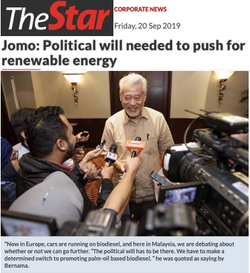
The Star 20 Sept 2019

The Star 20 Sept 2019

Political will needed to push for renewable energy

The Star 10July 2019

The Star 10July 2019

Malaysian businesses need boost

The Star 9 Oct 2019

The Star 9 Oct 2019

Subsidise public transport for bottom 40%

The Edge 26 Sept 2019

The Edge 26 Sept 2019

Call for measures to counteract global headwinds

The Edge 9 Oct 2019

The Edge 9 Oct 2019

Subsidise public transportation, not fuel

The Star 8 Oct 2019

The Star 8 Oct 2019

Subsidise public transportation for bottom 70%

TheEdge 2Oct 2019

TheEdge 2Oct 2019

"We need to counteract downward forces"

Fake News

PLEASE BEWARE OF MISREPRESENTATIONS OF IMAGES OF JOMO

Commercial and political misrepresentation of his image attributing to him to things which he never said or misrepresenting things he may have said is being circulated on websites such as those posted here. 


You should also be warned, in case you are not already aware, of ‘click bait’ i.e. using such images simply to attract your interest, and then to download your online information for abuse for a variety of ends.

Please inform us and provide a screenshot and weblink to enable further action, which is incredibly difficult. 

Thank you for reading this and for your help and cooperation.

This has also been flagged on his official Facebook page


JKS image ad2.jpg
JKS image Bitcoin ad on  Facebook.jpg
JKS - Fake News 2.jpg
Contact Me
JKS - Fake News 3.jpg
JKS fake news 1.jpg

Contact Me

  • Facebook Social Icon
  • Twitter Social Icon

Thank you for reaching out!

bottom of page