top of page

Follow on Social Media

  • Facebook
  • Twitter
  • Screenshot 2022-09-18 at 5.20.40 PM

M'sia Developments
[on SubStack]

  • Screenshot 2022-09-18 at 5.20.40 PM

KUALA LUMPUR, Malaysia, Mar 11 2026 (IPS) - US Secretary of State Marco Rubio’s Munich speech last month seemed to seduce the European elite behind President Trump, against the ‘Rest’, especially the resource-rich Global South.


New international order?

Recognising the deliberate ‘wrecking-ball’ demolition of the post-1945 world order, February’s 62nd Munich Security Conference theme was ‘Under Destruction’.


Billed as the world’s leading forum for international security, the conference programme made clear whose interests and security were prioritised.

In its first year, Trump 2.0 bombed ten nations, besides threatening aggression against four other Latin American nations, but none were represented at Munich!

The Munich conference shed all pretence of objectivity and diplomacy on Iran, applauding Israeli-led military intervention to overthrow the Islamic Republic.

German Chancellor Friedrich Merz emphasised the world’s return to great power competition after the post-Cold War ‘unipolar moment’, making his loyalty clear.

At Davos in January, Canadian Prime Minister Mark Carney noted that Trump 2.0’s geopolitical “rupture” had forced many to abandon earlier illusions.

Dangerous new trends have been emerging, hardly any ‘order’. Trump insists US supremacy must be even more dominant, isolating rather than confronting rivals.


In January 2026, the US withdrew from dozens of mainly multilateral organisations. Old rules, even those revised during his first term, are out, alarming many accustomed to them.


Trump’s predecessors’ ‘rules-based order’ had offered a legal and diplomatic fig leaf to subordinate other states to US supremacy.

Now, Washington repudiates the very framework it demanded others accept, instead of the ostensibly universal but sometimes inconvenient ‘rule of law’.

Instead of diplomatic and commercial negotiations, economic and military threats prevail. Without velvet gloves of soft power, the mailed fists of military force and economic weaponry are exposed.

Reuniting the West

Rubio welcomed this “new era in geopolitics”, urging better transatlantic relations while reiterating Trump 2.0’s demands for Europe to pay more, albeit more gently.


After the end of the Cold War, Samuel Huntington’s Clash of Civilizations urged defending the ‘Judaeo-Christian’ West against the ‘Rest’, including Catholic Latin America.


In Munich, Cuban-American Rubio reinvented himself as a White Christian European, warning his European audience that the West is under threat.


For Rubio, “the West had been expanding” to “settle new continents, build vast empires extending out across the globe” over the last five centuries.


His history obscured Western imperialism’s dispossession, exploitation and slaughter of indigenous peoples worldwide, especially in the Global South.


Praising the superiority of European civilisation and values, he lamented setbacks to these “great Western empires” due to “godless communist” and “anti-colonial” uprisings after the Second World War.


Rather than progress inspired by the 1776 US Declaration and War of Independence, for Rubio, national self-determination was a civilisational setback.


“We in America have no interest in being polite and orderly caretakers of the West’s managed decline”. For Rubio, no more ‘liberal’ human rights, freedom and democracy rhetoric.


He did not hesitate to invoke racist, white supremacist mythology and crusader ideology to demand stronger militaries to defend Western civilisation.


The renewed Western alliance will share their common civilisational identity, bound by “Christian faith, culture, heritage, language, ancestry”.


Ethno-chauvinistic beliefs about race, religion and culture are the new bases for solidarity and authority. ‘Defending Christians’ became the pretext for the US 2025 Christmas Day bombing of Nigeria.


Another Western century?

Rubio appealed for pan-European Western unity against multilateralism and other threats, calling for increased military spending and immigration controls.


He urged Europe to “take back control” of ‘Western’ industries and supply chains. After all, NATO allies have joined the US in seizing foreign assets at will.


Vassal-like and desperate for reassurance after a year of Trump’s blatant contempt and threats, the audience welcomed his speech with a standing ovation.


Fearing Washington might negotiate with Moscow over Ukraine without them, European leaders have intensified demands for all-out war against Russia.


Rubio is working to secure critical minerals supplies against “extortion from other powers”, including Europe, through opaque bilateral agreements secured with threats.


Trump 2.0 is making military threats for profit, including post-war ownership, mining and other rights. For many, NATO’s US-Europe divide is not over peace, but rather sharing Ukraine war costs and spoils.


While funding for European welfare states and other ‘social’ purposes continues to fall, military budgets continue to spike, as demanded by Trump.


Meanwhile, Merz has invoked military Keynesianism to justify Germany’s largest-ever military budget since the Cold War, aimed at strengthening NATO.


Ostensibly to strengthen national security, the Trump administration has cut social programmes. Instead, US military spending is being prioritised.


Meanwhile, the US Congress has shown support by approving a larger War Department budget than the Pentagon requested.


Armaments contracts have mainly benefited established companies, while the ‘tech bros’ increasingly supply newer weapons and related systems using artificial intelligence.


Following Trump, the European elites are strengthening their already powerful militaries and securing commercial deals for their own advantage, rather than defending the peaceful multilateral cooperation they once advocated.


Related IPS Articles


KUALA LUMPUR, Malaysia, Feb 27 2026 (IPS) - As US President Donald Trump pushes the world to war, arms spending has been rising worldwide. Wars secure more budgetary allocations, mainly benefiting the US-dominated military-industrial complex.


US military spending increases

After bombing Venezuela, the Trump administration raised its war budget from $1.0 trillion, 47% of discretionary government spending in 2024, to $1.5 trillion!


In 2024, the US accounted for over 36% of the world’s military spending of $2.7 trillion! This exceeded the total expenditure of the next nine biggest spenders – China, Russia, Germany, India, UK, Saudi Arabia, Ukraine, France, and Japan!

China’s military budget for 2025 was $250-300 billion. Most others are US allies who have pledged to increase war spending from under 2% of GDP to 5%!

The US and its allies will be even further ahead despite pushing friends and foes to spend more. Fortune magazine projects that US spending will exceed that of the next 35 highest-spending countries combined!

Despite its huge economic costs, the hike is being justified as helping to achieve ‘peace through strength’. After all, bombing ten nations in Trump 2.0’s first year did not incur any significant American military casualties.


Borrowing for war

Early this year, Dean Baker warned that President Trump was planning to increase annual military spending by $600 billion. Just under 2% of GDP, the spending increase would be massive.


As Trump is more committed to cutting taxes than the US federal public debt, the “$600 billion increase in annual taxes would come to $6 trillion, roughly $45,000 per household” over the next decade.


The independent Committee for a Responsible Federal Budget projects federal debt for military spending will increase by $5.8 trillion over the next decade!


Trump has long promised to cut US public debt, which is already equivalent to 120% of annual output, and not to increase the deficit! But this would require massive tax increases, impossible to raise with tariffs alone.


Worse, federal government debt, which Trump promised to cut, will rise. Meanwhile, 94% of his Big Beautiful Bill (BBB) tax cuts benefit the top 60%, with only 1% trickling down to the poorest fifth.


The top fifth nominally gets 69%, but only the top 5% will actually pay less! The bottom 95% will pay more tax, with low-income households paying relatively more for tariffs!


Trump’s Department of Government Efficiency (DOGE), led by Elon Musk, was supposed to cut federal government fraud, waste, and debt, but instead cut US growth in 2025’s last quarter.


While the BBB cut $186 billion of food aid for poorer Americans, rising war spending will mainly benefit US military-industrial complex cronies.


US consumers will pay more

Increased tariff rates would have to be impossibly high. And these would need to be even higher if exemptions are granted. Imports would fall sharply with such high tariffs.


Trump claimed additional tariff revenue would cover half a trillion dollars of additional military spending. He has long claimed other countries pay for tariffs.


With deindustrialisation over the past half-century, consumers have been buying more imports, paying for most tariff revenue.


Imports would fall sharply with such high tariffs. As many imports are intermediate goods used in manufacturing, high tariffs would hurt the industries Trump is claiming to promote.


High tariffs will raise consumer prices sharply. Cost-of-living increases would be unaffordable to many, including in Trump’s political base.


Before the 20 February Supreme Court decision declaring them unconstitutional, the tariffs were only expected to raise $300 billion in the first year.


Revenue was expected to fall as consumers bought more domestically produced goods instead of imports.


As many intermediate goods for manufacturing are imported, higher tariffs would hurt the very industries Trump claims to be helping. Thus, high tariffs will sharply raise consumer prices for both imports and US-made substitutes.


Also, massively increasing military spending will divert resources, including labour, away from more productive uses.


Military industrial cronies

US military contracts mainly went to five corporate groups even before Trump 2.0. While projects are worth more, beneficiaries are fewer, reflecting lobbying efforts.


More government military spending is unlikely to increase jobs in the long run, as jobs have decreased drastically since the 1980s due to greater automation.


Military contractors pass the costs of R&D and capital expenditures onto taxpayers, freeing revenue to pay for cash dividends and stock buybacks.


In 2024, the Pentagon’s leading contractor, Lockheed Martin paid out $7 billion for stock buybacks and dividends.


Although Trump once offered to work with China and Russia to cut the trio’s military spending by half, it was difficult to take his offer seriously given his other pronouncements and actions.


US military spending will continue to rise, driven by the same interests and impulses behind the recent massive hikes.


Military expenditure needs wars to secure yet more allocations for buying more military equipment, to the beat of war drums.


The actual political and business relationships are complex and ever-changing. As Walter Scott observed in 1808:

Oh, what a tangled web we weave,

When first we practice to deceive


Related IPS Articles


  • Feb 11, 2025
  • 4 min read

HARARE, Zimbabwe, Feb 11 2025 (IPS) - Many in the West, of the political right and left, now deny imperialism. For Josef Schumpeter, empires were pre-capitalist atavisms that would not survive the spread of capitalism. But even the conservative Economist notes President Trump’s revival of this US legacy.


Economic liberalism challenged

Major liberal economic thinkers of the 19th century noted capitalism was undermining economic liberalism. John Stuart Mill and others acknowledged the difficulties of keeping capitalism competitive. In 2014, billionaire Peter Thiel declared competition is for losers.


A century and a half ago, Dadabhai Naoroji, from India, became a Liberal Party Member of the UK Parliament. In his drainage theory, colonialism and imperial power enabled surplus extraction.


As the Anglo-Boer war drew to a close in 1902, another English liberal, John Hobson, published his study of economic imperialism, drawing heavily on the South African experience.


Later, Vladimir Ilyich Lenin cited Hobson, his comrade Nikolai Bukharin and Rudolf Hilferding’s Finance Capital for his famous 1916 imperialism booklet urging comrades not to take sides in the European inter-imperialist First World War (WW1).


Three pre-capitalist empires – Russian, Austro-Hungarian and Ottoman – ended at the start of the 20th century. Their collapse spawned new Western nationalisms, which contributed to both world wars.


Germany lost its empire at Versailles after WW1, while Italian forays into Africa were successfully rebuffed. Western powers did little to check Japanese militaristic expansion from the late 19th century until the outbreak of World War Two (WW2) in Europe.


Imperialism and capitalism

Economists Utsa and Prabhat Patnaik argue that the primary accumulation of economic surplus – not involving the exploitation of free wage labour – was necessary for capitalism’s emergence.


Drawing on economic history, they clarify that primary accumulation has been crucial for capitalism’s ascendance.

Thus, imperialism was a condition for capitalism’s emergence and rapid early development. Ensuring continued imperial dominance has sustained capitalist accumulation since.


The 1910s and 1920s debates between the Second and Third Internationals of Social Democrats and allied movements in Europe and beyond involved contrasting positions on WW1 and imperialism.


For most of humanity in emerging nations, now termed developing countries, imperialism and capital accumulation did not ‘generalise’ the exploitation of free wage labour, spreading capitalist relations of production, as in ‘developed’ Western economies.


Due to capitalism’s uneven development worldwide, the Third International maintained the struggle against imperialism was foremost for the Global South or Third World of ‘emerging nations’, not the class struggle against capitalism, as in developed capitalist economies.


After decades of uneven international economic integration, including globalisation, the struggle against imperialism continues to be foremost a century later. Imperialism has reshaped colonial and now national economies but has also united the Global South, even if only in opposition to it.


Blinkers at Versailles

After observing the peace negotiations after WWI, John Maynard Keynes presciently criticised the terms of the Treaty of Versailles, warning of likely consequences. In The Economic Consequences of the Peace, he warned that its treatment of the defeated Germany would have dangerous consequences.


But Keynes failed to consider some of the Treaty’s other consequences. Newly Republican China had contributed the most troops to the Allied forces in WW1, as India did in WW2.


Germany was forced to surrender the Shantung peninsula, which it had dominated since before WW1. But instead of China’s significant contributions to the war effort being appreciated at Versailles with the peninsula’s return, Shantung was given to imperial Japan!


Unsurprisingly, the Versailles Treaty’s terms triggered the May Fourth movement against imperialism in China, culminating in the communist-led revolution that eventually took over most of China in October 1949.


Even today, popular culture, especially Western narratives, largely ignores the role and effects of war on these ‘coloured peoples’. By contrast, understating the Soviet contributions to and sacrifices in WW2 was probably primarily politically motivated.


Another counter-revolution

Franklin Delano Roosevelt was elected US president in 1932. He announced the New Deal in early 1933, years before Keynes published his General Theory in 1936.


Many policies have been introduced and implemented well before they were theorised. Unsurprisingly, it is often joked that economic theory rationalises actual economic conditions and policies already implemented.


Keynesian economic thinking inspired much economic policymaking before, during, and after WW2. Both Allied and Axis powers adopted various state-led policies. Keynesian economics remained influential worldwide until the 1960s and arguably to this day.


The counter-revolution against Keynesian economics from the late 1970s saw a parallel opposition movement against development economics, which had legitimised more pragmatic and unconventional policy thinking. From the 1980s, neoliberal economics spread with a vengeance and much encouragement from Washington, DC.


This Washington Consensus – the shared ‘neoliberal’ views of the US capital’s economic establishment, including its Treasury, the World Bank, and the International Monetary Fund – has since been replaced by brazenly ethno-nationalist ‘geoeconomic’ and ‘geopolitical’ responses to unipolar globalisation.


Related IPS Articles:


Available here online: Imperialism (Still) Rules


Latest Videos

All Videos

All Videos

AN URGENT CALL: A PEOPLE"S VACCINE AGAINST COVID-19

00:00
9 June 2020: IHD-ILO-ISLE Virtual Conference - Day 2

9 June 2020: IHD-ILO-ISLE Virtual Conference - Day 2

05:08:34
Learning in Governance in times of COVID-19

Learning in Governance in times of COVID-19

46:30
Beyond the Lockdown: Towards the ‘New Normal’

Beyond the Lockdown: Towards the ‘New Normal’

59:10

About Jomo

Jomo Kwame Sundaram is Research Adviser, Khazanah Research Institute, Fellow, Academy of Science, Malaysia, and Emeritus Professor, University of Malaya. Previously, he was UN Assistant Secretary-General for Economic Development, Assistant Director General, Food and Agriculture Organization (FAO), Founder-Chair, International Development Economics Associates (IDEAs) and President, Malaysian Social Science Association. 

In The Media

TheStar 26 June 2020

TheStar 26 June 2020

The Star 20 Sept 2019

The Star 20 Sept 2019

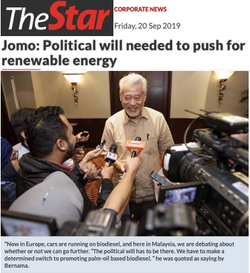
Political will needed to push for renewable energy

The Star 10July 2019

The Star 10July 2019

Malaysian businesses need boost

The Star 9 Oct 2019

The Star 9 Oct 2019

Subsidise public transport for bottom 40%

The Edge 26 Sept 2019

The Edge 26 Sept 2019

Call for measures to counteract global headwinds

The Edge 9 Oct 2019

The Edge 9 Oct 2019

Subsidise public transportation, not fuel

The Star 8 Oct 2019

The Star 8 Oct 2019

Subsidise public transportation for bottom 70%

TheEdge 2Oct 2019

TheEdge 2Oct 2019

"We need to counteract downward forces"

Fake News

PLEASE BEWARE OF MISREPRESENTATIONS OF IMAGES OF JOMO

Commercial and political misrepresentation of his image attributing to him to things which he never said or misrepresenting things he may have said is being circulated on websites such as those posted here. 


You should also be warned, in case you are not already aware, of ‘click bait’ i.e. using such images simply to attract your interest, and then to download your online information for abuse for a variety of ends.

Please inform us and provide a screenshot and weblink to enable further action, which is incredibly difficult. 

Thank you for reading this and for your help and cooperation.

This has also been flagged on his official Facebook page


JKS image ad2.jpg
JKS image Bitcoin ad on  Facebook.jpg
JKS - Fake News 2.jpg
Contact Me
JKS - Fake News 3.jpg
JKS fake news 1.jpg

Contact Me

  • Facebook Social Icon
  • Twitter Social Icon

Thank you for reaching out!

bottom of page