top of page

Follow on Social Media

  • Facebook
  • Twitter
  • Screenshot 2022-09-18 at 5.20.40 PM

M'sia Developments
[on SubStack]

  • Screenshot 2022-09-18 at 5.20.40 PM

KUALA LUMPUR, Malaysia, Mar 31 2026 (IPS) - While media coverage of Iran’s restrictions on passage through the Hormuz Straits focuses on fuel prices, partial closure is also disrupting crucial fertiliser and other supplies, risking catastrophe for billions worldwide.


Hormuz chokepoint

Since the war began, only a few of the hundred or so vessels, previously passing through the narrow Straits of Hormuz daily, still do so.


Hormuz is not just a chokepoint on a shipping lane for oil and gas; it has strategic implications for fertiliser, helium, and other energy-intensive exports as well as for food and other imports to the region.

Higher energy costs affect most transportation and farming requirements, such as tilling and harvesting, as well as fertiliser supplies.

Wars, especially protracted ones, have lasting effects, including for agrifood systems. Without earlier investments, output elsewhere cannot be easily increased.

Alternative fertiliser supply sources are not readily available, especially as agro-ecological options have rarely been seriously pursued despite their proven viability.

As with renewable energy generation to reduce the need for petroleum imports, it is unclear whether the looming food crisis will accelerate the needed and feasible agro-ecological transition for enhanced food security.

Disrupted food supplies

Shipping delays and port congestion disrupt food supplies, trade and availability.


The Gulf’s populations, augmented by millions of migrant workers, have become reliant on food imports for wheat, rice, soy, sugar, cooking oil, meat, animal feed and more.

Many states have recently tried to improve their food security, expanding strategic reserves, investing in food agriculture and alternative supply routes.

Such measures have improved resilience but cannot address a prolonged blockade of the Persian Gulf. About 70% of the food for Saudi Arabia, Iraq and the Gulf emirates passes through Hormuz.

Replacing disrupted food imports for about 100 million people would require moving almost 100 million kilograms (kg) of food into the region daily by other means.

Supplying food to the Gulf region under blockade would require an unprecedented operation, possibly through contested airspace.

In 2024, the UN World Food Programme delivered about 7 million kg of food daily to 81 million people in 71 countries.

Weather-driven food shortages and price spikes triggered political instability in 2008 and 2010-11. With food systems worldwide increasingly vulnerable to climate shocks, food insecurity threatens regimes everywhere.


Fertilisers

Farmers worldwide need stable supplies of fertilisers and fuel.


The Iran war threatens to disrupt these supplies, so crucial to agricultural production. Staple crops like wheat, rice and maize rely heavily on fertilisers.


Iran, Qatar, Saudi Arabia, the Emirates and Bahrain all ship petroleum products through Hormuz, including a fifth of the world’s liquefied natural gas (LNG).


As LNG is key to producing many fertilisers, Gulf exports have become more significant, especially after the war cut Ukraine’s exports, and China and Russia reduced theirs as well.


In 2024, the Middle East accounted for almost 30% of major fertiliser exports, including nitrogen, phosphate and potash.


The Gulf alone exported 23% of the world’s ammonia and 34% of its urea, while 30-40% of the world’s nitrogen fertiliser exports pass through Hormuz!


In mid-2025, Kpler estimated that a Hormuz closure could reduce fertiliser supplies by 33%, with sulphur-based ones falling by 44% and urea by 30%.


Reduced nitrogen-based fertiliser exports would hurt major food exporters such as Brazil, the US, Thailand, and India, all heavily reliant on fertiliser imports. However, the impact of shortages may be delayed until imported stocks run out.


As the war drags on, farmers may cut fertiliser use by planting less or switching to crops requiring less. Poorer harvests would, in turn, adversely affect later investment, planting and fertiliser use.


Who suffers most?

The economic consequences of the unprovoked US-Israeli assault on Iran and Tehran’s responses are spreading fast and catastrophically, especially for the most vulnerable.


Iran’s new leadership mistrusts Washington and will keep Hormuz closed – choking fuel, food, and fertiliser flows through it – to secure the guarantees it needs to reduce its vulnerability.


As attacks on Iran continued, Tehran stepped up targeted attacks on infrastructure in the Gulf kingdoms hosting US military facilities. US-led efforts have provided little relief to its allies.


The worldwide impact is uneven, with the poorest taking the brunt. Asia and Africa have been hard hit by heavy reliance on oil, gas, and fertiliser imports.


Rich nations’ aid cuts to increase military spending have worsened poverty and hunger for millions, many of whom are also victims of war and aggression.


Unlike the rich, many migrant workers in the Gulf who cannot leave will struggle to make ends meet and send money home to their families.


And as the world’s attention has turned to the Gulf, Israel has worsened conditions in Gaza while taking over southern Lebanon and increasing Yemen’s pain.


Concerned about retribution in November’s mid-term elections, the White House is keen on a ceasefire.


But it has not offered terms acceptable to Iran, which remains suspicious of the US commitment to its own promises, let alone the rule of law.


Hence, the Iranian leadership is unlikely to agree to a ceasefire without credible guarantees for its future security from renewed Israeli and US aggression.


The Iran war has highlighted, yet again, the collateral damage of war and the food system’s vulnerability. Meanwhile, the suffering of the more vulnerable is ignored by the greater powers, who pay little heed to their plight.


Related IPS Articles


ZAMBOANGA, Philippines, Feb 10 2026 (IPS) - Despite lacking both evidence and theory, many economists claim trade liberalisation accelerates development. But only a few economies have gained many jobs from external market access.


Instead, most economies have experienced greater deindustrialisation and food insecurity, besides deepening their vulnerability to recent tariff threats.


Multilateral trade liberalisation

In conventional trade theory, gains from trade liberalisation are mainly one-time increases in output and exports due to static comparative advantage.

Post-World War Two (WWII) US foreign policy transformed multilateral relations and transnational institutions, including international economic governance.

With the growing power of transnational corporations, many multilateral institutions, including the United Nations system, have been reconfigured or marginalised.

The General Agreement on Tariffs and Trade (GATT) was a ‘second-bestcompromise after the US Congress vetoed the creation of the International Trade Organisation, despite widespread international enthusiasm for the 1948 Havana Charter.

Almost half a century later, the World Trade Organisation (WTO) was established in 1995, following the 1994 Marrakesh Declaration concluding the Uruguay Round of GATT negotiations.

Trade mahaguru Jagdish Bhagwati argued that multilateral trade has been undermined by plurilateral and bilateral arrangements favouring dominant partners.


With the era of trade liberalisation essentially over since the 2008-09 global financial crisis (GFC), free trade advocacy has received a new lease of life from mythmaking about the ‘pre-Trump’ era.


Uneven, mixed effects

Mainstream trade theory does not entertain the possibility of ‘unequal exchange’, however defined.


Nor does it even incorporate Bhagwati’s notion of ‘immiserising growth’ when productivity gains reduce prices for consumers, rather than increase producers’ earnings.


The three decades of trade liberalisation from the 1980s saw slower, but more volatile growth than the post-WWII quarter-century termed the ‘Golden Age’. More recently, stagnationist tendencies have dominated since the GFC.


With trade liberalisation, many developing countries have experienced greater food insecurity and deindustrialisation, as the manufacturing shares of their national income shrank.


Much import-substituting industrialisation after WWII or independence has since collapsed. Besides resource processing, very few new industries have emerged in Africa.


‘Aid for Trade’ for poorer developing countries implicitly acknowledges trade liberalisation’s adverse effects by mitigating some of them. Why then should they abandon protectionism if they need to be compensated for doing so?


Wealthy nations have also insisted that developing countries end manufacturing tariffs. But as Dani Rodrik has quipped, why rich nations “need to be bribed by poor countries to do what is good for them is an enduring mystery”.


African nations and Caribbean and Pacific small island developing states enjoyed preferential access to European markets, which full multilateral trade liberalisation would eliminate.


Such preferences for Sub-Saharan Africa have pitted African against Asian least developed countries, undermining the collective negotiating strengths of both.


Many countries had expected the current Doha Round to eliminate rich nations’ producer subsidies, tariffs, and non-tariff barriers, but that has not happened.


Cutting farm support in the North could make food agriculture in developing countries more viable, but would also raise food import prices in the interim.


World Bank ‘structural adjustment’ programmes and IMF fiscal discipline requirements have undermined rural infrastructure and productivity, setting back smallholder agriculture in most developing countries.


Setbacks, not gains

Trade liberalisation also reduces tariff revenue. Such losses have hurt developing nations, especially the poorest, for whom tariffs often accounted for up to half of all tax revenue.


Such revenue cuts severely undermined the fiscal means of developing nations, crucial for government spending and investment, including for development and welfare.


Most governments are unable to replace lost tariff revenue with new or higher taxes. Meanwhile, more borrowing to offset lost tariff revenue has worsened indebtedness.


Trade liberalisation advocates are typically vague about how it is supposed to raise exports, incomes, and tax revenue, besides compensating for lost tariff revenue.


Instead, tax burdens typically become more regressive as overall tax revenue declines. Real consumption is supposed to rise as import prices fall with lower tariffs, but could also decline due to increasing consumption taxes.


Less policy space

Trade liberalisation has also reduced available development policy tools, especially those relating to trade, investment, and industrialisation.


The constraints imposed by trade liberalisation and investment agreements have generally limited the scope for and potential of development policy initiatives.


The actual role and impact of trade policy for growth and employment remain moot. But there are no analytical reasons or robust empirical evidence that trade liberalisation per se ensures sustainable development.


World Bank and most other studies acknowledged modest, if not negative, net gains for most developing countries from any realistically achievable outcome.


It is often ignored that realistic expectations of gains from trade liberalisation rely crucially on a strong positive export supply response.


However, such a response is unlikely when internationally competitive, productive and export capacities do not already exist, as in most developing countries, especially the poorest.


Hence, most of the Global South has not been able to overcome the worst consequences of trade liberalisation to achieve sustainable development.


In any case, the WTO Doha Round talks were ended by rich nations in 2015.


With the increasingly blatant self-interested contravention of WTO rules by the US, European and other wealthy nations, developing countries may best enhance their development prospects by reverting to GATT rules.


This would allow them to opt in, as appropriate, rather than resign themselves to the uniform ‘one size fits all’ WTO rules and regulations, regardless of context, circumstances, capacities and capabilities.


Related IPS Articles


Admin's note: This is a corrected version of the article, which originally appeared on IPS on 29 July here.


KUALA LUMPUR, Malaysia, Jul 29 2025 (IPS) - US President Trump has successfully used tariff threats to achieve economic, political and even personal goals. These threats, reminiscent of colonialism, have secured submission and concessions.


Indonesian template?

After hearing the 2024 US election results, Indonesian President Prabowo Subianto respectfully stood up in his Jakarta office to call to congratulate the winner.


Trump bragged about his tariff offer to Indonesia in mid-July 2025, profusely flattering its president. After initially hesitating, former General Prabowo agreed to join BRICS despite Trump’s clear disapproval.


“I spoke to their really great president, very popular, very strong, smart. And we made the deal. We will pay no tariffs … they are giving us access to Indonesia … the other part is they are going to pay 19% and we are going to pay nothing.”


An Indian commentator noted, “Those words say it all. This deal is clearly one-sided, and it should bother the whole world.” Americans, not Indonesians, will pay tariffs on imports from Indonesia.


The US is Indonesia’s second-largest export market, importing apparel, palm oil, footwear, and cosmetics. Initially, Trump had threatened a 32% tariff on such imports.


This has been reduced to 19%, still almost four times more than last year! In 2024, Indonesian exports to the US were taxed at 5% on average. The Indonesian president has not complained but instead seemed relieved.


Indonesia will lose not only exports, but also growth and jobs. As Trump loves to brag, he added insult to injury as he could not resist reiterating: “They will pay 19%, and we will pay nothing.”


Guaranteed sales

Indonesia will also buy $15 billion of US oil and gas, $4.5 billion of farm produce, and 50 Boeing jets. But the 2019 Lion Air plane tragedy, which the US plane manufacturer quickly blamed on Indonesian pilots, is still alive in the national memory.


Boeing’s reputation worldwide has not recovered from the investigation into the Nairobi air crash involving the same plane model, which led to its grounding.


Indonesia is among the US’s top 25 trade partners. The deal secures American access to the Indonesian market, allowing US goods to be sold tariff-free.


Last year, Indonesia shipped $28 billion worth of goods to the US. Higher tariffs are now expected to cut Indonesian exports by a quarter, GDP growth by 0.3%, and many jobs!


Other Southeast Asian lessons?

The Philippines’ Marcos II government is the most pro-US in Southeast (SE) Asia, hosting 11 American military bases.

Yet it was the only one without a US tariff offer before Secretary of State Rubio’s SE Asian visit earlier this month. The Philippines has since been offered a new US trade deal with the same 19% tariff rate despite its loyalty to Washington.


Loyal long-term support for the US, 11 military bases and serving as an additional ‘unsinkable aircraft carrier’ just south of Taiwan did not secure a better trade deal for the other archipelagic nation in SE Asia.


Trump wants trade deals even more favourable to the US than existing ones. With deadlines passing, the US is expected to announce more trade deals.


The tariff threats have been more effective for Trump, thanks to decades of trade liberalisation forced on the Global South, undermining earlier import-substituting industrialisation and food security measures.


Washington has already revised earlier demands, sometimes not just once, but typically to the chagrin of US trade partners. Vietnam’s Communist Party leader was initially thought to have negotiated a better deal than other SE Asian governments.


Lessons for others?

Will the US offer to Indonesia become a template for others? Or even for countries of comparable significance in the world economy? Nobody knows Trump’s strategy, let alone how it may still change.


Perhaps it begins with the threat of high tariffs, shock and awe. Then, a less painful deal is offered, dressed up as a concession.


This may be worse than the status quo ante, but it still seems preferable to the original threat. Nations will also be required to buy US goods that may not be needed or offer the best value for money.


Thus, US offers to SE Asia are being studied worldwide for lessons on better negotiating with Washington. Meanwhile, the US refuses to negotiate collectively except with the European Union.


All over the world, policymakers will continue to debate Trump’s tariff war strategy after Monday’s agreement in Scotland, which included a 15% baseline tariff on most EU exports to the US.


The US-EU deal makes clear the West, including Europe, has never really been committed to a rules-based international order, including multilateral trade liberalisation.


As American buyers pay the tariffs, imported goods become more expensive. US trading partners will lose exports, related growth and jobs. This will mean less expansion, employment and exports worldwide, deepening stagnation.


Meanwhile, most SE Asian governments believe they have little choice but to continue negotiating with the US, which is driving them to others willing to engage them on more favourable, if not fairer, terms.


Related IPS Articles

·                   Trump Undresses Rival Trade Myths

·                   Trump Accord Sows Discord in US Empire

·                   Trump’s ‘Shock and Awe’ Tariffs

·                   Weaponizing Free Trade Agreements

·                   Trade, Currency War Weapons Double-Edged

·                   What’s different about Trump’s tariffs?

·                   Trump’s Trade War in Perspective


Latest Videos

All Videos

All Videos

AN URGENT CALL: A PEOPLE"S VACCINE AGAINST COVID-19

00:00
9 June 2020: IHD-ILO-ISLE Virtual Conference - Day 2

9 June 2020: IHD-ILO-ISLE Virtual Conference - Day 2

05:08:34
Learning in Governance in times of COVID-19

Learning in Governance in times of COVID-19

46:30
Beyond the Lockdown: Towards the ‘New Normal’

Beyond the Lockdown: Towards the ‘New Normal’

59:10

About Jomo

Jomo Kwame Sundaram is Research Adviser, Khazanah Research Institute, Fellow, Academy of Science, Malaysia, and Emeritus Professor, University of Malaya. Previously, he was UN Assistant Secretary-General for Economic Development, Assistant Director General, Food and Agriculture Organization (FAO), Founder-Chair, International Development Economics Associates (IDEAs) and President, Malaysian Social Science Association. 

In The Media

TheStar 26 June 2020

TheStar 26 June 2020

The Star 20 Sept 2019

The Star 20 Sept 2019

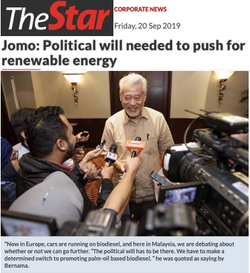
Political will needed to push for renewable energy

The Star 10July 2019

The Star 10July 2019

Malaysian businesses need boost

The Star 9 Oct 2019

The Star 9 Oct 2019

Subsidise public transport for bottom 40%

The Edge 26 Sept 2019

The Edge 26 Sept 2019

Call for measures to counteract global headwinds

The Edge 9 Oct 2019

The Edge 9 Oct 2019

Subsidise public transportation, not fuel

The Star 8 Oct 2019

The Star 8 Oct 2019

Subsidise public transportation for bottom 70%

TheEdge 2Oct 2019

TheEdge 2Oct 2019

"We need to counteract downward forces"

Fake News

PLEASE BEWARE OF MISREPRESENTATIONS OF IMAGES OF JOMO

Commercial and political misrepresentation of his image attributing to him to things which he never said or misrepresenting things he may have said is being circulated on websites such as those posted here. 


You should also be warned, in case you are not already aware, of ‘click bait’ i.e. using such images simply to attract your interest, and then to download your online information for abuse for a variety of ends.

Please inform us and provide a screenshot and weblink to enable further action, which is incredibly difficult. 

Thank you for reading this and for your help and cooperation.

This has also been flagged on his official Facebook page


JKS image ad2.jpg
JKS image Bitcoin ad on  Facebook.jpg
JKS - Fake News 2.jpg
Contact Me
JKS - Fake News 3.jpg
JKS fake news 1.jpg

Contact Me

  • Facebook Social Icon
  • Twitter Social Icon

Thank you for reaching out!

bottom of page