top of page

Follow on Social Media

  • Facebook
  • Twitter
  • Screenshot 2022-09-18 at 5.20.40 PM

M'sia Developments
[on SubStack]

  • Screenshot 2022-09-18 at 5.20.40 PM

ZAMBOANGA, Philippines, Feb 10 2026 (IPS) - Despite lacking both evidence and theory, many economists claim trade liberalisation accelerates development. But only a few economies have gained many jobs from external market access.


Instead, most economies have experienced greater deindustrialisation and food insecurity, besides deepening their vulnerability to recent tariff threats.


Multilateral trade liberalisation

In conventional trade theory, gains from trade liberalisation are mainly one-time increases in output and exports due to static comparative advantage.

Post-World War Two (WWII) US foreign policy transformed multilateral relations and transnational institutions, including international economic governance.

With the growing power of transnational corporations, many multilateral institutions, including the United Nations system, have been reconfigured or marginalised.

The General Agreement on Tariffs and Trade (GATT) was a ‘second-bestcompromise after the US Congress vetoed the creation of the International Trade Organisation, despite widespread international enthusiasm for the 1948 Havana Charter.

Almost half a century later, the World Trade Organisation (WTO) was established in 1995, following the 1994 Marrakesh Declaration concluding the Uruguay Round of GATT negotiations.

Trade mahaguru Jagdish Bhagwati argued that multilateral trade has been undermined by plurilateral and bilateral arrangements favouring dominant partners.


With the era of trade liberalisation essentially over since the 2008-09 global financial crisis (GFC), free trade advocacy has received a new lease of life from mythmaking about the ‘pre-Trump’ era.


Uneven, mixed effects

Mainstream trade theory does not entertain the possibility of ‘unequal exchange’, however defined.


Nor does it even incorporate Bhagwati’s notion of ‘immiserising growth’ when productivity gains reduce prices for consumers, rather than increase producers’ earnings.


The three decades of trade liberalisation from the 1980s saw slower, but more volatile growth than the post-WWII quarter-century termed the ‘Golden Age’. More recently, stagnationist tendencies have dominated since the GFC.


With trade liberalisation, many developing countries have experienced greater food insecurity and deindustrialisation, as the manufacturing shares of their national income shrank.


Much import-substituting industrialisation after WWII or independence has since collapsed. Besides resource processing, very few new industries have emerged in Africa.


‘Aid for Trade’ for poorer developing countries implicitly acknowledges trade liberalisation’s adverse effects by mitigating some of them. Why then should they abandon protectionism if they need to be compensated for doing so?


Wealthy nations have also insisted that developing countries end manufacturing tariffs. But as Dani Rodrik has quipped, why rich nations “need to be bribed by poor countries to do what is good for them is an enduring mystery”.


African nations and Caribbean and Pacific small island developing states enjoyed preferential access to European markets, which full multilateral trade liberalisation would eliminate.


Such preferences for Sub-Saharan Africa have pitted African against Asian least developed countries, undermining the collective negotiating strengths of both.


Many countries had expected the current Doha Round to eliminate rich nations’ producer subsidies, tariffs, and non-tariff barriers, but that has not happened.


Cutting farm support in the North could make food agriculture in developing countries more viable, but would also raise food import prices in the interim.


World Bank ‘structural adjustment’ programmes and IMF fiscal discipline requirements have undermined rural infrastructure and productivity, setting back smallholder agriculture in most developing countries.


Setbacks, not gains

Trade liberalisation also reduces tariff revenue. Such losses have hurt developing nations, especially the poorest, for whom tariffs often accounted for up to half of all tax revenue.


Such revenue cuts severely undermined the fiscal means of developing nations, crucial for government spending and investment, including for development and welfare.


Most governments are unable to replace lost tariff revenue with new or higher taxes. Meanwhile, more borrowing to offset lost tariff revenue has worsened indebtedness.


Trade liberalisation advocates are typically vague about how it is supposed to raise exports, incomes, and tax revenue, besides compensating for lost tariff revenue.


Instead, tax burdens typically become more regressive as overall tax revenue declines. Real consumption is supposed to rise as import prices fall with lower tariffs, but could also decline due to increasing consumption taxes.


Less policy space

Trade liberalisation has also reduced available development policy tools, especially those relating to trade, investment, and industrialisation.


The constraints imposed by trade liberalisation and investment agreements have generally limited the scope for and potential of development policy initiatives.


The actual role and impact of trade policy for growth and employment remain moot. But there are no analytical reasons or robust empirical evidence that trade liberalisation per se ensures sustainable development.


World Bank and most other studies acknowledged modest, if not negative, net gains for most developing countries from any realistically achievable outcome.


It is often ignored that realistic expectations of gains from trade liberalisation rely crucially on a strong positive export supply response.


However, such a response is unlikely when internationally competitive, productive and export capacities do not already exist, as in most developing countries, especially the poorest.


Hence, most of the Global South has not been able to overcome the worst consequences of trade liberalisation to achieve sustainable development.


In any case, the WTO Doha Round talks were ended by rich nations in 2015.


With the increasingly blatant self-interested contravention of WTO rules by the US, European and other wealthy nations, developing countries may best enhance their development prospects by reverting to GATT rules.


This would allow them to opt in, as appropriate, rather than resign themselves to the uniform ‘one size fits all’ WTO rules and regulations, regardless of context, circumstances, capacities and capabilities.


Related IPS Articles


JOHANNESBURG, South Africa, Oct 7 2025 (IPS) - The World Bank’s 1981 Berg Report provided the blueprint for structural adjustment, including economic liberalisation in Africa. Urging trade liberalisation, it promised growth from its supposed comparative advantage in agriculture.


Berg promises

Accelerated Development in Sub-Saharan Africa: A Plan for Action by Professor Elliot Berg blamed government interventions for blocking post-colonial African economic progress.


Removing ‘distortions’ caused by marketing boards and other state interventions and institutions was supposed to unleash export-led growth for Sub-Saharan African (SSA) producers.

However, despite the supposed comparative advantage and trade preferences, African agricultural exports have not grown significantly due to protection by wealthy nations.

By the turn of the century, Africa’s share of worldwide non-oil exports had declined to less than half of what it was in the early 1980s.

African agricultural output and export capacities have been undermined by decades of low investment, economic stagnation and neglect.

Significant public spending cuts accelerated the deterioration of existing infrastructure (roads, water supply, etc.), undermining potential ‘supply responses’.


However, high growth in East and South Asian economies boosted SSA mineral exports, often mined by foreign firms from the most significant economies in Asia.


Even the primary commodity price collapse from 2014 did not prevent Africa’s share of world exports from increasing.

Promises, promises

The 1994 Marrakech declaration, concluding the Uruguay Round of multilateral trade negotiations, created the World Trade Organisation (WTO) in 1995.

The new Doha Development Round of trade negotiations began in 2001, following the dramatic walkout by African trade ministers at the WTO Seattle ministerial conference in 1999.

The Public Health Exception to the WTO’s onerous new intellectual property rules alleviated this concern but was ignored during the deadly COVID-19 pandemic.

Developing countries were projected to gain US$16 billion in the most likely scenario, according to a 2005 World Bank study led by Kym Anderson, which estimated the likely effects of a Doha Round trade agreement.

However, various studies estimating the welfare effects of multilateral agricultural trade liberalisation – including Anderson et al. – suggest significant net losses, not gains, for SSA.


Gains from agricultural trade liberalisation would largely accrue to existing major agricultural exporters – mainly from the Cairns Group – not SSA.


Nevertheless, the World Bank and others continued to insist that trade liberalisation would benefit all developing countries, including SSA, although most studies indicated otherwise.


WTO trade rules have reduced the policy space for developing countries – especially in industrial, trade, or investment policy – although some claim that room for industrial policy remains.


African governments were told that a Doha Round deal would reduce agricultural subsidies, import tariffs and non-tariff barriers by rich nations, especially in Europe.


But the neglect of both physical and economic infrastructure over two decades of structural adjustment programmes left little effective capacity to respond to new export opportunities.


Worse still, trade liberalisation of manufactured goods also undermined nascent African industrialisation.


African market access to rich, mainly European, markets was secured through negotiated preferential agreements, rather than trade liberalisation. Hence, further multilateral trade liberalisation would erode these modest gains.


Additionally, most African governments – particularly those of poorer economies with limited government capacities – were unable to replace lost tariff revenues with new taxes.


African losses foretold

What was Africa expected to gain from a Doha Round deal?


Thandika Mkandawire warned the WTO trade regime would make Africa worse off, especially without preferential treatment from the European Union under the Lomé Convention.


Anderson et al. claimed SSA would gain substantially as “farm employment, the real value of agricultural output and exports, the real returns to farm land and unskilled labor, and real net farm incomes would all rise substantially in capital scarce SSA countries with a move to free merchandise trade”.


To be sure, the modest gains from trade liberalisation would be ‘one-time’ improvements projected by the models used.

Anderson et al. claimed that SSA, excluding South Africa, would gain US$3.5 billion, compared to roughly US$550 billion worldwide.


These projected gains of less than one per cent of its 2007 output were nonetheless much more than the tenth of one per cent for all developing countries!


World Bank structural adjustment programmes undermined the limited competitiveness of African smallholder agriculture. However, their projections ignored the reasons why African food agriculture declined after the 1970s.


Meanwhile, the agricultural exports of wealthy nations have benefited from higher production subsidies, which more than offset lower export subsidies. However, reducing agricultural subsidies would likely lead to higher prices of imported food.


Uneven effects

Uneven and partial trade liberalisation and subsidy reduction will have mixed implications. These effects vary with national conditions, including food imports and share of consumer spending.


Earlier estimates for all developing countries obscured the likely impacts of trade liberalisation on Africa. The one-time welfare improvement for SSA, excluding most of Southern Africa, would be three-fifths of one per cent by 2015!


With deindustrialisation accelerated by structural adjustment, Sandra Polaski estimated that SSA, excluding South Africa, would lose US$122 billion from Doha Round trade liberalisation.


Although former World Bank economists agreed the lost decades were due to Bank structural adjustment programmes, these were reimposed a decade ago.


SSA, excluding South Africa, would lose US$106 billion to agricultural trade liberalisation. Poor infrastructure, export capacities and competitiveness in both SSA industry and agriculture were responsible.


Most of the poorest and least developed SSA countries were likely to be worse off in all ‘realistic’ Doha Round outcome scenarios.


With more realistic model assumptions – e.g., allowing for unemployment – Lance Taylor and Rudiger von Arnim found SSA would not gain, on balance, from trade liberalisation.


Mainstream international trade theory cannot justify trade liberalisation for SSA. Worse, ‘new trade theories’ and evolutionary studies of technological development suggest trade liberalisation would permanently slow growth.


Export growth?

As economic growth typically precedes export expansion, trade can foster a virtuous circle but cannot trigger it.


Specifically, a weak investment-export nexus hinders export expansion and diversification, as rapid resource reallocation is unlikely without high investment and sustained growth.


Citing the World Bank, Mkandawire noted Africa’s export collapse in the 1980s and 1990s meant “a staggering annual income loss of US$68 billion – or 21 per cent of regional GDP”!


For Dani Rodrik, Africa’s ‘marginalisation’ was not due to its trade performance, although poor by international standards. Gerald Helleiner has emphasised, “Africa’s failures have been developmental, not export failure per se”.


With its geography and income, Africa probably trades as much as can be expected. Indeed, “Africa overtrades compared with other developing regions in the sense that its trade is higher than would be expected from the various determinants of bilateral trade”!


Vulnerable Africa

The Doha Round of WTO negotiations effectively ended over a decade ago as the backlash in wealthy nations – against globalisation and its consequences – gained momentum.


Meanwhile, trade liberalisation – as part of structural adjustment programmes – deepened SSA deindustrialisation and food insecurity.


With Africa unevenly integrated by economic globalisation, most of the continent exports little to the USA, making it less of a target of Trump’s tariffs.


Nevertheless, trade liberalisation has made developing economies more vulnerable to and unprotected from the recent weaponisation of tariffs and other economic measures.


Last month’s expiration of the African Growth and Opportunity Act (AGOA) prompted some African leaders to scramble for an extension.


US AGOA imports in 2023 totalled US$10 billion, accounting for high shares of some countries’ exports. Tariff imposition will exacerbate problems due to AGOA’s demise.


Meanwhile, there have been great expectations for the African Continental Free Trade Area (AfCFTA). Still, regional trade integration may not be very beneficial, as SSA exports are more competitive than complementary.


K. Kuhaneetha Bai studied at the University of Malaya and does policy research at Khazanah Research Institute.


Related IPS Articles


Latest Videos

All Videos

All Videos

AN URGENT CALL: A PEOPLE"S VACCINE AGAINST COVID-19

00:00
9 June 2020: IHD-ILO-ISLE Virtual Conference - Day 2

9 June 2020: IHD-ILO-ISLE Virtual Conference - Day 2

05:08:34
Learning in Governance in times of COVID-19

Learning in Governance in times of COVID-19

46:30
Beyond the Lockdown: Towards the ‘New Normal’

Beyond the Lockdown: Towards the ‘New Normal’

59:10

About Jomo

Jomo Kwame Sundaram is Research Adviser, Khazanah Research Institute, Fellow, Academy of Science, Malaysia, and Emeritus Professor, University of Malaya. Previously, he was UN Assistant Secretary-General for Economic Development, Assistant Director General, Food and Agriculture Organization (FAO), Founder-Chair, International Development Economics Associates (IDEAs) and President, Malaysian Social Science Association. 

In The Media

TheStar 26 June 2020

TheStar 26 June 2020

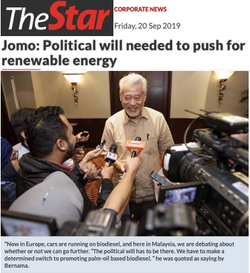
The Star 20 Sept 2019

The Star 20 Sept 2019

Political will needed to push for renewable energy

The Star 10July 2019

The Star 10July 2019

Malaysian businesses need boost

The Star 9 Oct 2019

The Star 9 Oct 2019

Subsidise public transport for bottom 40%

The Edge 26 Sept 2019

The Edge 26 Sept 2019

Call for measures to counteract global headwinds

The Edge 9 Oct 2019

The Edge 9 Oct 2019

Subsidise public transportation, not fuel

The Star 8 Oct 2019

The Star 8 Oct 2019

Subsidise public transportation for bottom 70%

TheEdge 2Oct 2019

TheEdge 2Oct 2019

"We need to counteract downward forces"

Fake News

PLEASE BEWARE OF MISREPRESENTATIONS OF IMAGES OF JOMO

Commercial and political misrepresentation of his image attributing to him to things which he never said or misrepresenting things he may have said is being circulated on websites such as those posted here. 


You should also be warned, in case you are not already aware, of ‘click bait’ i.e. using such images simply to attract your interest, and then to download your online information for abuse for a variety of ends.

Please inform us and provide a screenshot and weblink to enable further action, which is incredibly difficult. 

Thank you for reading this and for your help and cooperation.

This has also been flagged on his official Facebook page


JKS image ad2.jpg
JKS image Bitcoin ad on  Facebook.jpg
JKS - Fake News 2.jpg
Contact Me
JKS - Fake News 3.jpg
JKS fake news 1.jpg

Contact Me

  • Facebook Social Icon
  • Twitter Social Icon

Thank you for reaching out!

bottom of page