top of page

Follow on Social Media

  • Facebook
  • Twitter
  • Screenshot 2022-09-18 at 5.20.40 PM

M'sia Developments
[on SubStack]

  • Screenshot 2022-09-18 at 5.20.40 PM
  • Jul 24, 2024
  • 4 min read

KUALA LUMPUR, Malaysia, Jul 24 2024 (IPS) - Many low-income countries (LICs) continue to slip further behind the rest of the world. Meanwhile, people in extreme poverty have been increasing again after decades of decline.


Falling further behind


World output more than doubled from $36 trillion in 1990 to $87 trillion by 2021 (in constant US dollars), but this growth has not been evenly distributed, causing most LICs to fall further behind.


Many of the world’s poorest economies have had meagre growth since the 1960s. As most developing countries have made progress, income gaps among nations have declined.


World economic stagnation adversely affects most countries and people, especially developing countries relying on commodity demand and prices. As much of the world grew, most LICs fell further behind.


Hundreds of millions are stuck in extreme poverty, with incomes per capita in many post-colonial countries barely changing. A World Bank paper argues the poor are especially worse off.


Many poor nations have not caught up, let alone diversified their colonial-type economies. Meanwhile, many poor nations remain mired in conflict, deepening their stagnation.


Poverty has risen due to poor progress as populations grew. Another World Bank report found lower growth correlated with conflict deaths and institutional fragility. Unsurprisingly, these countries often had the world’s highest poverty rates.

Worse, global warming disproportionately harms poor tropical nations and their populations much more. Climate change is expected to push well over a hundred million into extreme poverty by 2030.


Left behind

Paper co-author Paul Collier identified 58 countries in Africa, Asia and Latin America, with about 1.4 billion people in 2021, as the ‘Bottom Billion’. Collier argues most still face problems and have failed to progress since.


These nations have long suffered from persistent poverty, low growth, and failure to develop. Their plight has been exacerbated by civil conflict, geographic constraints, and, often, the inability to use their natural resources to accelerate economic development.


Since the 1980s – not the 1960s and 1970s, as the Bank paper claims – the Bottom Billion countries have failed to grow, falling behind instead. By contrast, the few former LICs that sustained high growth now enjoy per capita outputs at least thrice that of other Bottom Billion countries.


Except for these few notable exceptions, most of the 58 Bottom Billion countries remain LICs or have become lower-middle-income countries. Only six have achieved upper-middle-income country status in the past decade, mainly due to rapid growth thanks to oil and gas.


Although the Bottom Billion countries exist in all regions, about two-thirds (38 of 58) are in SSA. They account for 77% of the Bottom Billion population. Over half have abundant natural resources, but most have not used their mineral wealth to sustain economic progress.


In 2012, the IMF classified 34 of the 58 Bottom Billion countries as ‘resource-rich’, with non-renewable resource exports and revenue often exceeding 20% of their total exports and government revenue, respectively. But most still experience lacklustre growth, if any.


Since 1990, Sub-Saharan Africa (SSA) averaged barely 0.8% annual per capita income growth. Meanwhile, global growth rates doubled as regions like East Asia registered more than 6% yearly per capita growth rates.


Anaemic growth meant that the average incomes of Africans and other slow-growing LICs slipped further behind the rest of the world. Using the World Bank’s global poverty line, the number of poor Africans grew by tens of millions.

If current growth and poverty trends persist, many slow-growing or stagnant LICs, mainly in Africa, will be unable to end extreme poverty, let alone catch up with the rest of the world.


Poorest worst off


Conventional growth models imply that countries lagging behind should grow faster than those already ahead. East Asian industrialisation – supposedly emulating earlier European growth – supports this notion.


Growth in many LICs has slowed since the turn of the century. The paper finds that “The Bottom Billion fared worst of all”, as per capita output barely rose.


The poorest Bottom Billion did not experience convergence by catching up with the others. While some studies suggest overall income convergence, the world’s poorest are relatively worse off.


Now, the Bottom Billion are ‘falling behind’ while those in extreme poverty may be rising again. Incomes of the world’s poorest countries and people are likely to fall behind, even if only relatively, despite some convergence among countries.

The situation has worsened since 2022. In addition to the commodity-price collapse since 2015, the COVID-19 pandemic, the Ukraine and Gaza wars, and geopolitically driven unilateral sanctions have ensured protracted stagnation.

Bottom Billion countries lack the policy and fiscal space to cope with, let alone address, the impending debt crises. The situation has been exacerbated by tighter credit with high interest rates set by the US Fed.


Despite decades of recognising LIC characteristics, the World Bank has yet to develop strategies, policies and means to overcome their poverty. It is unclear why the Bank has endorsed the Bottom Billion designation, although it has not enhanced our understanding of poverty.


Related IPS Articles

·                   Land Grabs Squeeze Rural Poor Worldwide

·                   Chronicle of a Catastrophe Foretold

·                   Global South Stagnating under Heavier Debt Burden

·                   Onerous Debt Making Poorest Poorer

·                   Rich Nations, IMF Deepen World Stagnation

·                   Out of Africa: Rich Continent, Poor People

·                   Neoliberal Finance Undermines Poor Countries’ Recovery

·                   Poor Lives Matter, but Less

·                   Social Protection Necessary to Quickly End Poverty, Hunger


Available online here: More Poverty for the Poor


DAKAR and KUALA LUMPUR, Jun 20 2024 (IPS) - Developing country governments are being blamed for irresponsibly borrowing too much. The resulting debt stress has blocked investments and growth in this unequal and unfair world economic order.


Money as debt


Myths about public debt are legion. The most pernicious see governments as households. Hence, a ‘responsible’ government must try to run a surplus like an exemplary household head or balance its budget.


This analogy is simplistic, unfounded and misleading. It ignores the fact that governments and households are not equivalent monetary entities. Unlike households, most national governments issue their currencies.


As currency is widely used for economic transactions, government debt and liabilities influence households’ and businesses’ earnings and wealth accumulation.


The standard analogy also ignores principles of double-entry bookkeeping, as one entity’s expenditure is another’s income, one entity’s debit is another’s credit, and so on. The government deficit equals the surplus of the non-government sector, which includes households, businesses, and the ‘rest of the world’.


Thus, when a government budget is in deficit – spending exceeds revenue – the government has created net financial wealth for the non-government sector. Government deficits, therefore, increase private savings and the money supply.

Since only the government issues the national currency, its spending does not ‘crowd out’ private-sector spending but complements it. As the currency is debt issued by the state, no money would be left in an economy if the government paid off all its debt!


Hence, media hysteria about public debt is unjustified. Instead, attention should be paid to the macroeconomic and distributive impacts of public spending. For example, will it generate inflation or negatively impact the balance of payments? Who would benefit or lose?


Debt-to-GDP ratio useless


Another widespread myth maintains that public debt beyond a certain level is not sustainable or negatively impacts economic growth. Allegedly supportive studies have been discredited many times, including by IMF research. Yet, the myth persists.


Mimicking eurozone criteria, many West African governments have set policy targets, including public deficits of less than 3% of GDP and debt-to-GDP ratios of less than 70%.


The debt-to-GDP ratio undoubtedly shows relative levels of indebtedness. But otherwise, this ratio has no analytical utility. After all, public debt is a ‘stock’, whereas GDP or output is a ‘flow’.


Suppose a country has an annual income of $100 and zero debt. Suppose its government issues debt of $50 over 25 years, with annual repayments of $2. Its public debt-to-GDP ratio will suddenly increase by 50%.


This poses no problem as GDP will likely increase thanks to increased investments while repaying the $50 debt. With an annual economic growth rate averaging 3%, GDP will more than double over this period.


Second, public debt is always sustainable when issued and held in domestic currency, and the central bank controls interest rates.


With a debt-to-GDP ratio of 254%, the Japanese government will never lack the means to pay off its debt. Unlike developing countries that take on foreign currency debt at rates they do not control, it will always be solvent. Thus, Peru defaulted in 2022 with a debt-to-GDP ratio of 33.9%!


Monetary ‘Berlin Wall’


Thus, there is a significant difference between the governments of the North – mainly indebted in their own currencies – and those in the South, whose debt is at least partly denominated in foreign currencies.


But governments in the South are not indebted in foreign currencies due to inadequate savings.


They can always finance any spending requiring local resources, including labour, land, equipment, etc. Objectively, no country issuing currency can lack ‘financing’ for what it has the technical and material capacity to do.


The chronic indebtedness of most developing countries and the ensuing crises are thus manifestations of the international economic and financial system’s unequal and unfair nature.


Global South countries have been required to accumulate ‘hard currencies’ – typically dollars – to transact internationally. This monetary ‘Berlin Wall’ separates two types of developing countries.


First, net exporting countries that accumulate ‘enough’ dollars usually invest in low-yielding US Treasury bonds, allowing the US to import goods and services virtually free.


Second, those which do not earn ‘enough’ hard currencies resort to transnational finance, typically increasing their foreign indebtedness. Most eventually have to turn to the IMF for emergency relief, inadvertently deepening their predicament.


However, as they have to cope with prohibitive terms and conditions for access to emergency foreign financing, it is difficult to escape these external debt traps.


Paradoxically, countries of the South with chronic dollar deficits are often rich in natural resources. Bretton Woods institutions typically demand protracted fiscal austerity and economic denationalisation, undermining developing countries’ chances of getting fair returns for their resources and labour.


Abuses and mismanagement may aggravate Global South governments’ indebtedness in foreign currencies, but these should always be understood in the context of the unequal world economic and financial order.


Related IPS Articles

·                   Developing Countries’ Government Debt Crises Loom Larger

·                   Global South Stagnating under Heavier Debt Burden

·                   Onerous Debt Making Poorest Poorer

·                   Debt-Pushing as Financial Inclusion

·                   Inflation Phobia Hastens Recessions, Debt Crises


KUALA LUMPUR, Malaysia, Jun 17 2024 (IPS) - Since 2008, farmland acquisitions have doubled prices worldwide, squeezing family farmers and other poor rural communities. Such land grabs are worsening inequality, poverty, and food insecurity.


Squeezing land and farmersnew IPES-Food report highlights land grabs (including for ostensibly ‘green’ purposes), the financial means used, and some significant implications.


Powerful governments, financiers, speculators, and agribusinesses are opportunistically gaining control of more cultivable land. The report notes the 2007-08 food price spike and financial crash catalysed more land acquisitions.

Quantitative easing and financialization after the 2008 global financial crisis enabled even more land grabs. Investors, agri-food companies, and even sovereign wealth funds have obtained farmland worldwide.


Agribusinesses and other investors want land to make more profits, urging governments to enable takeovers. Cultivable land is being used for cash crops, natural resource extraction, mining, real property and infrastructure development, and ‘green’ projects, including biofuels.


The land squeeze has developed in novel ways, with most large-scale deals diverting farmland from food production. Instead, environmentally damaging ‘industrial agriculture’ has spread, worsening rural poverty and outmigration.

The new land rush has displaced small-scale farmers, indigenous peoples, pastoralists, and rural communities or otherwise eroded their access to land. It has worsened rural poverty, food insecurity, and land inequality. Marginalising local land users has made family farming less viable.


‘Green grabs’ involve governments and corporations taking land for dubious large-scale tree planting, biodiversity offsets, carbon sequestration, conservation, biofuels, and ‘green hydrogen’ projects. Water and other resource demands also threaten food production.


The land rush has slowed recently, but underlying pressures and trends continue. The pandemic, Ukraine and Gaza wars, and government and market responses have revived alarmist ‘food shortage’ narratives, justifying more grabs.


Investing in dispossession


Agricultural investments rose tenfold during 2005-18. By 2023, 960 investment funds specialising in food and farming assets had properties worth over $150 billion.


Nearly 45% of all farmland investments in 2018, worth $15 billion, were by pension funds and insurance companies. During 2005-17, pension, insurance and endowment funds invested $45 billion in farmland.


Unsurprisingly, land prices have risen continuously for two decades in North America and three in Canada. During 2008-22, land prices nearly doubled worldwide, even tripling in Central and Eastern Europe!


Pension funds and other private investments doubled UK farmland prices during 2010-15. More recently, investments in US farmland have doubled since the pandemic!


The largest one per cent of farms worldwide now have 70% of farmland. In Latin America, 55% of farms only have 3% of farmland!


More than half the farmland thus obtained is for water-demanding crop production. While a fifth of large-scale land deals claim to be ‘green’, 87% are in areas of high biodiversity!


Mining accounted for 14% of large-scale land deals over the past decade.Growing demand for rare earths and other critical minerals is driving mining on former farmland, worsening environmental degradation and conflicts.


Instead of protecting national, social or community interests, regulations seem to protect the culprits. The terms of such deals often make things worse. Thus, foreign corporations successfully sued the Colombian government for trying to stop their large-scale mining project.


Green land grabs


Some governments and big businesses advocate compliance with environmental, social and governance (ESG) standards. They invoke sustainability, including climate goals, to justify elitist conservation and carbon offset schemes.

Over half of government carbon removal pledges involve the land of small-scale farmers and indigenous peoples. ‘Green grabs’ – for carbon offsets, biodiversity, conservation and biofuel projects – account for a fifth of large-scale land deals.

Government pledges to absorb carbon dioxide into the land surface commit almost 1.2 billion hectares, equivalent to the world’s cropland area! Despite modest climate benefits, problematic carbon offset markets are expected to quadruple over the next seven years, driving even more land grabs.


Carbon offset and biodiversity markets drive such transactions, drawing major polluters into land markets. Oil giant Shell alone has committed over $450 million for offset projects.


African land grabbed


The land squeeze is worldwide, affecting various places differently. Land grabs have significantly affected Sub-Saharan Africa and Latin America, while land inequality grows in Central and Eastern Europe, Latin America, and South Asia.

Susan Chomba and Million Belay found almost a thousand large-scale land deals in Africa since 2000. Mozambique had 110 such deals, followed by Ethiopia, Cameroon, and the Democratic Republic of Congo (DRC).


Some 25 million hectares involve Blue Carbon, run by a Dubai royal. The company has bought rights to forests and farmland to sell carbon offsets. The land is from five Anglophone African governments, involving a fifth of Zimbabwe, a tenth of Liberia, Kenya, Tanzania, and Zambia.


Large-scale land deals put indigenous and pastoralist communities at greater risk. In Ethiopia, Ghana, and elsewhere, land sales have forced farmers to work on smaller fragmented plots, become wage labourers, or migrate, undermining their ability to feed themselves, their communities and others.


African smallholders, pastoralists, and indigenous communities have long protected their land and biodiversity. However, most now lack the rights and means to do so more effectively, let alone feed Africa and improve climate action. Thus, the climate crisis is being used against rural African communities.


Related IPS Articles

·                   Peasants Marginalized by Big Farmers

·                   World Bank Dispossessing Rural Poor

·                   Hunger in Africa, Land of Plenty

·                   We Can Overcome Poverty and Hunger by 2030


Latest Videos

All Videos

All Videos

AN URGENT CALL: A PEOPLE"S VACCINE AGAINST COVID-19

00:00
9 June 2020: IHD-ILO-ISLE Virtual Conference - Day 2

9 June 2020: IHD-ILO-ISLE Virtual Conference - Day 2

05:08:34
Learning in Governance in times of COVID-19

Learning in Governance in times of COVID-19

46:30
Beyond the Lockdown: Towards the ‘New Normal’

Beyond the Lockdown: Towards the ‘New Normal’

59:10

About Jomo

Jomo Kwame Sundaram is Research Adviser, Khazanah Research Institute, Fellow, Academy of Science, Malaysia, and Emeritus Professor, University of Malaya. Previously, he was UN Assistant Secretary-General for Economic Development, Assistant Director General, Food and Agriculture Organization (FAO), Founder-Chair, International Development Economics Associates (IDEAs) and President, Malaysian Social Science Association. 

In The Media

TheStar 26 June 2020

TheStar 26 June 2020

The Star 20 Sept 2019

The Star 20 Sept 2019

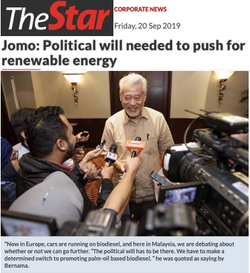
Political will needed to push for renewable energy

The Star 10July 2019

The Star 10July 2019

Malaysian businesses need boost

The Star 9 Oct 2019

The Star 9 Oct 2019

Subsidise public transport for bottom 40%

The Edge 26 Sept 2019

The Edge 26 Sept 2019

Call for measures to counteract global headwinds

The Edge 9 Oct 2019

The Edge 9 Oct 2019

Subsidise public transportation, not fuel

The Star 8 Oct 2019

The Star 8 Oct 2019

Subsidise public transportation for bottom 70%

TheEdge 2Oct 2019

TheEdge 2Oct 2019

"We need to counteract downward forces"

Fake News

PLEASE BEWARE OF MISREPRESENTATIONS OF IMAGES OF JOMO

Commercial and political misrepresentation of his image attributing to him to things which he never said or misrepresenting things he may have said is being circulated on websites such as those posted here. 


You should also be warned, in case you are not already aware, of ‘click bait’ i.e. using such images simply to attract your interest, and then to download your online information for abuse for a variety of ends.

Please inform us and provide a screenshot and weblink to enable further action, which is incredibly difficult. 

Thank you for reading this and for your help and cooperation.

This has also been flagged on his official Facebook page


JKS image ad2.jpg
JKS image Bitcoin ad on  Facebook.jpg
JKS - Fake News 2.jpg
Contact Me
JKS - Fake News 3.jpg
JKS fake news 1.jpg

Nadi Insan by the People's History Centre

Read all editions of #NadiInsan from 1979 to 1983 free of charge at the Peoples History Center website.


Containing writings on socio-political issues, film and cultural commentary, as well as in-depth interviews, Nadi Insan is motivated by community activists and intellectuals in Malaysia.

Happy reading!

Dapatkan kesemua siri majalah #NadiInsan dari tahun 1979 hingga 1983 secara percuma di laman Pusat Sejarah Rakyat.


Berisi tulisan memperihal sosio-politik, ulasan filem dan budaya sehinggalah wawancara yang rencam, Nadi Insan digerakkan oleh aktivis masyarakat dan intelektual di Malaysia.


Selamat membaca!

Contact Me

  • Facebook Social Icon
  • Twitter Social Icon

Thank you for reaching out!

bottom of page