top of page

Follow on Social Media

  • Facebook
  • Twitter
  • Screenshot 2022-09-18 at 5.20.40 PM

M'sia Developments
[on SubStack]

  • Screenshot 2022-09-18 at 5.20.40 PM

KUALA LUMPUR, Malaysia, Apr 14 2026 (IPS) - Trump 2.0 has been marked by the blatantly aggressive exercise of power to secure US interests as defined by him. While many recent trends even predate his first term, his reduced use of ‘soft power’ has exposed his bullying, extortionary use of US power.


Rule of law?

Trade liberalisation has been reversed for at least two decades. Almost all G20 developed nations raised trade barriers following the 2008-09 global, actually Western, financial crisis.

The US has illegally weaponised more laws and policies, especially by unilaterally imposing sanctions and tariffs, especially on dissenting regimes.

Often, such threats are not ends in themselves but actually weapons to strengthen the US bargaining position to secure more advantageous deals.

Under World Trade Organization (WTO) rules, members are obliged to extend ‘most favoured nation’ status to all other member nations.

On April 2, 2025, President Trump announced supposedly ‘reciprocal tariffs’, ostensibly responding to others having trade surpluses with the US.

Appealing to the WTO dispute settlement mechanism is futile, as the US has blocked the appointment of Appellate Body members since the Obama presidency.

Trump 2.0 has also been trying to get rich investors and governments – mainly from Europe, Japan, and the oil-rich Gulf states – to invest in the US.

Most such investments are in financial markets, rather than the real economy. Such portfolio investments have propped up asset prices, even bubbles.


Trump’s bullying is resented but has not been very effective vis-à-vis strong adversaries. Consequently, allies have been most affected and resentful.


Deepening stagflation

Meanwhile, much of the world economy has never really recovered from the COVID-19 slowdown, while Western sanctions and tariffs have raised production costs, worsening inflation.


Recent trends have also deepened the stagnation since 2009. Many governments and the IMF have made things worse by cutting spending when most needed.


Impacts have varied, generally worse in poorer countries, where the IMF limits policy options and credit rating agencies raise borrowing costs.


US Fed chair Powell’s interest rate hikes, ostensibly to address inflation, also reversed ‘quantitative easing’, which had lowered interest rates from 2009.


Trump’s aggression has reduced economic engagement with the US, inadvertently accelerating de-dollarisation, thus undermining the dollar’s ‘exorbitant privilege’.


Central banks worldwide have responded predictably, refusing to be counter-cyclical in the face of economic slowdown, citing inflationary pressures.


Transactional?

Trump’s transactional approach has meant bilateral, one-on-one dealings, further advantaging the world’s dominant power.


Involving one-time asymmetric ‘zero-sum games’, such transactions ensure the US gains, necessarily at the expense of the ‘other’. Transactionalism also enables ‘buying influence’, or corruption.


The resulting uncertainty reduces investments, not only in the US, but everywhere, due to greater perceived risks, exacerbating the stagnation. Thus, Trump 2.0 policies have reduced investment and growth.


The whole world, including the US, has suffered much ‘collateral damage’, but the White House seems content as long as others lose more.


Unipolar sovereigntism

The transitions to unipolar sovereigntism and then to a multipolar world have been much debated.


Three decades ago, the influential US Council on Foreign Relations’ journal, Foreign Affairs, argued that the post-Cold War unipolar world was actually ‘sovereigntist’.


NATO Secretary-General Mark Rutte’s ‘Daddy’ reference to Trump suggests that the sovereigntist moment is not quite over, as the US ‘No Kings’ mobilisation suggests.


Trump’s ‘America First’ clearly opposes multilateralism, generating broader concerns. He has withdrawn the US from many, but not all, multilateral bodies.


On January 7, the US withdrew from 66 international organisations deemed “wasteful, ineffective, or harmful”, addressing issues it claimed were “contrary” to national interests.


Trump’s continued, selective use of multilateral bodies has served him well, retaining privileges, e.g., permanent membership of the UN Security Council with veto power.


The UN Security Council’s Gaza ceasefire resolution was used to create and legitimise his Board of Peace, now touted by some as an alternative to the UN!


Trump will not withdraw from the WTO as its Trade-Related Intellectual Property Rights (TRIPS) agreement is key to US tech bros’ trillions from transnational IP.


End of soft power

Some of Canadian Prime Minister Mark Carney’s January 20th remarks at Davos are telling:


“More recently, great powers have begun using economic integration as weapons, tariffs as leverage. Financial infrastructure as coercion. Supply chains as vulnerabilities to be exploited.


“You cannot live within the lie of mutual benefit through integration when integration becomes the source of your subordination… If we are not at the table, we are on the menu.”


Besides exercising overwhelming military superiority, Trump 2.0 has increasingly weaponised rules, agreements and economic relations to its advantage.


The abandonment of ‘soft power’ – accelerated by Elon Musk’s DOGE – has ripped the velvet glove off US ‘hegemony’, exposing the mailed fist beneath.


USAID and other US government-funded agencies and programmes have been crucial for soft power, fostering the illusion of domination with consent. Abandoning soft power may well increase the costs of achieving America First.


Related IPS Articles


ZAMBOANGA, Philippines, Feb 10 2026 (IPS) - Despite lacking both evidence and theory, many economists claim trade liberalisation accelerates development. But only a few economies have gained many jobs from external market access.


Instead, most economies have experienced greater deindustrialisation and food insecurity, besides deepening their vulnerability to recent tariff threats.


Multilateral trade liberalisation

In conventional trade theory, gains from trade liberalisation are mainly one-time increases in output and exports due to static comparative advantage.

Post-World War Two (WWII) US foreign policy transformed multilateral relations and transnational institutions, including international economic governance.

With the growing power of transnational corporations, many multilateral institutions, including the United Nations system, have been reconfigured or marginalised.

The General Agreement on Tariffs and Trade (GATT) was a ‘second-bestcompromise after the US Congress vetoed the creation of the International Trade Organisation, despite widespread international enthusiasm for the 1948 Havana Charter.

Almost half a century later, the World Trade Organisation (WTO) was established in 1995, following the 1994 Marrakesh Declaration concluding the Uruguay Round of GATT negotiations.

Trade mahaguru Jagdish Bhagwati argued that multilateral trade has been undermined by plurilateral and bilateral arrangements favouring dominant partners.


With the era of trade liberalisation essentially over since the 2008-09 global financial crisis (GFC), free trade advocacy has received a new lease of life from mythmaking about the ‘pre-Trump’ era.


Uneven, mixed effects

Mainstream trade theory does not entertain the possibility of ‘unequal exchange’, however defined.


Nor does it even incorporate Bhagwati’s notion of ‘immiserising growth’ when productivity gains reduce prices for consumers, rather than increase producers’ earnings.


The three decades of trade liberalisation from the 1980s saw slower, but more volatile growth than the post-WWII quarter-century termed the ‘Golden Age’. More recently, stagnationist tendencies have dominated since the GFC.


With trade liberalisation, many developing countries have experienced greater food insecurity and deindustrialisation, as the manufacturing shares of their national income shrank.


Much import-substituting industrialisation after WWII or independence has since collapsed. Besides resource processing, very few new industries have emerged in Africa.


‘Aid for Trade’ for poorer developing countries implicitly acknowledges trade liberalisation’s adverse effects by mitigating some of them. Why then should they abandon protectionism if they need to be compensated for doing so?


Wealthy nations have also insisted that developing countries end manufacturing tariffs. But as Dani Rodrik has quipped, why rich nations “need to be bribed by poor countries to do what is good for them is an enduring mystery”.


African nations and Caribbean and Pacific small island developing states enjoyed preferential access to European markets, which full multilateral trade liberalisation would eliminate.


Such preferences for Sub-Saharan Africa have pitted African against Asian least developed countries, undermining the collective negotiating strengths of both.


Many countries had expected the current Doha Round to eliminate rich nations’ producer subsidies, tariffs, and non-tariff barriers, but that has not happened.


Cutting farm support in the North could make food agriculture in developing countries more viable, but would also raise food import prices in the interim.


World Bank ‘structural adjustment’ programmes and IMF fiscal discipline requirements have undermined rural infrastructure and productivity, setting back smallholder agriculture in most developing countries.


Setbacks, not gains

Trade liberalisation also reduces tariff revenue. Such losses have hurt developing nations, especially the poorest, for whom tariffs often accounted for up to half of all tax revenue.


Such revenue cuts severely undermined the fiscal means of developing nations, crucial for government spending and investment, including for development and welfare.


Most governments are unable to replace lost tariff revenue with new or higher taxes. Meanwhile, more borrowing to offset lost tariff revenue has worsened indebtedness.


Trade liberalisation advocates are typically vague about how it is supposed to raise exports, incomes, and tax revenue, besides compensating for lost tariff revenue.


Instead, tax burdens typically become more regressive as overall tax revenue declines. Real consumption is supposed to rise as import prices fall with lower tariffs, but could also decline due to increasing consumption taxes.


Less policy space

Trade liberalisation has also reduced available development policy tools, especially those relating to trade, investment, and industrialisation.


The constraints imposed by trade liberalisation and investment agreements have generally limited the scope for and potential of development policy initiatives.


The actual role and impact of trade policy for growth and employment remain moot. But there are no analytical reasons or robust empirical evidence that trade liberalisation per se ensures sustainable development.


World Bank and most other studies acknowledged modest, if not negative, net gains for most developing countries from any realistically achievable outcome.


It is often ignored that realistic expectations of gains from trade liberalisation rely crucially on a strong positive export supply response.


However, such a response is unlikely when internationally competitive, productive and export capacities do not already exist, as in most developing countries, especially the poorest.


Hence, most of the Global South has not been able to overcome the worst consequences of trade liberalisation to achieve sustainable development.


In any case, the WTO Doha Round talks were ended by rich nations in 2015.


With the increasingly blatant self-interested contravention of WTO rules by the US, European and other wealthy nations, developing countries may best enhance their development prospects by reverting to GATT rules.


This would allow them to opt in, as appropriate, rather than resign themselves to the uniform ‘one size fits all’ WTO rules and regulations, regardless of context, circumstances, capacities and capabilities.


Related IPS Articles


Latest Videos

All Videos

All Videos

AN URGENT CALL: A PEOPLE"S VACCINE AGAINST COVID-19

00:00
9 June 2020: IHD-ILO-ISLE Virtual Conference - Day 2

9 June 2020: IHD-ILO-ISLE Virtual Conference - Day 2

05:08:34
Learning in Governance in times of COVID-19

Learning in Governance in times of COVID-19

46:30
Beyond the Lockdown: Towards the ‘New Normal’

Beyond the Lockdown: Towards the ‘New Normal’

59:10

About Jomo

Jomo Kwame Sundaram is Research Adviser, Khazanah Research Institute, Fellow, Academy of Science, Malaysia, and Emeritus Professor, University of Malaya. Previously, he was UN Assistant Secretary-General for Economic Development, Assistant Director General, Food and Agriculture Organization (FAO), Founder-Chair, International Development Economics Associates (IDEAs) and President, Malaysian Social Science Association. 

In The Media

TheStar 26 June 2020

TheStar 26 June 2020

The Star 20 Sept 2019

The Star 20 Sept 2019

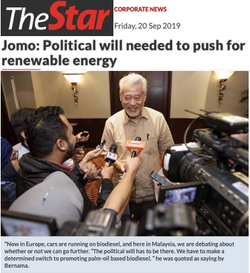
Political will needed to push for renewable energy

The Star 10July 2019

The Star 10July 2019

Malaysian businesses need boost

The Star 9 Oct 2019

The Star 9 Oct 2019

Subsidise public transport for bottom 40%

The Edge 26 Sept 2019

The Edge 26 Sept 2019

Call for measures to counteract global headwinds

The Edge 9 Oct 2019

The Edge 9 Oct 2019

Subsidise public transportation, not fuel

The Star 8 Oct 2019

The Star 8 Oct 2019

Subsidise public transportation for bottom 70%

TheEdge 2Oct 2019

TheEdge 2Oct 2019

"We need to counteract downward forces"

Fake News

PLEASE BEWARE OF MISREPRESENTATIONS OF IMAGES OF JOMO

Commercial and political misrepresentation of his image attributing to him to things which he never said or misrepresenting things he may have said is being circulated on websites such as those posted here. 


You should also be warned, in case you are not already aware, of ‘click bait’ i.e. using such images simply to attract your interest, and then to download your online information for abuse for a variety of ends.

Please inform us and provide a screenshot and weblink to enable further action, which is incredibly difficult. 

Thank you for reading this and for your help and cooperation.

This has also been flagged on his official Facebook page


JKS image ad2.jpg
JKS image Bitcoin ad on  Facebook.jpg
JKS - Fake News 2.jpg
Contact Me
JKS - Fake News 3.jpg
JKS fake news 1.jpg

Contact Me

  • Facebook Social Icon
  • Twitter Social Icon

Thank you for reaching out!

bottom of page