top of page

Follow on Social Media

  • Facebook
  • Twitter
  • Screenshot 2022-09-18 at 5.20.40 PM

M'sia Developments
[on SubStack]

  • Screenshot 2022-09-18 at 5.20.40 PM
  • Mar 28, 2022
  • 5 min read

Anis Chowdhury and Jomo Kwame Sundaram


SYDNEY and KUALA LUMPUR: The spectre of ‘stagflation’ threatens the world once again. This time, the risk is the direct consequence of political provocations and war, and not simply due to inexorable economic forces.


Stagflation?

Stagflation is a composite word implying inflation with stagnation. Stagnation refers to weak, ‘near zero’ growth, inevitably worsening unemployment. Inflation refers to price increases – not high prices, as often implied.

The term ‘stagflation’ was supposedly first used in 1965 by Iain Macleod, then UK Conservative Party economic spokesperson. He later became Chancellor of the Exchequer, or finance minister, in 1970 for little over a month, the shortest tenure in modern times.

In 1965, he told the UK Parliament that amid “swiftly rising” incomes and “completely stagnant” production, “we now have the worst of both worlds. We have a sort of stagflation situation”.

The term caught on in the 1970s, when high inflation and unemployment ended an economic era dubbed the ‘Golden Age of capitalism’ describing the post-World War Two (WW2) boom.

Normally, in a recession, the inflation rate i.e., the overall rate at which prices increase – falls. As unemployment rises, wages come under pressure, consumers and businesses spend less, reducing demand for goods and services, slowing price rises.

Similarly, when the economy booms, the labour market tightens, pushing up wages, in turn passed on to consumers via increasing prices. Thus, inflation rises and unemployment falls during a boom.

However, stagflation poses a dilemma for central banks. Normally, when economies stall, central banks try to stimulate growth by cutting interest rates, encouraging more borrowing, and thus spending.

But that could also fuel further price rises and higher inflation. On the other hand, if they raise interest rates to check inflation, growth may slow even more, further worsening unemployment.


1970s’ stagflation

The growth of world trade after WW2 increased demand for the US dollar, the de facto world currency under the 1944 Bretton Woods (BW) international monetary agreement. The US financed much post-WW2 reconstruction to broaden its ‘Free World’ sphere of influence as the Cold War began.

Following post-WW2 reconstruction, demand for the greenback was met by greater US imports paid for with US dollars. As foreign central banks increasingly accumulated dollar reserves, flows were reversed in the 1960s, with net resources into rather than out of the US.

During the 1960s, US economic growth was increasingly sustained by government military and social expenditure. Spending increased for both ‘defence’, especially the Vietnam War, and social programmes, e.g., President Lyndon B. Johnson’s ‘war on poverty’ and ‘Great Society’.

As LBJ was reluctant to acknowledge the rising costs of the Vietnam War, it was difficult to raise taxes to pay for his ‘swords and ploughshares’ spending. Instead, spending was financed by government debt, from selling US Treasury bonds. Thus, the world financed US government spending, including the war.

By January 1967, Johnson was under pressure to cut the growing budget deficit. But it took a year and a half for the US Congress to pass his new budget with tax increases. When finally passed in mid-1968, US federal debt had grown even more as spending for both ‘guns and butter’ did not decline.

US monetary policy was obligingly expansionary. Unsurprisingly, inflation shot up from 1.1% during 1960-64 to 4.3% in 1965-70. Higher inflation also eroded US competitiveness, further worsening its balance of payments deficit.

Inflation also undermined US ability to honour its BW commitment to maintain full convertibility to gold at US$35 per ounce. This obligation did not go unnoticed by foreign governments and currency speculators.

As inflation rose in the late 1960s, US dollars were increasingly converted to gold. In August 1971, US President Richard M. Nixon ended the exchange of dollars for gold by foreign central banks, effectively violating its BW commitment.

A last-ditch attempt to salvage the international monetary system – through the short-lived Smithsonian Agreement – failed soon after. By 1973, the post-WW2 BW international monetary arrangements were effectively done with.


Commodity supply disruptions

Oil exporting, European and other countries which held reserves in US dollars suddenly found their assets worth much less. With Venezuela, the Middle East-led Organization of Petroleum Exporting Countries (OPEC) reacted by dropping their earlier willingness to keep oil prices low.

In October 1973, ‘nationalist’ Saudi monarch Faisal embargoed oil exports to nations supporting Israel soon after President Anwar Sadat’s attempted reprisal following Egypt’s defeat by Israel in 1970. The oil price almost quadrupled – from US$3 to nearly US$12 per barrel when the embargo ended in March 1974.

This steep oil price rise was paralleled by great increases in other commodity prices during 1973-74. Besides petroleum, other primary commodity prices more than doubled between mid-1972 and mid-1974. Meanwhile, the prices of some commodities – such as sugar and urea – rose more than five-fold.

Commodity supply shocks and higher commodity prices increased production costs, consumer prices and unemployment. As rising consumer prices triggered demands for higher wages, these in turn increased consumer prices. Thus, wage-price spirals accelerated price increases and inflation.

The 1979 Iranian revolution triggered a second oil price shock. The resulting ‘great inflation’ saw US prices rise over 14% in 1980. In the UK – then deemed the ‘sick man of Europe’ – inflation averaged 12% a year during 1973-75, peaking at 24% in 1975, while inflation in West Germany and Switzerland exceeded 5%.

In the 1960s, unemployment in the seven major industrial countries – Canada, France, West Germany, Italy, Japan, the UK and the US – rarely exceeded 3.25%. But in the 1970s, the unemployment rate never fell below that. By mid-1982, it rose to 8%, exacerbated by interest rate hikes, ostensibly to fight inflation.

The 1970s’ growth slowdowns – with rising unemployment and inflation – in major industrial economies caught many economists off-guard. Economic thinking then presumed inflation and unemployment were alternatives.

The Phillips Curve implied low unemployment came at the cost of higher inflation, and vice versa. This crude and static caricature of Keynesian economics enabled a major assault on its influence. The assault on development economics was collateral damage in this ‘counter-revolution’.


Peace is our best option

In October 2021, the International Monetary Fund, the European Central Bank, the US Fed and other such institutions believed the factors driving inflation were transitory. None of these authorities saw an urgent need for interest rate hikes.

But in the last month, the war in Ukraine and sanctions against Russia have driven up the prices of commodities such as wheat and oil. This will exacerbate rising inflation in much of the developed world. The threat of stagflation is undoubtedly more real now than six months ago.

By October 2021, Google searches for ‘stagflation’ hit their highest level since 2008. Mention of stagflation in online news stories surged to more than 4,000 weekly by mid-March, up from slightly more than 200 at the start of the year.

This time, ‘stagflation’ is the direct consequence of political choices, especially for war, not unavoidable economic trends. Developing countries are fast learning where they really stand in this unequal world of endless war, e.g., from the European treatment of Ukrainian refugees.

Peace is therefore imperative. The alternative is the barbarism of conflict among big powers in which most of us have no vested interests. Instead, our shared hope lies in ensuring peace, to focus instead on the common challenges facing humanity.


Related IPS commentaries

Ukraine Incursion, World Stagflation. 14 Mar. 2022. https://www.ipsnews.net/2022/03/ukraine-incursion-world-stagflation/

Stagflation Threat: Be Pragmatic, Not Dogmatic. 22 Mar. 2022. https://www.ipsnews.net/2022/03/stagflation-threat-pragmatic-not-dogmatic/


Anis Chowdhury and Jomo Kwame Sundaram


SYDNEY and KUALA LUMPUR: “If your only tool is a hammer, every problem looks like a nail”. Still haunted by the clever preaching of monetarist guru Milton Friedman’s ghost, all too many monetary authorities address every inflationary threat or sign they see by raising interest rates.

Friedman’s dictum that “inflation is always and everywhere a monetary phenomenon” still defines the orthodoxy. Despite changed circumstances in the world today, for Friedmanites, inflation must be curbed by monetary tightening, especially interest rate hikes.


No central banker consensus

The threat of higher inflation has risen with Russia’s Ukraine incursion and the punitive Western ‘sanctions from hell’ in response. International Monetary Fund (IMF) Managing Director Kristalina Georgieva warns wide-ranging sanctions on Russia will worsen inflation.

European Central Bank (ECB) President Christine Lagarde fears, “The Russia-Ukraine war will have a material impact on economic activity and inflation”. US Treasury Secretary Janet Yellen has also acknowledged the new threat.

She recognizes tighter monetary policy could be contractionary, but expresses confidence in the Federal Reserve’s ability to balance that. Meanwhile, US Federal Reserve chair Jerome Powell has pledged to be “careful”.

Terming Russia’s invasion “a game changer”, with unpredictable consequences, he stressed readiness to move more aggressively if needed. On 16 March, the Fed raised its benchmark short-term interest rate while signalling up to six more rate hikes this year.

But other central bankers do not agree on how best to respond. Bank of Japan Governor Kuroda has ruled out tightening monetary policy. He recently noted, “It’s inappropriate to deal with [cost-push inflation] by scaling back stimulus or tightening monetary policy”. For Kuroda, an interest rate hike is inappropriate to deal with inflation due to surging fuel and food prices.

Friedman’s disciples at some central banks began tightening monetary policy from mid-2021. The Reserve Bank of New Zealand, the first to adopt strict inflation targeting in 1989, raised interest rates in August for the second time in two months.

The Bank of England (BOE) raised interest rates for the first time in more than three years in December. Going further, Norway’s central bank doubled its policy rate on the same day.

Anticipating interest rate rises in the US and under pressure from financial markets, central banks in some emerging market and developing economies (EMDEs) – such as Brazil, Russia and Mexico – began raising policy interest rates after inflation warning bells went off in mid-2021. Indonesia and South Africa joined the bandwagon in January 2022.


Ukraine effect

With inflation surging after the Ukraine incursion, the Bank of Canada doubled its key rate on 2 March – its first increase since October 2018.

The ECB has a more hawkish stance, dropping its more cautious earlier language. Its governing council has reiterated an old pledge to “take whatever action is needed” to pursue price stability and safeguard financial stability.

Following the US Fed’s move, the BOE raised its interest rate the next day. A month before, in February, the BOE Chief Economist was against raising interest rates, favouring a more nuanced approach.

However, instead of kneejerk interest rate responses, Reserve Bank of Australia’s Governor Philip Lowe is “prepared to be patient” while monitoring developments.

EMDE central bankers have also responded differently. Brazil has raised its benchmark interest rate after the Fed, and signalled more increases could follow this year. But Indonesia has been more circumspect.


Interest rate not inflation cure-all

The interest rate is a blunt policy tool. It does not differentiate between activities facing rising demand and those experiencing supply disruptions. Thus, interest rate hikes adversely impact investments in sectors facing supply bottlenecks needing more investment.

In short, the interest rate is indiscriminate. But the prevailing policy orthodoxy of the past four decades does not differentiate among causes of inflation, prescribing higher interest rates as the miracle ‘cure-all’.

This monetarist policy orthodoxy does not even recognize multiple causes or sources of inflation. Most observers believe that current inflationary pressures are due to both demand and supply factors.

Some sectors may be experiencing surging demand while others are facing supply disruptions and rising production costs. All this has now been exacerbated by the Ukraine crisis and the ensuing sanctions interrupting supplies.


Old lessons forgotten

Well over half a century ago, the UN’s World Economic Survey 1956 warned, “A single economic policy seems no more likely to overcome all sources of imbalance which produce rising prices and wages than is a single medicine likely to cure all diseases which produce a fever”.

Addressing ‘cost-push’ inflation using measures designed for ‘demand-pull’ phenomena is not only inappropriate, but also damaging. It can increase unemployment significantly without dampening inflation, warned the UN’s World Economic Survey 1955 as Friedman’s anti-Keynesian arguments were emerging.

Interest rates do not discriminate between credit for consumer and investment spending. In efforts to dampen demand sufficiently, interest rates are raised sharply. Such monetary tightening can do much lasting economic damage.

Declining or lower investment is harmful for the progress needed for sustainable development, requiring innovation and productivity growth. After all, improved technologies typically require new machines and tools.

No one ‘one size fits all’

Dealing with ‘stagflation’ – economic stagnation with inflation – caused by multiple factors requires both fiscal and monetary policies working together complementarily. They also need particular tools and regulatory measures for specific purposes.

Monetary authorities should also create government fiscal space by financing unanticipated urgent needs and long-term sustainable development projects, e.g., for renewable energy.

Governments need to first provide some immediate cost of living relief to defuse unrest as food and fuel prices surge. This can be done with measures that may include food vouchers, suspending some taxes on key consumer products.

In the medium- to long-term, governments can expand subsidized public provisioning of healthcare, transport, housing, education and childcare to offset rising living costs. Such public provisioning – increasing the “social wage” – diffuses wage demands, preventing wage-price spirals.

Such policy initiatives brought down inflation in Australia during the 1980s without causing large-scale unemployment. This contrasted with the deep recessions in the UK and USA then due to high interest rates.


Get correct medicine

But to do so, governments need more fiscal space. Hence, tax reforms are critical. Progressive tax reforms – such as introducing wealth taxes and raising marginal tax rates for high income earners – also mitigate inequality. Governments also need to align their short- and long-term fiscal policy frameworks.

Monetary authorities need to apply a combination of tools, such as reserve requirements for commercial bank deposits, more credit, including differential interest rate facilities, and more inclusive financing.

For example, central banks should restrict credit growth in ‘overheated’ sectors, while expanding affordable credit for those facing supply bottlenecks. Central banks also need to curb credit growth likely to be used for speculation.

Governments also need regulatory measures to prevent unscrupulous monopolies or cartels trying to manipulate markets and create artificial shortages. Regulatory measures are also needed to check commodity futures and other speculation. These increase food and fuel price rises and other problems.

Relying exclusively on the interest rate hammer is an article of monetarist faith, not macroeconomic wisdom. Pragmatic policymakers have demonstrated much ingenuity in designing more appropriate macroeconomic policy responses – not only against inflation, but worse, the stagflation now threatening the world.


Related IPS commentaries

Ukraine Incursion, World Stagflation. 14 March 2022. https://www.ipsnews.net/2022/03/Ukraine-incursion-world-stagflation/

Inflation Targeting Constrains Development. 8 March 2022. https://www.ipsnews.net/2022/03/inflation-targeting-constrains-development/

Inflation Targeting Voodoo. 1 March 2022. https://www.ipsnews.net/2022/03/inflation-targeting-voodoo/

Resist Inflation Phobia Coup. 8 February 2022. https://www.ipsnews.net/2022/02/resist-inflation-phobia-coup/

Inflation Paranoia Threatens Recovery. 1 February 2022. https://www.ipsnews.net/2022/02/inflation-paranoia-threatens-recovery/


Anis Chowdhury and Jomo Kwame Sundaram


SYDNEY and KUALA LUMPUR: Finger pointing in the blame game over Russia’s Ukraine incursion obscures the damage it is doing on many fronts. Meanwhile, billions struggle to cope with worsening living standards, exacerbated by the pandemic and more.


Losing sight in the fog of war

US Secretary of State Anthony Blinken insists, “the Russian people will suffer the consequences of their leaders’ choices”. Western leaders and media seem to believe their unprecedentedcrushing sanctions” will have a “chilling effect” on Russia.

With sanctions intended to strangle Russia’s economy, the US and its allies somehow hope to increase domestic pressure on Russian President Vladimir Putin to retreat from Ukraine. The West wants to choke Russia by cutting its revenue streams, e.g., from oil and gas sales to Europe.

Already, the rouble has been hammered by preventing Russia’s central bank from accessing its US$643bn in foreign currency reserves, and barring Russian banks from using the US-run global payments transfer system, SWIFT.

Withdrawal of major Western transnational companies – such as Shell, McDonald’s and Apple – will undoubtedly hurt many Russians – not only oligarchs, their ostensible target.

Thus, Blinken’s claim that “The economic costs that we’ve been forced to impose on Russia are not aimed at you [ordinary Russians]” may well ring hollow to them. They will get little comfort from knowing, “They are aimed at compelling your government to stop its actions, to stop its aggression”.

As The New York Times notes, “sanctions have a poor record of persuading governments to change their behavior”. US sanctions against Cuba over six decades have undoubtedly hurt its economy and people.

But – as in Iran, North Korea, Syria and Venezuela – it has failed to achieve its supposed objectives. Clearly, “If the goal of sanctions is to compel Mr. Putin to halt his war, then the end point seems far-off.”


Russia, major commodity exporter

Undoubtedly, Russia no longer has the industrial and technological edges it once had. Following Yeltsin era reforms in the early 1990s, its economy shrank by halflowering Russian life expectancy more than anywhere else in the last six millennia!

Russia has become a major primary commodity producer – not unlike many developing countries and the former settler colonies of North America and Australasia. It is now a major exporter of crude oil and natural gas.

It is also the largest exporter of palladium and wheat, and among the world’s biggest suppliers of fertilizers using potash and nitrogen. On 4 March, Moscow suspended fertilizer exports, citing “sabotage” by “foreign logistics companies”.

Farmers and consumers will suffer as yields drop by up to half. Sudden massive supply disruptions will thus have serious ramifications for the world economy – now more interdependent than ever, due to earlier globalization.


Sanctions’ inflation boomerang

International Monetary Fund Managing Director Kristalina Georgieva has ominously warned of the Ukraine crisis’ economic fallouts. She cautions wide-ranging sanctions on Russia will worsen inflation and further slow growth.

No country is immune, including those imposing sanctions. But the worst hit are poor countries, particularly in Africa, already struggling with rising fuel and food prices.

For Georgieva, more inflation – due to Russian sanctions – is the greatest threat to the world economy. “The surging prices for energy and other commoditiescorn, metals, inputs for fertilizers, semiconductors – coming on top of already high inflation” are of grave concern to the world.

Russia and Ukraine export more than a quarter of the world’s wheat while Ukraine is also a major corn exporter. Supply chain shocks and disruptions could add between 0.2% to 0.4% to ‘headline inflation’ – which includes both food and fuel prices – in developed economies over the coming months.

US petrol prices jumped to a 17-year high in the first week of March. The costs of other necessities, especially food, are rising as well. US Treasury Secretary Janet Yellen has acknowledged that the sanctions are worsening US inflation.

The European Union (EU) gets 40% of its natural gas from Russia. Finding alternative supplies will be neither easy nor cheap. The EU is Russia’s largest trading partner, accounting for 37% of global trade in 2020. Thus, sanctions may well hurt Europe more than Russia – like cutting one’s nose to spite one’s face.

The European Central Bank now expects stagflation – economic stagnation with inflation, and presumably, rising unemployment. It has already slashed its growth forecast for 2022 from 4.2% to 3.7%. Inflation is expected to hit a record 5.1% – way above its previous 3.2% forecast!


Developing countries worse victims

Global food prices are already at record highs, with the Food Price Index (FPI) of the Food and Agricultural Organization up more than 40% over the past two years.

The FPI hit an all-time high in February – largely due to bad weather and rising energy and fertilizer costs. By February 2022, the Agricultural Commodity Price Index was 35% higher, while maize and wheat prices were 26% and 23% more than in January 2021.

Besides shortages and rising production costs – due to surging fuel and fertilizer prices – speculation may also push food prices up – as in 2007-2008.

Signs of such speculation are already visible. Chicago Board of Trade wheat future prices rose 40% in early March – its largest weekly increase since 1959!

Rising food prices impact people in low- and middle-income countries more as they spend much larger shares of their incomes on food than in high-income countries. The main food insecurity measure has doubled in the past two years, with 45 million people close to starvation, even before the Ukraine crisis.

Countries in Africa and Asia rely much more on Russian and Ukrainian grain. The World Bank has warned, “There will be important ramifications for the Middle East, for Africa, North Africa and sub-Saharan Africa, in particular”, where many were already food insecure before the incursion.

The Ukraine crisis will be devastating for countries struggling to cope with the pandemic. Unable to access enough vaccines or mount adequate responses, they already lag behind rich countries. The latest food and fuel price hikes will also worsen balance-of-payments problems and domestic inflationary pressures.


No to war!

The African proverb, “When two elephants fight, all grass gets trampled”, sums up the world situation well. The US and its allies seem intent to ‘strangle Russia’ at all costs, regardless of the massive collateral damage to others.

This international crisis comes after multilateralism has been undermined for decades. Hopes for reduced international hostilities, after President Biden’s election, have evaporated as US foreign policy double standards become more apparent.

Russia has little support for its aggressive violation of international law and norms.Despite decades of deliberate NATO provocations, even after the Soviet Union ended, Putin has lost international sympathy with his aggression in Ukraine.

But there is no widespread support for NATO or the West. Following the vaccine apartheid and climate finance fiascos, the poorer, ‘darker nations’ have become more cynical of Western hypocrisy as its racism becomes more brazen.


Latest Videos

All Videos

All Videos

AN URGENT CALL: A PEOPLE"S VACCINE AGAINST COVID-19

00:00
9 June 2020: IHD-ILO-ISLE Virtual Conference - Day 2

9 June 2020: IHD-ILO-ISLE Virtual Conference - Day 2

05:08:34
Learning in Governance in times of COVID-19

Learning in Governance in times of COVID-19

46:30
Beyond the Lockdown: Towards the ‘New Normal’

Beyond the Lockdown: Towards the ‘New Normal’

59:10

About Jomo

Jomo Kwame Sundaram is Research Adviser, Khazanah Research Institute, Fellow, Academy of Science, Malaysia, and Emeritus Professor, University of Malaya. Previously, he was UN Assistant Secretary-General for Economic Development, Assistant Director General, Food and Agriculture Organization (FAO), Founder-Chair, International Development Economics Associates (IDEAs) and President, Malaysian Social Science Association. 

In The Media

TheStar 26 June 2020

TheStar 26 June 2020

The Star 20 Sept 2019

The Star 20 Sept 2019

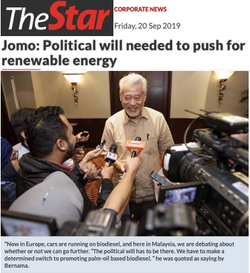
Political will needed to push for renewable energy

The Star 10July 2019

The Star 10July 2019

Malaysian businesses need boost

The Star 9 Oct 2019

The Star 9 Oct 2019

Subsidise public transport for bottom 40%

The Edge 26 Sept 2019

The Edge 26 Sept 2019

Call for measures to counteract global headwinds

The Edge 9 Oct 2019

The Edge 9 Oct 2019

Subsidise public transportation, not fuel

The Star 8 Oct 2019

The Star 8 Oct 2019

Subsidise public transportation for bottom 70%

TheEdge 2Oct 2019

TheEdge 2Oct 2019

"We need to counteract downward forces"

Fake News

PLEASE BEWARE OF MISREPRESENTATIONS OF IMAGES OF JOMO

Commercial and political misrepresentation of his image attributing to him to things which he never said or misrepresenting things he may have said is being circulated on websites such as those posted here. 


You should also be warned, in case you are not already aware, of ‘click bait’ i.e. using such images simply to attract your interest, and then to download your online information for abuse for a variety of ends.

Please inform us and provide a screenshot and weblink to enable further action, which is incredibly difficult. 

Thank you for reading this and for your help and cooperation.

This has also been flagged on his official Facebook page


JKS image ad2.jpg
JKS image Bitcoin ad on  Facebook.jpg
JKS - Fake News 2.jpg
Contact Me
JKS - Fake News 3.jpg
JKS fake news 1.jpg

Nadi Insan by the People's History Centre

Read all editions of #NadiInsan from 1979 to 1983 free of charge at the Peoples History Center website.


Containing writings on socio-political issues, film and cultural commentary, as well as in-depth interviews, Nadi Insan is motivated by community activists and intellectuals in Malaysia.

Happy reading!

Dapatkan kesemua siri majalah #NadiInsan dari tahun 1979 hingga 1983 secara percuma di laman Pusat Sejarah Rakyat.


Berisi tulisan memperihal sosio-politik, ulasan filem dan budaya sehinggalah wawancara yang rencam, Nadi Insan digerakkan oleh aktivis masyarakat dan intelektual di Malaysia.


Selamat membaca!

Contact Me

  • Facebook Social Icon
  • Twitter Social Icon

Thank you for reaching out!

bottom of page