top of page

Follow on Social Media

  • Facebook
  • Twitter
  • Screenshot 2022-09-18 at 5.20.40 PM

M'sia Developments
[on SubStack]

  • Screenshot 2022-09-18 at 5.20.40 PM

Anis Chowdhury and Jomo Kwame Sundaram


SYDNEY and KUALA LUMPUR. The world is being pressed by financial interests to raise interest rates, ostensibly to check inflation. After the US Federal Reserve started raising interest rates, more central banks have been doing likewise.

Considering inflation’s contemporary causes, such ‘follow the leader’ central bank mimicry cannot check it except by slowing economies. Worse, this has meant taking on huge new risks, seriously damaging world economic prospects in the medium and long-term.


Inflation bogey dangerous

Much earlier, World Bank supported research had shown moderate inflation – in the range of 15–30% – was not harmful to growth, and could “be reduced only at a substantial cost to … growth”.

Nonetheless, “The ratio of fervent beliefs to tangible evidence seems unusually high on this topic”. Unsurprisingly, central banks are still trying to keep inflation below 2% – an arbitrary target “plucked out of the air”, due to a “chance remark” by New Zealand’s finance minister then.

Raising interest rates will derail recovery and worsen supply disruptions and shortages due to the pandemic, war and sanctions. European Central Bank (ECB) Executive Board member Fabio Panetta has noted the euro zone is “de facto stagnating” as economic growth has almost stopped.

As policymakers struggle with inflation, growth and wellbeing are being subjected to huge risks. As Panetta warns, “monetary tightening aimed at containing inflation would end up hampering growth that is already weakening”.


Interest rates rising globally

Among emerging markets and developing economies, South Africa’s central bank raised interest rates for the first time in three years in November 2021.

On 24 March 2022, the Bank of Mexico raised interest rates for the seventh consecutive time. On the same day, Brazil’s central bank raised interest rates to its highest level since 2017.

On 4 May, the Reserve Bank of India raised interest rates – its first rate change in two years and first rate hike in nearly four. On 5 May, Chile’s central bank raised interest rates. Pressed by finance to curb inflation, more central bankers are tightening monetary policy.

Without evidence or reasoning, they insist higher interest rates will check inflation. Their recognized adverse effects for recovery and growth are dismissed as unavoidably necessary short-term costs for some unspecified long-term gains.

But despite facing higher inflationary expectations, tightening international monetary conditions, and Ukraine war uncertainties, the ECB and Bank of Japan have not joined the bandwagon, refusing to raise policy interest rates so far.


Interest rateblunt tool

But central bankers’ dogmatic stances, knee-jerk responses and ‘follow the leader’ behaviour are not helpful. Even when inflation reaches dangerous levels, raising interest rates may still not be the right policy response for several reasons.

First, raising interest rates only addresses the symptoms – not the causes – of inflation. Inflation is often said to be a consequence of an economy ‘overheating’. But overheating can be due to many factors.

Higher interest rates may relieve overheating, by slowing economic activity. But a good doctor should first investigate and diagnose an ailment’s causes before prescribing appropriate treatment – which may or may not require medication.

It is widely accepted that the current inflationary surge is due to supply chain disruptions – exacerbated by war and sanctions – especially of essential goods such as food and fuel. If so, long-term solutions require increasing supplies, including by removing bottlenecks.

Higher interest rates reduce aggregate demand. But simply raising interest rates does not even address the specific causes of inflation, let alone rising prices due to supply disruptions of essential goods, such as food and fuel.


Interest rate – indiscriminate

Second, the interest rate affects all sectors, everyone. It does not even distinguish between sectors or industries needing to expand or be encouraged, and those that should be phased out, for being less productive or inefficient.

Also, raising interest rates too often, and to excessively high levels, can squeeze, or even kill productive and efficient businesses along with inefficient or less productive ones.

US bankruptcies had soared in the early 1980s after US Fed chair Volcker’s legendary interest rate spike. “Thousands of businesses that took out bank loans could fail”, warned a leading UK tax advisory firm recently.

Third, interest rates do not distinguish among households and businesses. Higher interest rates may discourage household expenditure, but also dampen all kinds of spending – for both consumption and investment.

Hence, overall demand may shrink – discouraging investment in new technology, plant, equipment and skills. Thus, higher interest rates adversely affect long-term productive capacities and technological progress of economies.


Debt, recessions and financial crises

Fourth, higher interest rates raise debt servicing costs for governments, businesses and households. With the exceptionally low interest rates previously available after the 2008-09 global financial crisis (GFC), debt burdens rose in most countries.

These undoubtedly encouraged risky, speculative behaviour as well as unproductive share buybacks, increased dividends, and mergers & acquisitions. Interest rate hikes have triggered many recessions and financial crises. Thus, raising interest rates now will likely trigger a new, albeit different era of stagflation.

The pandemic has pushed public debt to historic new highs. Forty-four per cent of low-income and least developed countries were at high risk of, or already in external debt distress in 2020.

Before the COVID-19 crisis, half the small island developing states surveyed already had solvency problems, i.e., were at high risk of, or already in debt distress. Thus, raising interest rates can trigger a global debt crisis.

Fifth, paradoxically, higher interest rates raise debt-servicing expenses, especially mortgage payments, for indebted households. Costs of living also rise if businesses pass higher interest costs on to consumers by raising prices.

Hence, the main beneficiaries of low inflation and higher interest rates are the holders of financial assets who fear the relative diminution of their value.


Developing countries vulnerable

Developing countries are particularly vulnerable. Higher interest rates in developed countries – particularly the US – trigger capital outflows from developing countries – causing exchange rate depreciations and inflationary pressures.

Higher interest rates and weaker exchange rates will aggravate already high debt service burdens – as happened in Latin America in the early 1980s after US Fed chair Volcker greatly increased US interest rates.

To discourage sudden capital outflows and prevent large currency depreciations, developing countries raise interest rates sharply. This may lead to economic collapse – as in Indonesia during the 1997-98 Asian financial crisis.

Although pandemic response measures – such as debt moratoria – provided some relief, business failures rose nearly 60% in 2020 from 2019. Middle- and low-income countries saw more business failures.

The World Bank’s Pulse Enterprise Survey – of 24 middle- and low-income countries – found 40% of businesses surveyed in January 2021 expected to be in arrears within six months.

This included more than 70% of firms in Nepal and the Philippines, and over 60% in Turkey and South Africa. Business failures of such scale can trigger banking crises as non-performing loans suddenly soar.

Instead of checking contemporary inflation, raising interest rates is likely to greatly damage recovery and medium-term growth prospects. Hence, it is imperative for developing countries to innovatively develop appropriate means to better address the economic dilemmas they face.


Related IPS commentaries

Deepening Stagflation: Out of the Frying Pan into the Fire. 5 April 2022. https://www.ipsnews.net/2022/04/deepening-stagflation-frying-pan-fire/

Stagflation Threat: Be Pragmatic, Not Dogmatic. 22 March 2022. https://www.ipsnews.net/2022/03/stagflation-threat-pragmatic-not-dogmatic/

Ukraine Incursion, World Stagflation. 14 March 2022. https://www.ipsnews.net/2022/03/ukraine-incursion-world-stagflation/

Inflation Targeting Constrains Development. 8 March 2022. https://www.ipsnews.net/2022/03/inflation-targeting-constrains-development/

Inflation Targeting Voodoo. 1 March 2022. https://www.ipsnews.net/2022/03/inflation-targeting-voodoo/

Resist Inflation Phobia Coup. 8 February 2022. https://www.ipsnews.net/2022/02/resist-inflation-phobia-coup/

Inflation Paranoia Threatens Recovery. 1 February 2022. https://www.ipsnews.net/2022/02/inflation-paranoia-threatens-recovery/

Inflation Bogey Blocking Recovery. 19 October 2021. https://www.ipsnews.net/2021/10/inflation-bogey-blocking-recovery/


Updated: May 3, 2022

Jomo Kwame Sundaram


KUALA LUMPUR. Capital flight from the global South is immense, with widespread adverse effects. A new book proposes measures to curb, even reverse capital flight from Africa. It also offers pragmatic lessons for many developing countries.


On the trail of capital flight from Africa extends pioneering work begun much earlier. The editors – Leonce Ndikumana and James Boyce – estimate Sub-Saharan Africa (SSA) has lost more than US$2 trillion to capital flight in the last half century!

SSA currently loses US$65 billion annually – more than yearly official development assistance (ODA) inflows. The book’s studies carefully investigate natural resource exploitation – of South African minerals, Ivorian cocoa, and Angolan oil and diamonds.


Such forensic country analyses are crucial to more effectively check capital flight. Outflows since the 1980s from the three countries have been massive: US$103 billion from Angola, US$55 billion from Cote d’Ivoire, and US$329 billion from South Africa in 2018 dollars.


Capital flight has been much more than cumulative external debt. Annual outflows were between 3.3% and 5.3% of national income. Nigeria, South Africa and Angola account for the most capital outflows from SSA, with Cote d’Ivoire seventh.


Resource booms


As governments get more revenue from natural resources, the fiscal ‘social contract’ is eroded. When people pay taxes, they expect state spending to benefit the public. But with more revenue from resources – via state monopolies, royalties and taxes – governments become less accountable to their own citizens.


Gaining and maintaining access to foreign credit has similar effects. Developing country governments then focus on ingratiating themselves with friendly foreign donor governments to get ODA, and on enhancing their credit ratings.


Hence, such regimes have less political need to provide ‘public goods’, including services, let alone accelerate social progress. Thus, erosion of the fiscal ‘social contract’ undermines not only public wellbeing, but also state legitimacy.


To secure power, ruling cliques often rely on ‘clientelism’ – patronage or patron-client relations – typically on regional, ethnic, tribal, religious or sectarian lines. Their regimes inevitably provoke dissent – including oppositional ethno-populism and civil unrest, even armed insurgencies.


Unsurprisingly, such regimes believe their choices are limited. Another option is repression – which typically rises as the status quo is threatened. The resulting sense of insecurity spreads from the public to the elite, worsening capital flight.


Exploiting valuable natural resources not only generates export earnings, but also attracts foreign investments. One result is ‘Dutch disease’ as the national currency rises in value – reducing other exports and jobs, inevitably hurting development prospects.


Thus, vast private fortunes have been made and illicitly transferred abroad. Ruling elites and their allies rarely only rely on either state or market to become richer. The book shows how both state and market strengthen private and personal power and influence.


Plundering Africa

The book’s case studies show how resource extraction has been central to capital flight. In all three countries, the efficacy of fiscal policy tools – especially to foster investments for development – has been undermined.


Outflows have increased with economic liberalization, as unrecorded financial outflows – via the current account – grow with freer trade. Thus, trade-related financial transactions enable corruption and capitalflight.


In Côte d’Ivoire – the world’s top cocoa producer – rents initially came from supply chains connecting farmers to consumers. Corrupt partnerships – connecting domestic elites to foreign businesses – have been crucial to such arrangements.

Thus, natural resource primary commodity exports have enabled illicit capital flows. Ivorian cocoa exports have been consistently under-reported – with trade statistics of major importers showing massive under-invoicing by exporters.

Post-colonial political settlements have given a few privileged access to resource rents. With capital flight thus enabled, successive Ivorian regimes have been less obliged to spend more on development or public wellbeing.


Due to the cocoa boom, the post-colonial ‘Ivorian miracle’ ended when prices fell. The bust triggered a political crisis, culminating in civil war. But the crunch also meant the country could no longer service its foreign debt.

In Angola too, natural resources worsened its protracted civil wars. After these ruinous conflicts, oil rents enriched the triumphant nepotistic regime. This enabled the control to gain control of more, even as most Angolans continued to live in destitution.


Angola’s massive oil exports mainly benefited the small elite of cronies around the president. They failed to develop the economy or improve most lives. All this has been enabled by ‘helpful’ professionals who have enriched themselves doing so.

While benefiting its elite and foreign transnationals, Angola’s ‘oil curse’ has blocked balanced and sustainable development of its economy. Despite rapidly depleting its oil reserves, Angola and most Angolans have benefited little.


South Africa – SSA’s second largest economy after Nigeria – seems less reliant on natural resources. Post-apartheid economic liberalization has enabled capital flight as private corporate interests – especially the influential minerals-energy complex – quickly took advantage of the new dispensation.


By under-invoicing their exports, mineral interests have been engaged in massive capital flight and tax evasion. Meanwhile, business cronies have enriched themselves in new ways, e.g., in the state’s electric power sector. Such abuses were exposed by the Gupta family scandal, leading to then President Jacob Zuma’s downfall.


Stemming capital flight


‘State capture’ by politically influential nationals have undermined government regulatory capacities with help from transnational enablers. Ostensible ‘good governance’ reforms have enabled capital flight and tax evasion – by undermining ‘developmental governance’, including prudential regulation.


Institutional environments, mechanisms and enablers facilitate capital flight, tax evasion and wealth accumulation offshore. With often complex, varied and changing facilitation, capital flight has shifted massive wealth abroad for elites.


Transnational financial networks have eased capital outflows – at the expense of productive investments, good jobs and social wellbeing. Capital flight has worsened financing, including budgetary gaps – aggravating related social deprivations.


Wealth creation enhances the economic pie, but distribution depends on who appropriates it. Improved understanding of such varied and ever-changing relations of appropriation is crucial to effectively curb this haemorrhage.


Greater awareness should inspire and inform better measures to check capital flight from the global South. Instead of the Washington Consensus ‘good governance’ mantra, a developmental governance agenda is needed.


Hence, curbing capital flight is crucial for financing sustainable development. Checking capital flight and related abuses – such as trade mis-invoicing, money laundering, tax evasion and public asset acquisition by elites – requires well-coordinated efforts at both national and international levels.


All researchers, policymakers and regulators will gain from the book’s forensic analyses of financial, fiscal and other such abuses. International financial institutions now have little excuse for continuing to enable the capital flight and tax evasion still bleeding the global South.


Related IPS articles


Jomo Kwame Sundaram


KUALA LUMPUR. Curbing capital flight from developing countries is long overdue. New sanctions against Russian oligarchs show this can be done with the requisite political will. Recent research also shows how to more effectively stop capital flight.


Capital flight

Capital flight is widespread, with resource-rich countries more vulnerable. ‘Mis-invoicing’ exports and embezzling export earnings of state-owned mineral companies have been central to such wealth appropriation.

Capital flight is enabled, not only by national conditions, but also by transnational facilitators. Internationally, capital flight is aided by institutions and professional enablers such as bankers, lawyers, accountants and consultants.

Capital should flow to investments yielding the most returns. But economic theory suggests making more depends on appropriating what economists call ‘rents’. These rents may be secured by many means, legal or otherwise.

Developing countriesespecially resource-rich economiesare generally more susceptible to abuse. Wealth buys power and influence, enabling further accumulation. Thus, in the real world, natural resource endowments become a curse – not a blessing.

Since the 1990s, the IMF’s sixth Article of Association – authorizing national capital controls – has been ‘flexibly reinterpreted’ by management and staff. Instead of protecting national economies, they have eased transborder capital flows – and flight.

To add insult to injury, advocates falsely claim that more capital will thus flow into, rather than out of developing countries. After all, conventional economic theory insists capital flows from ‘capital-rich’ to ‘capital-poor’ countries.

The reality of capital flowing ‘upstream’ – to rich countries – underscores how mainstream economic textbooks mislead. Clearly, the real world is very different from the one that such economists believe should exist.


Enabling illicit outflows

Unsurprisingly, the wealthy – especially the ‘crooked’ – want to keep their assets abroad – beyond the reach of national authorities, and rivals. As such wealth has often been acquired illicitly, owners want to protect themselves from investigation, prosecution and expropriation.

Capital flight is enabled by transnational financial networks with considerable influence. These involve global banks and financial institutions, auditors and accounting firms, tax lawyers and consulting firms for hire. Along with corporate executives and government officials, they facilitate capital flight, sharing in the spoils.

With both states and markets at their disposal, transnational financial networks successfully overcome national constraints. Prerogatives of national sovereignty are also abused to obscure their transactions and operations from surveillance.

Capital flight is enabled, even incentivized by national environments allowing the wealthy to surreptitiously sneak financial assets offshore. Instead of helping developing countries protect their meagre assets, international financial institutions have facilitated, even worsened the haemorrhage.

Elites influence the law and its enforcement, typically by employing enabling professionals and friendly legislators. After all, laws and governments are neither impartial nor efficient, constantly reshaped by influence, often connected to wealth. Hence, some illicit activities and wealth may be unlawful while others may not be.

National legal jurisdictions have been changed to ease cross-border flows. Rules, norms and practices have been changed to hide wealth transfers from national and international authorities, rules and regulations. Hence, natural resource endowments especially enable capital flight.

Such outflows may even be triply illicit in terms of mode of acquisition, concealment from tax authorities, and transfer across borders. But not all illicitly transferred flight capital is illicitly acquired. Conversely, illicitly obtained wealth – ‘laundered’ before being transferred abroad legally – is not deemed capital flight.

Some capital flight involveslegally acquired wealth illicitly transferred abroad. This may be reported as trade-related payments on the current account – not involving capital account transfers. They may thus bypass, or even contravene capital controls and foreign exchange regulations.

They strive to evade detection, prosecution, litigation, fines, charges and taxes by various revenue authorities. Illicit foreign exchange outflows secretly transferred abroad and not recorded in official national accounts may not be deemed illegal.

Hence, the volume and significance of capital flight estimates tend to be understated. Capital flight is easier from most developing economies which have become more open in the last four decades with economic liberalization, often demanded by structural adjustment programmes.


Why stop capital flight?

Transnational corruption – across national borders – undermines governance and national resource mobilization needed to enhance productive investments. But many advocates of opening capital accounts justify capital flight by blaming it on allegedly predatory or incompetent governments.

The international financial system features enabling capital flight often also facilitate tax avoidance and evasion by the wealthy. Thus, capital flight doubly undermines domestic resource mobilization by leaching both investible and government resources.

Transborder capital flows avoid or minimize taxes paid, while hiding beneficiaries’ identities and wealth in secretive offshore tax havens. Government finances are also directly hit when externally borrowed funds, or state-owned enterprises and natural resources are embezzled.

Worse, government or public foreign debt has often been abused to directly finance capital flight. Meanwhile, illicit offshore flight capital goes untaxed. This shifts the tax burden to the middle class and domestic businesses unable to sneak their assets abroad, or to otherwise avoid revenue authorities.

Many developing countries continue to suffer significant resource outflows, largely due to illicit capitalflight. On the trail of capital flight from Africa: The Takers and the Enablers – edited by Leonce Ndikumana and James Boyce – studies this blight in sub-Saharan Africa. The world has much to learn from their forensic analysis.

The volume estimates haemorrhage from African countries since 1970 at US$2 trillion! Of this, almost 30% has been lost in the 21st century. Adding interest, cumulative offshore assets were US$2.4 trillion by 2018 – more than thrice Africa’s external debt!

The West’s piecemeal approach to sanctions targeting individuals is recognized as costly, time-consuming and ineffectual. Instead, the editors recommend a pre-emptive, across-the-board effort to undermine transnational networks enabling illicit financial flows. This should begin with closing financial system loopholes.


Related IPS articles


Latest Videos

All Videos

All Videos

AN URGENT CALL: A PEOPLE"S VACCINE AGAINST COVID-19

00:00
9 June 2020: IHD-ILO-ISLE Virtual Conference - Day 2

9 June 2020: IHD-ILO-ISLE Virtual Conference - Day 2

05:08:34
Learning in Governance in times of COVID-19

Learning in Governance in times of COVID-19

46:30
Beyond the Lockdown: Towards the ‘New Normal’

Beyond the Lockdown: Towards the ‘New Normal’

59:10

About Jomo

Jomo Kwame Sundaram is Research Adviser, Khazanah Research Institute, Fellow, Academy of Science, Malaysia, and Emeritus Professor, University of Malaya. Previously, he was UN Assistant Secretary-General for Economic Development, Assistant Director General, Food and Agriculture Organization (FAO), Founder-Chair, International Development Economics Associates (IDEAs) and President, Malaysian Social Science Association. 

In The Media

TheStar 26 June 2020

TheStar 26 June 2020

The Star 20 Sept 2019

The Star 20 Sept 2019

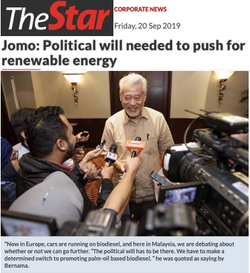
Political will needed to push for renewable energy

The Star 10July 2019

The Star 10July 2019

Malaysian businesses need boost

The Star 9 Oct 2019

The Star 9 Oct 2019

Subsidise public transport for bottom 40%

The Edge 26 Sept 2019

The Edge 26 Sept 2019

Call for measures to counteract global headwinds

The Edge 9 Oct 2019

The Edge 9 Oct 2019

Subsidise public transportation, not fuel

The Star 8 Oct 2019

The Star 8 Oct 2019

Subsidise public transportation for bottom 70%

TheEdge 2Oct 2019

TheEdge 2Oct 2019

"We need to counteract downward forces"

Fake News

PLEASE BEWARE OF MISREPRESENTATIONS OF IMAGES OF JOMO

Commercial and political misrepresentation of his image attributing to him to things which he never said or misrepresenting things he may have said is being circulated on websites such as those posted here. 


You should also be warned, in case you are not already aware, of ‘click bait’ i.e. using such images simply to attract your interest, and then to download your online information for abuse for a variety of ends.

Please inform us and provide a screenshot and weblink to enable further action, which is incredibly difficult. 

Thank you for reading this and for your help and cooperation.

This has also been flagged on his official Facebook page


JKS image ad2.jpg
JKS image Bitcoin ad on  Facebook.jpg
JKS - Fake News 2.jpg
Contact Me
JKS - Fake News 3.jpg
JKS fake news 1.jpg

Nadi Insan by the People's History Centre

Read all editions of #NadiInsan from 1979 to 1983 free of charge at the Peoples History Center website.


Containing writings on socio-political issues, film and cultural commentary, as well as in-depth interviews, Nadi Insan is motivated by community activists and intellectuals in Malaysia.

Happy reading!

Dapatkan kesemua siri majalah #NadiInsan dari tahun 1979 hingga 1983 secara percuma di laman Pusat Sejarah Rakyat.


Berisi tulisan memperihal sosio-politik, ulasan filem dan budaya sehinggalah wawancara yang rencam, Nadi Insan digerakkan oleh aktivis masyarakat dan intelektual di Malaysia.


Selamat membaca!

Contact Me

  • Facebook Social Icon
  • Twitter Social Icon

Thank you for reaching out!

bottom of page