top of page

Follow on Social Media

  • Facebook
  • Twitter
  • Screenshot 2022-09-18 at 5.20.40 PM

M'sia Developments
[on SubStack]

  • Screenshot 2022-09-18 at 5.20.40 PM
  • Aug 25, 2023
  • 1 min read

230814 GPE NAM 2.0 + G77 vs G7+NATO+OECD+WEF


230805 RTM Kadar bunga redakan inflasi? https://youtu.be/dUqmMowtbfo

230703 AstroAwani Nilai matawang ringgit menjunam https://www.youtube.com/watch?v=HaOvPPld6Xs

230620 Khoo Hsu Chuang: Facing war, stagnation, food insecurity, etc.

230531 LSE Malaysian Futures? https://www.youtube.com/watch?v=knG-uFJO6Wk

230427 Contextualizing Rents – An interview

230328 APM Globalisation, War, Non-alignment and Malaysia

230327 Oxbridge Society conversation about the economy https://youtu.be/yFVHalossyI

230225 IDEAS US policies driving world to war and depression

230216. Democracy Now! Global South Debt Crisis


Part 2: Rising U.S. Interest Rates Push Countries in Global South Toward Economic Collapse

230215 IDEAS Food systems worsening malnutrition crises https://youtu.be/Tu_1TafzPIk

230208 G20-G7-BRICS nexus vs inclusive multilateralism @ POP Global Forum.

230202. CEPR The Impact of US Policy on the Global Economy. https://cepr.net/events/the-impact-of-us-policy-on-the-global-economy/


KUALA LUMPUR, Malaysia, Aug 24 2023 (IPS) - International governance arrangements are in trouble. Condemned as ‘dysfunctional’ by some, multilateral agreements have been discarded or ignored by the powerful except when useful to protect their interests or provide legitimacy.


Economic multilateralism under siege

Undoubtedly, many multilateral arrangements have become less appropriate. At their heart is the United Nations (UN) system, conceived in the last year of US President Franklin Delano Roosevelt’s presidency and World War Two.

The 1944 UN conference at Bretton Woods sought to build the foundations for the post-war economic order. The International Monetary Fund (IMF) would create conditions for lasting growth and stability, with the World Bank financing post-war reconstruction and post-colonial development.


The Bretton Woods agreement allowed the US Federal Reserve Bank (Fed) to issue dollars, as if backed by gold. In 1971, President Richard Nixon repudiated the US’s Bretton Woods obligations. With US military and ‘soft’ power, widespread acceptance of the dollar since has effectively extended the Fed’s ‘exorbitant privilege’.


This unilateral repudiation of US commitments has been a precursor of the fate of some other multilateral arrangements. Most were US-designed, some in consultation with allies. Most key privileges of the global North – especially the US – continue, while duties and obligations are ignored if deemed inconvenient.


The International Trade Organization (ITO) was to be the third leg of the post-war multilateral economic order, later reaffirmed by the 1948 Havana Charter. Despite post-war world hegemony, the ITO was rejected by the protectionist US Congress.


The General Agreement on Tariffs and Trade (GATT) became the compromise substitute. Recognizing the diversity of national economic capacities and capabilities, GATT did not impose a ‘one-size-fits-all’ requirement on all participants.

But lessons from such successful flexible precedents were ignored in creating the World Trade Organization (WTO) from 1995. The WTO has imposed onerous new obligations such as the all-or-nothing ‘single commitment’ requirement and the Agreement on Trade-related Intellectual Property Rights (TRIPS).


Overcoming marginalization

In September 2021, the UN Secretary-General (SG) issued Our Common Agenda, with new international governance proposals. Besides its new status quo bias, the proposals fall short of what is needed in terms of both scope and ambition.


Problematically, it legitimizes and seeks to consolidate already diffuse institutional responsibilities, further weakening UN inter-governmental leadership. This would legitimize international governance infiltration by multi-stakeholder partnerships run by private business interests.


The last six decades have seen often glacially slow changes to improve UN-led gradual – mainly due to the recalcitrance of the privileged and powerful. These have changed Member State and civil society participation, with mixed effects.

Fairer institutions and arrangements – agreed to after inclusive inter-governmental negotiations – have been replaced by multi-stakeholder processes. These are typically not accountable to Member States, let alone their publics.


Such biases and other problems of ostensibly multilateral processes and practices have eroded public trust and confidence in multilateralism, especially the UN system.


Multi-stakeholder processes – involving transnational corporate interests – may expedite decision-making, even implementation. But the most authoritative study so far found little evidence of net improvements, especially for the already marginalized.


New multi-stakeholder governance – without meaningful prior approval by relevant inter-governmental bodies – undoubtedly strengthens executive authority and autonomy. But such initiatives have also undermined legitimacy and public trust, with few net gains.


All too often, new multi-stakeholder arrangements with private parties have been made without Member State approval, even if retrospectively due to exigencies.

Unsurprisingly, many in developing countries have become alienated from and suspicious of those acting in the name of multilateral institutions and processes.


Hence, many in the global South have been disinclined to cooperate with the SG’s efforts to resuscitate, reinvent and repurpose undoubtedly defunct inter-governmental institutions and processes.


Way forward?

But the SG report has also made some important proposals deserving careful consideration. It is correct in recognizing the long overdue need to reform existing governance arrangements to adapt the multilateral system to current and future needs and requirements.


This reform opportunity is now at risk due to the lack of Member State support, participation and legitimacy. Inclusive consultative processes – involving state and non-state actors – must strive for broadly acceptable pragmatic solutions. These should be adopted and implemented via inter-governmental processes.


Undoubtedly, multilateralism and the UN system have experienced growing marginalization after the first Cold War ended. The UN has been slowly, but surely superseded by NATO and the Organization for Economic Cooperation and Development (OECD), led by the G7 group of the biggest rich economies.


The UN’s second SG, Dag Hammarskjold – who had worked for the OECD’s predecessor – warned the international community, especially developing countries, of the dangers posed by the rich nations’ club. This became evident when the rich blocked and pre-empted the UN from leading on international tax cooperation.


Seeking quick fixes, ‘clever’ advisers or consultants may have persuaded the SG to embrace corporate-dominated multi-stakeholder partnerships contravening UN norms. More recent SG initiatives may suggest his frustration with the failure of that approach.


After the problematic and controversial record of such processes and events in recent years, the SG can still rise to contemporary challenges and strengthen multilateralism by changing course. By restoring the effectiveness and legitimacy of multilateralism, the UN will not only be fit, but also essential for humanity’s future.


Related IPS Articles


The World Bank plans to use public funds to subsidize private finance, ostensibly to mobilize much more capital to address the climate crisis. But the new plan is likely to be a distraction, not the solution it purports to be.


KUALA LUMPUR, Malaysia, Aug 16 2023 (IPS) - Rich nations have contributed most to the current climate crisis. They are primarily responsible for the historical emissions and greenhouse gas (GHG) accumulation of the last two centuries.

Developing countries, especially in the tropics and sub-tropics, are the main victims of global warming today. Most need finance and other means to build resilience and to develop in the face of the climate crisis. But the rich have resisted major efforts to help developing nations better cope with the crisis.


Climate finance lacking

But recent international climate finance flows fall far short of developing countries’ needs, not only in the aggregate, but also due to their restrictive terms. Nonetheless, increasing demands have been made of the global South to stem the growing crisis.


Meanwhile, climate finance has become increasingly commercial, not concessional. After all, most international agreements tend to be poor compromises reflecting corporate and political power in the world. They fail to address the crisis, let alone advance climate justice.


Rich nations have fallen far behind on their $100 billion annual finance commitment for the 2009 Copenhagen climate conference. This modest commitment was supposed to increase significantly after 2020, but there have been no signs of progress, e.g., at French President Macron’s recent summit.


Instead of helping developing countries cope with more funds for adaptation, most available resources have been earmarked for mitigation. Finance for mitigation is over ten times more than the $56bn (8.4%) available for adaptation in 2020.


Meanwhile, official development assistance (ODA) has long fallen short of the promise of 0.7% of rich nations’ national incomes made over half a century ago. This fell further after the end of the first Cold War, over three decades ago, to barely 0.3%!


Much ODA has gone to climate finance, resulting in double counting. As concessional finance – especially its grant content – declines, developing countries have no choice but to turn to commercial loans as ‘debt-pushers’ gain influence the world over.


Meanwhile, the USA, the dominant World Bank (WB) shareholder, has blocked increasing WB capitalization, to avoid China gaining more influence with a greater capital share.


WB subsidizes private finance

The WB has revised its earlier failed ‘playbooks’ as global warming accelerates, with worsening consequences, especially for the global South. Its new plan – Evolving the World Bank Group’s Mission, Operations, and Resources – was issued in early 2023.


Eurodad warns, while it “seeks to incorporate climate considerations, the Roadmap does not address the continuing contradictions in its operations”. Most worryingly, ever more private commercial finance is being touted as development and/or climate finance.


Despite being among the world’s largest public lenders, the WB has been slow to provide climate finance, and is already years behind schedule. It is not even aligned with the non-binding 2015 Paris Agreement goals, with new operations only scheduled to become aligned from mid-2023!


Worse, WB subsidiaries – the International Finance Corporation and the Multilateral Investment Guarantee Agency – will only become aligned from mid-2025, a decade after Paris! Also, its climate finance definition, data and corporate strategy remain controversial and unhelpful.


Meanwhile, the WB has worsened the climate crisis, e.g., by providing $16 billion of project finance for fossil fuels since 2015. Its involvement in Clean Development Mechanism projects involves a ‘serious conflict of interests’, profiting from the climate crisis while worsening it!


The WB Group (WBG) intends to mobilize private capital with de-risking strategies, such as blended finance. Instead of using public finance to provide concessional terms to the deserving, public funds will thus make commercial finance more profitable.


Despite much cause for concern and caution, the WB’s problematic 2017 Maximizing Finance for Development promotes commercial finance as the main source of development and climate funding.


The WBG claims to want greater development and climate impacts from private commercial finance. This is undoubtedly in line with the WB creed that only the private sector can overcome the climate crisis despite being its major enabler, if not cause.


Such initiatives by former WB president Jim Kim and former Bank of England governor Mark Carney are considered ‘much ado about nothing’ by many in the global South. Enabling profit-seeking businesses to call the shots can hardly be the solution, and may instead worsen the problem.


Way forward?

Developing country leaders have long appealed for a new ‘international financial architecture’ to better address development and climate challenges, drawing support from civil society, especially in the global South.

Without any agreed multilateral definition of climate finance, governments and corporations are ‘greenwashing’ their financial abuses by labelling their financial operations as constituting climate and development finance.


As poor nations in the tropical zone suffer the worse consequences of accelerating global warming, only multilateral recognition of the need for financial reparations to address historical and contemporary losses and damages.


It is unlikely the needed climate financing will be voluntarily provided by those most responsible for the climate crisis. At the very least, rich nations should support regular issue of IMF Special Drawing Rights in the near term within the constraints imposed by likely US Congressional disapproval.


These should be urgently reallocated for concessional climate finance in the coming years prioritizing the adaptation needs of developing nations, prioritizing cumulative losses and damages due to the climate crisis.


Meanwhile, Eurodad urges penalizing “the private sector of the developed global north for failure to meet its carbon emission reduction” promises as it is responsible for over 90% of excess GHG emissions.


It has also called for “providing developmental space for developing countries” to progress, and re-orienting “the bank’s developmental model towards climate reparations”, especially for Africa, the least developed countries and small island developing states.


But the WB plan offers no major improvements, only more of the same. Instead, the WB should help the UN design and implement a comprehensive monitoring and reporting framework for all development and climate finance, including private finance.


By recognizing the international and intergenerational inequities of global warming, the WB can become far more equitable by ensuring all nations develop sustainably while addressing the climate crisis.


To do so, it will need to uphold ‘polluters pay’ and ‘common, but differentiated responsibilities’ principles, enshrined in international climate agreements.


Related IPS Articles


Latest Videos

All Videos

All Videos

AN URGENT CALL: A PEOPLE"S VACCINE AGAINST COVID-19

00:00
9 June 2020: IHD-ILO-ISLE Virtual Conference - Day 2

9 June 2020: IHD-ILO-ISLE Virtual Conference - Day 2

05:08:34
Learning in Governance in times of COVID-19

Learning in Governance in times of COVID-19

46:30
Beyond the Lockdown: Towards the ‘New Normal’

Beyond the Lockdown: Towards the ‘New Normal’

59:10

About Jomo

Jomo Kwame Sundaram is Research Adviser, Khazanah Research Institute, Fellow, Academy of Science, Malaysia, and Emeritus Professor, University of Malaya. Previously, he was UN Assistant Secretary-General for Economic Development, Assistant Director General, Food and Agriculture Organization (FAO), Founder-Chair, International Development Economics Associates (IDEAs) and President, Malaysian Social Science Association. 

In The Media

TheStar 26 June 2020

TheStar 26 June 2020

The Star 20 Sept 2019

The Star 20 Sept 2019

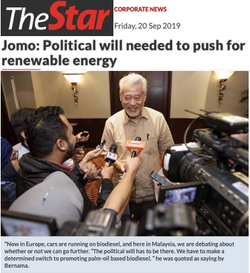
Political will needed to push for renewable energy

The Star 10July 2019

The Star 10July 2019

Malaysian businesses need boost

The Star 9 Oct 2019

The Star 9 Oct 2019

Subsidise public transport for bottom 40%

The Edge 26 Sept 2019

The Edge 26 Sept 2019

Call for measures to counteract global headwinds

The Edge 9 Oct 2019

The Edge 9 Oct 2019

Subsidise public transportation, not fuel

The Star 8 Oct 2019

The Star 8 Oct 2019

Subsidise public transportation for bottom 70%

TheEdge 2Oct 2019

TheEdge 2Oct 2019

"We need to counteract downward forces"

Fake News

PLEASE BEWARE OF MISREPRESENTATIONS OF IMAGES OF JOMO

Commercial and political misrepresentation of his image attributing to him to things which he never said or misrepresenting things he may have said is being circulated on websites such as those posted here. 


You should also be warned, in case you are not already aware, of ‘click bait’ i.e. using such images simply to attract your interest, and then to download your online information for abuse for a variety of ends.

Please inform us and provide a screenshot and weblink to enable further action, which is incredibly difficult. 

Thank you for reading this and for your help and cooperation.

This has also been flagged on his official Facebook page


JKS image ad2.jpg
JKS image Bitcoin ad on  Facebook.jpg
JKS - Fake News 2.jpg
Contact Me
JKS - Fake News 3.jpg
JKS fake news 1.jpg

Nadi Insan by the People's History Centre

Read all editions of #NadiInsan from 1979 to 1983 free of charge at the Peoples History Center website.


Containing writings on socio-political issues, film and cultural commentary, as well as in-depth interviews, Nadi Insan is motivated by community activists and intellectuals in Malaysia.

Happy reading!

Dapatkan kesemua siri majalah #NadiInsan dari tahun 1979 hingga 1983 secara percuma di laman Pusat Sejarah Rakyat.


Berisi tulisan memperihal sosio-politik, ulasan filem dan budaya sehinggalah wawancara yang rencam, Nadi Insan digerakkan oleh aktivis masyarakat dan intelektual di Malaysia.


Selamat membaca!

Contact Me

  • Facebook Social Icon
  • Twitter Social Icon

Thank you for reaching out!

bottom of page