top of page

Follow on Social Media

  • Facebook
  • Twitter
  • Screenshot 2022-09-18 at 5.20.40 PM

M'sia Developments
[on SubStack]

  • Screenshot 2022-09-18 at 5.20.40 PM

Jomo Kwame Sundaram


Few policymakers ever claim credit for causing stagnation and recessions. Yet, they do so all the time, justifying their actions by some supposedly higher purpose.


Now, that higher purpose is checking inflation as if it is the worst option for people today. Many supposed economists make up tall tales that inflation causes economic contraction which ordinary mortals do not know or understand.


Inflating inflation’s significance


Since early 2022, like many others in the world, Americans have been preoccupied with inflation. But official US data show inflation has been slowing since mid-2022.

Recent trends since mid-2022 are clear.

Inflation is no longer accelerating, but slowing. And for most economists, only accelerating inflation gives cause for concern.

Annualized inflation since has only been slightly above the official, but nonetheless arbitrary 2% inflation target of most Western central banks.


At its peak, the brief inflationary surge, in the second quarter of last year, undoubtedly reached the “highest (price) levels since the early 1980s” because of the way it is measured.


After decades of ‘financialization’, the public and politicians unwittingly support moneyed interests who want to minimize inflation to make the most of their financial assets.


War and price


Russia’s aggression against Ukraine began last February, with retaliatory sanctions following suit. Both have disrupted supplies, especially of fuel and food. The inflation spike in the four months after the Russian invasion was mainly due to ‘supply shocks’.


Price increases were triggered by the war and retaliatory sanctions, especially for fuel, food and fertilizer. Although no longer accelerating, prices remain higher than a year before.


To be sure, price pressures had been building up with other supply disruptions. Also, demand has been changing with the new Cold War against China, the Covid-19 pandemic and ‘recovery’, and credit tightening in the last year.


There is little evidence of any more major accelerating factors. There is no ‘wage-price spiral’ as prices have recently been rising more than wages despite government efforts ensuring full employment since the 2008 global financial crisis.


Despite difficulties due to inflation, tens of millions of Americans are better off than before, e.g., with the ten million jobs created in the last two years. Under Biden, wages for poorly paid workers have risen faster than consumer prices.


Higher borrowing costs have also weakened the lot of working people everywhere. Such adverse consequences would be much less likely if the public better understood recent price increases, available policy options and their consequences.


With the notable exception of the Bank of Japan, most other major central banks have been playing ‘catch-up’ with the US Federal Reserve interest rate hikes. To be sure, inflation has already been falling for many reasons, largely unrelated to them.


Making stagnation


But higher borrowing costs have reduced spending, for both consumption and investment. This has hastened economic slowdown worldwide following more than a decade of largely lackluster growth since the 2008 global financial crisis.


Ill-advised earlier policies now limit what governments can do in response. With the Fed sharply raising interest rates over the last year, developing country central banks have been trying, typically in vain, to stem capital outflows to the US and other ‘safe havens’ raising interest rates.


Having opened their capital accounts following foreign advice, developing country central banks always offer higher raise interest rates, hoping more capital will flow in rather than out.


Interestingly, conservative US economists Milton Friedman and Ben Bernanke have shown the Fed has worsened past US downturns by raising interest rates, instead of supporting enterprises in their time of need.


Four decades ago, increased servicing costs triggered government debt crises in Latin America and Africa, condemning them to ‘lost decades’. Policy conditions were then imposed by the International Monetary Fund and World Bank for access to emergency loans.


Globalization double-edged


Economic globalization policies at the turn of the century are being significantly reversed, with devastating consequences for developing countries after they opened their economies to foreign trade and investment.


Encouraging foreign portfolio investment has increasingly been at the expense of ‘greenfield’ foreign direct investment enhancing new economic capacities and capabilities.


The new Cold War has arguably involved more economic weapons, e.g., sanctions, than the earlier one. Trump’s and Japanese ‘reshoring’ and ‘friend-shoring’ discriminate among investors, remaking ‘value’ or ‘supply chains’.


Arguably, establishing the World Trade Organization in 1995 was the high water mark for multilateral trade liberalization, setting a ‘one size fits all’ approach for all, regardless of means. More recently, Biden has continued Trump’s reversal of earlier trade liberalization, even at the regional level.


1995 also saw strengthening intellectual property rights internationally, limiting technology transfers and progress. Recent ‘trade conflicts’ increasingly involve access to high technology, e.g., in the case of Huawei, TSMC and Samsung.


With declining direct tax rates almost worldwide, governments face more budget constraints. The last year has seen these diminished fiscal means massively diverted for military spending and strategic ends, cutting resources for development, sustainability, equity and humanitarian ends.


In this context, the new international antagonisms conspire to make this a ‘perfect storm’ of economic stagnation and regression. Hence, those striving for international peace and cooperation may well be our best hope against the ‘new barbarism’.


Jomo Kwame Sundaram

January 26, 2023


The Edge Malaysia Weekly, for January 23, 2023 - January 29, 2023.

Malaysians should ask why the previous international trade and industry minister Datuk Seri Mohamed Azmin Ali surreptitiously ratified the Comprehensive and Progressive Agreement for Trans-Pacific Partnership (CPTPP) days before the 15th general election, without parliamentary — let alone public — discussion despite his earlier ministerial promise to consult relevant parties.


Hidden costs


The high legal costs of its investor-state dispute settlement (ISDS) provisions need to be emphasised, even when governments win against powerful transnational corporations with deep pockets.


The US’ official reason for withdrawing from the Trans-Pacific Partnership (TPP) was ISDS. Although it had never lost an ISDS case up to that point, the US considered this a major threat, especially after former president Barack Obama cancelled a major pipeline construction project awarded to a Canadian company.


Yet, Malaysian CPTPP lobbyists claim ISDS is not a problem. Any experienced contract lawyer knows how vulnerable any government is, especially developing countries without deep fiscal pockets to bear legal costs.


Even Australia insisted on a tobacco “carve out” (exception) for the TPP after its costly experience fighting US tobacco company Philip Morris all the way to the Australian Supreme Court.


Perhaps the Ministry of International Trade and Industry (Miti) does not consider it a problem as it does not pay the legal bills — often running into tens, if not hundreds, of millions of ringgit — even when the government wins against the corporate plaintiff.


Lower corporate income and other tax rates in other CPTPP jurisdictions are another big problem. Why would any large company want to be registered and pay taxes in Malaysia if it offers no advantage but is more costly in terms of tax liability?


Meanwhile, governments everywhere are trying to increase revenue — especially from wealth, corporate income and windfall taxes — in the face of rising interest rates, economic stagnation and greater fiscal deficits following Covid-19 pandemic measures. The tax rate “race to the bottom”, promoted by the CPTPP, is over.


Exaggerating trade gains


While there will undoubtedly be some increased exports with any free trade agreement (FTA), these have been greatly exaggerated by TPP, and now CPTPP lobbyists, as several studies have shown.


But there is much less attention given to increased imports in most supposed trade projections, which may result in greater net trade deficits. Only FTA lobbyists claim that everybody can simultaneously increase exports, but not imports.

For Malaysia, current projections suggest we will probably import much more Japanese cars and plastic waste from others, thanks to former premier Datuk Seri Najib Razak’s earlier waste processing initiative. But about 85% of plastic waste is not commercially recycled, and hence dumped into landfills in Malaysia.


Supposed World Bank projections promoting the CPTPP were actually done by economists originally hired by the Peterson Institute of International Economics (PIIE) in Washington DC, which accepts funding from lobbyists.


Incredibly, their study claims more gains without US participation although the US economy accounted for two-thirds of the TPP area from an economic point of view. “More (gains) from less (trade)” surely deserves an award for economic fiction.


Even the official US International Trade Council (ITC) doubted the PIIE’s TPP projections and found our sceptical 2016 research paper (by Jere Capaldo, Alex Izurieta and Jomo KS) much more credible and robust.


For Vietnam and Malaysia, access to the US market was the main attraction of the TPP. Surely, the gains from joining the CPTPP, without the US, should be considerably less, even before considering the costs.


Also, 85% of the PIIE’s supposed economic gains from the TPP were from non-trade measures, mainly investments, not trade liberalisation.


The CPTPP lobbyists should also stop pretending that alleged gains projected are from trade liberalisation. More importantly, they need to clearly show where their anticipated economic investment boom is going to come from.

Former US president Donald Trump’s and the late former Japanese prime minister Shinzo Abe’s efforts to “reshore” US and Japanese foreign direct investment in China largely failed. Instead, Malaysia is now benefiting from diverted “friendshoring” interest from the two anti-China allies.


But China is the major trading partner of not only Malaysia, but all of Asean. It is also a major investor in our country. It would therefore be quite foolish and myopic to join either camp in the emerging new Cold War.


Economic agreements are political


The damning ITC report of mid-2016 forced Hillary Clinton to do a political U-turn and reject the TPP in the 2016 US presidential campaign after proposing and advocating the agreement earlier as part of the Obama cabinet.


As the recent IDEAS study, financed by Taiwan’s office in Kuala Lumpur, implicitly acknowledges, the TPP was, and the CPTPP is, about “containing” China, as Obama made very clear when he first suggested it as part of his “pivot to Asia”.

After China expressed interest in joining the CPTPP, Japan and Australia objected on political, not economic, grounds. For the CPTPP, the views of the Ministry of Finance and Wisma Putra are really more important than those of Miti.


When the previous Miti minister had a different portfolio in Tun Dr Mahathir Mohamad’s administration, a study he commissioned cautioned against joining the CPTPP.


So, one might well ask if the rushed ratification is Azmin’s poisoned chalice for the new government. One might also ask who was responsible for releasing and circulating a purported endorsement of CPTPP ratification by the new prime minister.


Jomo Kwame Sundaram, a former economics professor, was United Nations assistant secretary-general for economic development. He is the recipient of the Wassily Leontief Prize for Advancing the Frontiers of Economic Thought.


  • Jan 23, 2023
  • 1 min read

230123 RTM TV1 WEF 2023: Kompas Ekonomi Malaysia https://fb.watch/iefEnrVaSx/


221208 NIEO New International Economic Order+50 Progressive International +50


221127 RTM1 Pasca PRU15 https://youtu.be/au-gMVk2KV0


221121 Astro Awani. PRU 15 dan kesan ekonomi https://youtu.be/etZeMemVhSU


221116 Niaga AWANI: PRU15 | Manifesto tidak jelas depani cabaran ekonomi? https://www.astroawani.com/video-bisnes/niaga-awani-pru15-manifesto-tidak-jelas-depani-cabaran-ekonomi-1996987


Latest Videos

All Videos

All Videos

AN URGENT CALL: A PEOPLE"S VACCINE AGAINST COVID-19

00:00
9 June 2020: IHD-ILO-ISLE Virtual Conference - Day 2

9 June 2020: IHD-ILO-ISLE Virtual Conference - Day 2

05:08:34
Learning in Governance in times of COVID-19

Learning in Governance in times of COVID-19

46:30
Beyond the Lockdown: Towards the ‘New Normal’

Beyond the Lockdown: Towards the ‘New Normal’

59:10

About Jomo

Jomo Kwame Sundaram is Research Adviser, Khazanah Research Institute, Fellow, Academy of Science, Malaysia, and Emeritus Professor, University of Malaya. Previously, he was UN Assistant Secretary-General for Economic Development, Assistant Director General, Food and Agriculture Organization (FAO), Founder-Chair, International Development Economics Associates (IDEAs) and President, Malaysian Social Science Association. 

In The Media

TheStar 26 June 2020

TheStar 26 June 2020

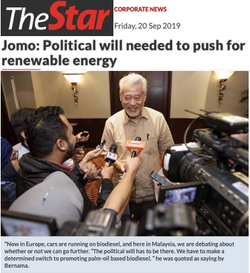
The Star 20 Sept 2019

The Star 20 Sept 2019

Political will needed to push for renewable energy

The Star 10July 2019

The Star 10July 2019

Malaysian businesses need boost

The Star 9 Oct 2019

The Star 9 Oct 2019

Subsidise public transport for bottom 40%

The Edge 26 Sept 2019

The Edge 26 Sept 2019

Call for measures to counteract global headwinds

The Edge 9 Oct 2019

The Edge 9 Oct 2019

Subsidise public transportation, not fuel

The Star 8 Oct 2019

The Star 8 Oct 2019

Subsidise public transportation for bottom 70%

TheEdge 2Oct 2019

TheEdge 2Oct 2019

"We need to counteract downward forces"

Fake News

PLEASE BEWARE OF MISREPRESENTATIONS OF IMAGES OF JOMO

Commercial and political misrepresentation of his image attributing to him to things which he never said or misrepresenting things he may have said is being circulated on websites such as those posted here. 


You should also be warned, in case you are not already aware, of ‘click bait’ i.e. using such images simply to attract your interest, and then to download your online information for abuse for a variety of ends.

Please inform us and provide a screenshot and weblink to enable further action, which is incredibly difficult. 

Thank you for reading this and for your help and cooperation.

This has also been flagged on his official Facebook page


JKS image ad2.jpg
JKS image Bitcoin ad on  Facebook.jpg
JKS - Fake News 2.jpg
Contact Me
JKS - Fake News 3.jpg
JKS fake news 1.jpg

Nadi Insan by the People's History Centre

Read all editions of #NadiInsan from 1979 to 1983 free of charge at the Peoples History Center website.


Containing writings on socio-political issues, film and cultural commentary, as well as in-depth interviews, Nadi Insan is motivated by community activists and intellectuals in Malaysia.

Happy reading!

Dapatkan kesemua siri majalah #NadiInsan dari tahun 1979 hingga 1983 secara percuma di laman Pusat Sejarah Rakyat.


Berisi tulisan memperihal sosio-politik, ulasan filem dan budaya sehinggalah wawancara yang rencam, Nadi Insan digerakkan oleh aktivis masyarakat dan intelektual di Malaysia.


Selamat membaca!

Contact Me

  • Facebook Social Icon
  • Twitter Social Icon

Thank you for reaching out!

bottom of page