top of page

Follow on Social Media

  • Facebook
  • Twitter
  • Screenshot 2022-09-18 at 5.20.40 PM

M'sia Developments
[on SubStack]

  • Screenshot 2022-09-18 at 5.20.40 PM

Updated: Aug 4, 2022

Anis Chowdhury and Jomo Kwame Sundaram


SYDNEY and KUALA LUMPUR. Colonial-style currency board arrangements have enabled continuing imperialist exploitation decades after the end of formal colonial rule. Such neo-colonial monetary systems persist despite modest reforms.


In 2019, Italian Deputy Prime Minister Luigi Di Maio accused France of using currencyarrangements to “exploit” its former African colonies, “impoverishing Africa” and causing refugees to “leave and then die in the sea or arrive on our coasts”.


Neo-colonial CFA

As France ratified the Bretton Woods Agreement (BWA) on 26 December 1945, it established the Colonies Françaises d’Afrique (CFA) franc zone, enabling France to update pre-war colonial monetary arrangements.


The ostensible intent of the ‘Franc of the French Colonies of Africa’ (FCFA) was to cushion its colonies from the drastic French franc (FF) devaluation required to peg its value to the US dollar, as agreed at Bretton Woods.


Then French finance minister René Pleven claimed, “In a show of her generosity and selflessness, metropolitan France, wishing not to impose on her faraway daughters the consequences of her own poverty, is setting different exchange rates for their currency”.


In December 1958, the CFA franc became the ‘Franc of the Communauté Financière Africaine’ (still FCFA). In 1960, President Charles de Gaulle made CFA membership a pre-condition for French decolonization in West and Central Africa.


The CFA recently involved 14 mainly Francophone sub-Saharan African countries belonging to two currency unions, both using the CFA franc (FCFA): the West African Economic and Monetary Union (UEMOA) and the Economic and Monetary Community of Central Africa (CEMAC).


UEMOA comprises Benin, Burkina Faso, Côte d’Ivoire, Guinea-Bissau, Mali, Niger, Senegal and Togo, while CEMAC includes Cameroon, the Central African Republic, Republic of Congo, Gabon, Equatorial Guinea and Chad.


France’s ‘incontestable advantages’


De Gaulle’s finance minister, and later President, Valéry Giscard d’Estaing correctly complained about the US dollar’s “exorbitant privilege”. But he seemed blissfully ignorant of the French Socio-Economic Council’s 1970 report on the CFA’s “incontestable advantages for France”.


First, France could pay for imports from CFA countries with its own currency, saving foreign exchange for other international obligations. This became especially advantageous when the FF was weak and unstable.


Second, the French Treasury often paid negative real interest rates for CFA reserves. Thus, CFA countries have been paying it to hold their foreign reserves! Investment income is then deployed as French aid to CFA countries in the form of loans to be repaid with interest!


But CFA countries themselves cannot use their own reserves as collateral to secure credit as these are held by the French Treasury. Thus, during the global financial crisis, they had to borrow, mainly from France, at commercial rates.


Third, by supplying FCFA at the fixed rate, seignioragethe difference between the cost of issuing currency and its face value – has effectively accrued to France and, more recently, the European Central Bank.


For every euro so deposited, the FCFA equivalent is issued and made available to the depositing country. When France joined the euro in 1999, one euro fetched 6.55957 FFs, or 655.957 FCFA.


CFA economies have thus effectively ceded monetary sovereignty to the French Treasury. Unsurprisingly, France’s monetary control has served its own, rather than CFA members’ economic interests.


Fourth, French companies operating in the CFA have been able to freely repatriate funds without incurring any foreign exchange risk. Worse, when CFA countries have faced foreign exchange problems, France has made things worse!


CFA elites, French patrons


The CFA not only benefits France, but also elites in CFA countries. Their appetite for faux French lifestyles explains their preference for overvalued exchange rates.


The CFA also facilitates financial outflows, no matter how illicitly acquired, as long as they do not challenge the neo-colonial status quo. For decades, all manner of French governments have consistently backed these elites, typically supporting despotic rule.


When its interests in Africa have been threatened, France has unilaterally deployed combat troops and superior armaments, always insisting on its ‘legitimate’ right to do so.


France is alleged to be behind military coups and even assassinations of prominent personalitiescritical of its interests, policies and stratagems. On 13 January 1963, only two days after issuing its own currency, Togo President Sylvanus Olympio was killed in a coup.


In 1968, six years after withdrawing Mali from the CFA, its independence leader and first President, Modibo Keita was ousted in a coup after trying to develop its economy along more independent and progressive lines.


Plus ça change, plus c’est la même chose


When the CFA was first created in 1945, the colonies deposited 100% of their foreign exchange reserves in a special French Treasury ‘operating account’. This requirement was reduced to 65% from 1973 to 2005, and then to 50%, plus an additional 20% for daily foreign currency transactions or “financial liabilities”.


Thus, CFA states are still deprived of most of their foreign exchange earnings, retaining only 30%! Meanwhile, Banque de France holds 90% of CFA gold reserves, making it the world’s fourth largest holder of gold reserves.


The FCFA arrangement was supposed to end for UEMOA countries from 20 May 2020. While only six former French colonies in Central Africa formally remain in the CFA, the reform is less than meets the eye.


France remains UEMOA’s ‘financial guarantor’, appointing an ‘independent’ member to its central bank board. Meanwhile, the proposed West African ‘eco’ currency is still not yet in circulation, while the transfer of euro reserves from the French Treasury to the West African Central Bank has yet to happen.


After its creation, FCFA parity was set at 50 to one FF. On 12 January 1994, the FCFA was devalued by half, as demanded by the International Monetary Fund, with support from France. This followed problems due to commodity price slumps.


The devaluation shocked CFA economies as the FCFA’s value fell by half overnight! This pushed up prices of imported goods, including food, while increasing the FF’s purchasing power.


Meanwhile, eight FF devaluations between 1948 and 1986 against the US dollar and gold have also meant great losses to the value of CFA reserves. CFA countries have ostensibly benefitted from anchoring the FCFA to a supposedly stable FF. But in fact, the FF experienced a 70% cumulative devaluation over this period!


Less inflation, no development


CFA advocates also claim that pegging the West and Central African FCFA to the FF, and later the euro, has ensured less inflation than in other African countries. But CFA members “traded decreased inflation for fiscal restraint and limited macroeconomic options”.


The cost of lower inflation “has been slower per capita growth and diminished poverty reduction”. They have had lower growth, on average, than in non-CFA countries. Eleven of the 14 CFA member states are least developed countries at the bottom of UNDP’s Human Development Index.


The CFA has also limited credit for economic growth and industrialization. This has been seen in lower credit-GDP ratios of between 10% to 25% in CFA countries, against over 60% in other Sub-Saharan African countries. These lower ratios also reflect weak financial and banking sectors, unable to be effectively developmental.


The CFA has also not enhanced trade among members. After six decades, trade among CEMAC and UEMOA members averaged 4.7% and 12% of total trade respectively – much less than, say, ASEAN’s 23%. Low intra-CFA trade and pegged exchange rates have ensured persistent balance of payments imbalances.


The currency arrangement also encourages capital outflows. Aggregate net capital flight out of CFA countries during 1970-2010 averaged $83.5 billion, 117% of combined GDP! Unregulated capital transfers between CFA countries and France have enabled much more capital flight than elsewhere during 1970-2015.


No sovereignty, no development


Socialist Party President François Mitterrand was no less neo-colonial. He warned that without control of Africa, France would become irrelevant in the 21st century.


In January 2001, French President Jacques Chirac admitted, “While speaking of Africa, we must check our memory. We started draining the continent four and a half centuries ago with the slave trade. Next, we discovered their raw materials and seized them.


“Having deprived Africans of their wealth, we sent in our elites who destroyed their culture. Now, we are depriving them of their brains thanks to scholarships … [as] the most intelligent students do not go back to their countries … In the end, noticing that Africa is not in a good state … we are giving lectures”.


In 2008, Chirac noted, “We have to be honest and acknowledge that a big part of the money in our banks comes precisely from the exploitation of the African continent. Without Africa, France will slide down [to] the rank of a Third World power.”

Claiming to be from a different generation, President Emmanuel Macron promised to end such neo-colonial arrangements. Yet, at the 2017 G20 Summit, he patronizingly declared Africa’s problem “civilizational”.


Such neo-colonial condescension refuses to acknowledge France’s continued exploitation of its West and Central African ex-colonies. Clearly, CFA currency arrangements have limited their economic policy space and progress.


Colonial style exploitation has thus continued in Africa long after decolonization. Unsurprisingly, Chad President Idriss Deby declared, “we must have the courage to say there is a cord preventing development in Africa that must be severed”.


Related IPS commentaries

Africa Taken for ‘Neo-Colonial’ Ride. 26 Jul 2022. https://www.ipsnews.net/2022/07/Africa-taken-neo-colonial-ride/

Out of Africa: Rich Continent, Poor People. 3 May 2022. https://www.ipsnews.net/2022/05/Africa-rich-continent-poor-people/

Hunger in Africa, Land of Plenty. 14 Oct 2017. http://www.ipsnews.net/2017/10/hunger-africa-land-plenty/


Africa taken for ‘neo-colonial’ ride

Anis Chowdhury and Jomo Kwame Sundaram

SYDNEY and KUALA LUMPUR. Like so many others, Africans have long been misled. Alleged progress under imperialism has long been used to legitimize exploitation. Meanwhile, Western colonial powers have been replaced by neo-colonial governments and international institutions serving their interests.

‘Shithole’ pots of gold 

US President Donald Trump’s “shitholes”, mainly in Africa, were and often still are ‘pots of gold’ for Western interests. From 1445 to 1870, Africa was the major source of slave labour, especially for Europe’s ‘New World’ in the Americas. 

Walter Rodney’s How Europe Underdeveloped Africa noted “colonised Africans, like pre-colonial African chattel slaves, were pushed around into positions which suited European interests and which were damaging to the African continent and its peoples.” 

The ‘scramble for Africa’ from the late nineteenth century saw European powers racing to secure raw materials monopolies through direct colonialism. Western powers all greatly benefited from Africa’s plunder and ruin. 

European divide-and-conquer tactics typically also had pliant African collaborators. Colonial powers imposed taxes and forced labour to build infrastructure to enable raw material extraction. 

Racist ideologies legitimized European imperialism in Africa as a “civilizing mission”. Oxford-trained, former Harvard history professor Niall Ferguson – an unabashed apologist for Western imperialism – insists colonialism laid the foundations for modern progress

Richest, but poorest and hungriest!

A recent blog asks, “Why is the continent with 60% of the world’s arable land unable to feed itself? … And how did Africa go from a relatively self-sufficient food producer in the 1970s to an overly dependent food importer by 2022?”

Deeper analyses of such uncomfortable African realities seem to be ignored by analysts influenced by the global North, especially the Washington-based international financial institutions. UNCTAD’s 2022 Africa report is the latest to disappoint. 

It does not guide African governments on how to actually implement its long list of recommendations given their limited policy space, resources and capabilities. Worse, their proposals seem indistinguishable from an Africa-oriented version of the discredited neoliberal Washington Consensus.

With 30% of the world’s mineral resources and the most precious metal reserves on Earth, Africa has the richest concentration of natural resources – oil, copper, diamonds, bauxite, lithium, gold, tropical hardwood forests and fruits. 

Yet, Africa remains the poorest continent, with the average per capita output of most countries worth less than $1,500 annually! Of 46 least developed countries, 33 are in Africa – more than half the continent’s 54 nations

Africa remains the world’s least industrialized region, with only South Africa categorized as industrialized. Incredibly, Africa’s share of global manufacturing fell from about 3% in 1970 to less than 2% in 2013.

About 60% of the world’s arable land is in Africa. A net food exporter until the 1970s, the continent has become a net importer. Structural adjustment reform conditionalities – requiring trade liberalization – have cut tariff revenue, besides undermining import-substituting manufacturing and food security. 

Sub-Saharan Africa accounts for 24% of the world’s hungry. Africa is the only continent where the number of undernourished people has increased over the past four decades. About 27.4% of Africa’s population was ‘severely food insecure’ in 2016.

In 2020, 281.6 million Africans were undernourished, 82 million more than in 2000! Another 46 million became hungry during the pandemic. Now, Ukraine sanctions on wheat and fertilizer exports most threaten Africa’s food security, in both the short and medium-term.

Structural adjustment

Many of Africa’s recent predicaments stem from structural adjustment programs (SAPs) much of Africa and Latin America have been subjected to from the 1980s. The Washington-based international financial institutions, the African Development Bank and all donors support the SAPs. 

SAP advocates promised foreign direct investment and export growth would follow, ensuring growth and prosperity. Now, many admit neoliberalism was oversold, ensuring the 1980s and 1990s were ‘lost decades’, worsened by denial of its painfully obvious consequences. 

Instead, ‘extraordinarily disadvantageous geography’, ‘high ethnic diversity’, the ‘natural resource curse’, ‘bad governance’, corrupt ‘rent-seeking’ and armed conflicts have been blamed. Meanwhile, however, colonial and neo-colonial abuse, exploitation and resource plunder have been denied.

While World Bank SAPs were officially abandoned in the late 1990s following growing criticism, replacements – such as Poverty Reduction Strategy Papers – have been like “old wine in new bottles”. Although purportedly ‘home-grown’, they typically purvey bespoke versions of SAPs.

With trade liberalization and greater specialization, many African countries are now more dependent on fewer export commodities. With more growth spurts during commodity booms, African economies have become even more vulnerable to external shocks

Can the West be trusted?

Earlier, G7 countries reneged on their 2005 Gleneagles pledge – to give $25 billion more yearly to Africa to ‘Make Poverty History’ – within the five years they gave themselves. Since then, developed countries have delivered far less than the $100 billion of climate finance annually they had promised developing nations in 2009.

The Hamburg G20’s 2017 ‘Compact with Africa’ (CwA) promised to combat poverty and climate change effects. In fact, CwA has been used to promote the business interests of donor countries, particularly Germany. 

Primarily managed by the World Bank and the International Monetary Fund, CwA has actually failed to deliver significant foreign investment, instead sowing confusion among participating countries. 

Powerful Organization for Economic Cooperation and Development governments successfully blocked developing countries’ efforts at the 2015 Addis Ababa UN conference on financing for development for inclusive UN-led international tax cooperation and to stem illicit financial outflows.

Africa lost $1.2–1.4 trillion in illicit financial flows between 1980 and 2009 – about four times its external debt in 2013. This greatly surpasses total official development assistance received over the same period. 

Africa must unite

Under Nelson Mandela’s leadership, Africa had led the fight for the ‘public health exception’ to international intellectual property law. Although Africa suffers most from ‘vaccine apartheid’, Western lobbyists blocked developing countries’ temporary waiver request to affordably meet pandemic needs.

African solidarity is vital to withstand pressures from powerful foreign governments and transnational corporations. African nations must also cooperate to build state capabilities to counter the neoliberal ‘good governance’ agenda. 

Africa needs much more policy space and state capabilities, not economic liberalization and privatization. This is necessary to unlock critical development bottlenecks and overcome skill and technical limitations.

Related IPS commentaries

Hunger in Africa, Land of Plenty. 14 Oct 2017. http://www.ipsnews.net/2017/10/hunger-africa-land-plenty/

Racism, Shitholes and Re-election. 23 Jun 2020. http://www.ipsnews.net/2020/06/racism-shitholes-re-election/

To Eliminate Poverty, Better Understanding Needed. 18 Oct 2017. http://www.ipsnews.net/2017/10/eliminate-poverty-better-understanding-needed/


Reject CPTPP, stay out of new Cold Wa

Jomo Kwame Sundaram and Anis Chowdhury


KUALA LUMPUR. Joining or ratifying dubious trade deals is supposed to offer miraculous solutions to recent lacklustre economic progress. Such naïve advocacy is misleading at best, and downright irresponsible, even reckless, at worst.


TPP ‘pivot to Asia’

US President Barack Obama’s ‘pivot to Asia’ after his 2012 re-election sought to check China’s sustained economic growth and technological progress. Its economic centrepiece was the Trans-Pacific Partnership (TPP).

But the US International Trade Commission (ITC) doubted the Washington-based Peterson Institute for International Economics (PIIE) and other exaggerated claims of significant TPP economic benefits in mid-2016, well before US President Donald Trump’s election.

The ITC report found projected TPP growth gains to be paltry over the long-term. Its finding was in line with the earlier 2014 findings of the Economic Research Service of the US Department of Agriculture.

Meanwhile, many US manufacturing jobs have been lost to corporations automating and relocating abroad. Worse, Trump’s rhetoric has greatly transformed US public discourse. Many Americans now blame globalization, immigration, foreigners and, increasingly, China for the problems they face.


Trump U-turn

The TPP was believed to be dead and buried after Trump withdrew the US from it immediately after his inauguration in January 2017. After all, most aspirants in the November 2016 election – including Hillary Clinton, once a TPP cheerleader – had opposed it in the presidential campaign.

Trump National Economic Council director Gary Cohn has accused presidential confidantes of ‘dirty tactics’ to escalate the trade war with China.

Cohn acknowledged “he didn’t quit over the tariffs, per se, but rather because of the totally shady, ratfucking way Commerce Secretary Wilbur Ross and economic adviser Peter Navarro went about convincing the president to implement them.”

Cohn, previously Goldman Sachs president, insisted it “was a terrible idea that would only hurt the US, and not extract the concessions from Beijing Trump wanted, or do anything to shrink the trade deficit.”

But US allies against China, the Japanese, Australian and Singapore governments have tried to keep the TPP alive. First, they mooted ‘TPP11’ – without the USA.

This was later rebranded the Comprehensive and Progressive TPP (CPTPP), with no new features to justify its ‘progressive’ pretensions. Following its earlier support for the TPP, the PIIE has been the principal cheerleader for the CPTPP in the West.

Although US President Joe Biden was loyal as Vice-President, he did not make any effort to revive Obama’s TPP initiative during his campaign, or since entering the White House. Apparently, re-joining the TPP is politically impossible in the US today.

Panning the Trump approach, Biden’s US Trade Representative has stressed, “Addressing the China challenge will require a comprehensive strategy and more systematic approach than the piecemeal approach of the recent past.” Now, instead of backing off from Trump’s belligerent approach, the US will go all out.


Favouring foreign investors

Rather than promote trade, the TPP prioritized transnational corporation (TNC)-friendly rules. The CPTPP did not even eliminate the most onerous TPP provisions demanded by US TNCs, but only suspended some, e.g., on intellectual property (IP). Suspension was favoured to induce a future US regime to re-join.

Onerous TPP provisions – e.g., for investor-state dispute settlement (ISDS) – remain. This extrajudicial system supersedes national laws and judiciaries, with secret rulings by private tribunals not bound by precedent or subject to appeal.

Lawyers have been advising TNCs on how to sue host governments for resorting to extraordinary COVID-19 measures since 2020. Most countries can rarely afford to incur huge legal costs fighting powerful TNCs, even if they win.

The Trump administration cited vulnerability to onerous ISDS provisions to justify US withdrawal from the TPP. Now, citizens of smaller, weaker and poorer nations are being told to believe ISDS does not pose any real threat to them!

After ratifying the CPTPP, TNCs can sue governments for supposed loss of profits due to policy changes – even if in the national or public interest, e.g., to contain COVID-19 contagion, or ensure food security.

Thus, supposed CPTPP gains mainly come from expected additional foreign direct investment (FDI) due to enhanced investor benefits – not more trade. This implies more host economy concessions, and hence, less net benefits for them.


Who benefits?

Those who have seriously studied the CPTPP agree it offers even fewer benefits than the TPP. After all, the main TPP attraction was access to the US market, now no longer a CPTPP member. Thus, the CPTPP will mainly benefit Japanese TNC exports subject to lower tariffs.

Unsurprisingly, South Korea and Taiwan want to join so that their TNCs do not lose out. China too wants to join, but presumably also to ensure the CPTPP is not used against it. However, the closest US allies are expected to block China.

The Soviet Union sought to join NATO in the 1950s before convening the Warsaw Pact to counter it. Russian President Vladimir Putin also tried to join NATO years after Vaclav Havel ended the Warsaw Pact and Boris Yeltsin dissolved the Soviet Union in 1991.

Unlike Northeast Asian countries, Southeast Asian economies seek FDI. But when foreign investors are favoured, domestic investors may relocate abroad, e.g., to ‘tax havens’ within the CPTPP, often benefiting from special incentives for foreign investment, even if ‘roundtrip’.


Stay non-aligned

The ‘pivot to Asia’ has become more explicitly military. As the new Cold War unfolds, foreign policy considerations – rather than serious expectations of significant economic benefits from the CPTPP – have become more important.

Trade protectionism in the North has grown since the 2008 global financial crisis. More recently, the pandemic has disrupted supply chains. With the new Cold War, the US, Japan and others are demanding their TNCs ‘onshore’, i.e., stop investing in and outsourcing to China, also hurting transborder suppliers.

Hence, net gains from joining the CPTPP – or from ratifying it for those who signed up in 2018 – are dubious for most, especially with its paltry benefits. After all, trade liberalization only benefits everyone when ‘winners’ compensate ‘losers’ – which neither the CPTPP nor its requirements do.

With big powers clashing in the new Cold War, developing countries should remain ‘non-aligned’ – albeit as appropriate for these new times. They should not take sides between the dominant West and its adversaries – led by China, the major trading partner, by far, for more and more countries.


Related IPS articles

Weaponizing Free Trade Agreements. Jul 05, 2022

Model Trade Deal Con. Feb 26, 2018

Lessons from the Demise of the TPP. January 5, 2017


Latest Videos

All Videos

All Videos

AN URGENT CALL: A PEOPLE"S VACCINE AGAINST COVID-19

00:00
9 June 2020: IHD-ILO-ISLE Virtual Conference - Day 2

9 June 2020: IHD-ILO-ISLE Virtual Conference - Day 2

05:08:34
Learning in Governance in times of COVID-19

Learning in Governance in times of COVID-19

46:30
Beyond the Lockdown: Towards the ‘New Normal’

Beyond the Lockdown: Towards the ‘New Normal’

59:10

About Jomo

Jomo Kwame Sundaram is Research Adviser, Khazanah Research Institute, Fellow, Academy of Science, Malaysia, and Emeritus Professor, University of Malaya. Previously, he was UN Assistant Secretary-General for Economic Development, Assistant Director General, Food and Agriculture Organization (FAO), Founder-Chair, International Development Economics Associates (IDEAs) and President, Malaysian Social Science Association. 

In The Media

TheStar 26 June 2020

TheStar 26 June 2020

The Star 20 Sept 2019

The Star 20 Sept 2019

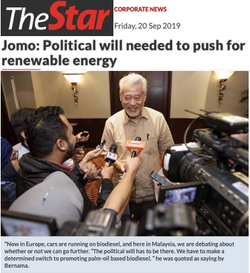
Political will needed to push for renewable energy

The Star 10July 2019

The Star 10July 2019

Malaysian businesses need boost

The Star 9 Oct 2019

The Star 9 Oct 2019

Subsidise public transport for bottom 40%

The Edge 26 Sept 2019

The Edge 26 Sept 2019

Call for measures to counteract global headwinds

The Edge 9 Oct 2019

The Edge 9 Oct 2019

Subsidise public transportation, not fuel

The Star 8 Oct 2019

The Star 8 Oct 2019

Subsidise public transportation for bottom 70%

TheEdge 2Oct 2019

TheEdge 2Oct 2019

"We need to counteract downward forces"

Fake News

PLEASE BEWARE OF MISREPRESENTATIONS OF IMAGES OF JOMO

Commercial and political misrepresentation of his image attributing to him to things which he never said or misrepresenting things he may have said is being circulated on websites such as those posted here. 


You should also be warned, in case you are not already aware, of ‘click bait’ i.e. using such images simply to attract your interest, and then to download your online information for abuse for a variety of ends.

Please inform us and provide a screenshot and weblink to enable further action, which is incredibly difficult. 

Thank you for reading this and for your help and cooperation.

This has also been flagged on his official Facebook page


JKS image ad2.jpg
JKS image Bitcoin ad on  Facebook.jpg
JKS - Fake News 2.jpg
Contact Me
JKS - Fake News 3.jpg
JKS fake news 1.jpg

Nadi Insan by the People's History Centre

Read all editions of #NadiInsan from 1979 to 1983 free of charge at the Peoples History Center website.


Containing writings on socio-political issues, film and cultural commentary, as well as in-depth interviews, Nadi Insan is motivated by community activists and intellectuals in Malaysia.

Happy reading!

Dapatkan kesemua siri majalah #NadiInsan dari tahun 1979 hingga 1983 secara percuma di laman Pusat Sejarah Rakyat.


Berisi tulisan memperihal sosio-politik, ulasan filem dan budaya sehinggalah wawancara yang rencam, Nadi Insan digerakkan oleh aktivis masyarakat dan intelektual di Malaysia.


Selamat membaca!

Contact Me

  • Facebook Social Icon
  • Twitter Social Icon

Thank you for reaching out!

bottom of page