top of page

Follow on Social Media

  • Facebook
  • Twitter
  • Screenshot 2022-09-18 at 5.20.40 PM

M'sia Developments
[on SubStack]

  • Screenshot 2022-09-18 at 5.20.40 PM
  • Jul 11, 2022
  • 5 min read

Anis Chowdhury and Jomo Kwame Sundaram


SYDNEY and KUALA LUMPUR. Long a means for powerful nations to influence developing countries, development finance has gained renewed significance in the new Cold War. Unlike during the US-Soviet Cold War, the rivalry now is between mixed market capitalist systems.


Development aid rivalry

After reneging repeatedly on development aid and climate finance promises, the G7 big rich nations dutifully lined up behind US President Biden’s Partnership for Global Infrastructure and Investment (PGII) at their 2022 Summit in Schloss Elmau, Germany.

With a $200bn US commitment, the G7 promised to mobilize $600bn in public and private funds for infrastructure investments in developing countries to compete with China’s multitrillion dollar Belt and Road Initiative (BRI).

The White House denounces BRI, claiming the PGII offers “values driven, high-quality, and sustainable infrastructure”. Hence, G7 funding is more likely to have strings attached, e.g., taking sides in the new Cold War.

A Chinese foreign ministry spokesman emphasized, “China continues to welcome all initiatives to promote global infrastructure development”, but insisted China is “opposed to pushing forward geopolitical calculations under the pretext of infrastructure construction or smearing the Belt and Road Initiative”.


US national security priority

At the 2021 G7 Summit, Biden had unveiled a similar Build Back Better World (B3W) initiative, insisting it would define the G7 alternative to China’s BRI. Based on his domestic Build Back Better (BBB) programme, B3W was soon ‘dead in the water’ when the Senate rejected BBB.

The White House’s claim that with the B3W, the “United States is rallying the world’s democracies to deliver for our people, meet the world’s biggest challenges, and demonstrate our shared values” has also been dropped from PGII.

With few B3W details forthcoming, the European Union (EU) launched its own Global Gateway for developing countries in December 2021, promising €300bn in infrastructure investments by 2027.

At the EU-African Union Summit in February 2022, the EU announced €150bn financing for the Africa-Europe Investment Package, half the Global Gateway budget.

EU leaders have touted their Global Gateway, suggesting G7 initiatives should be not only complementary, but also mutually reinforcing. But the EU’s African priority is not necessarily shared by other G7 members.

EU funding of €135bn will be from the European Fund for Sustainable Development. The UK Clean Green Initiative, from the 2021 Glasgow Climate Summit, and Japan’s $65bn for regional connectivity may also not be additional.

Acknowledging scepticism about how much is new money, German Chancellor Olaf Scholz urged G7 members to present their pledges consistently to allay doubts about double-counting and the low grants share viz loans.

When the PGII was announced to replace the B3W, it “created significant confusion”. Making clear its purpose, the White House unequivocally asserted PGII will “advance U.S. national security”.


Far-fetched, risky, conditional

The G7 also urges using public money to leverage private sector funds. But such initiatives have previously failed to mobilize significant private funding – hardly inspiring hope of meeting the trillion-dollar financing gap.

The Economist has found blended finance – mixing public, charitable and private money – “starry-eyed” and “struggling to take off”. Even the International Monetary Fund (IMF) and World Bank warn public-private partnerships (PPPs) incur contingent fiscal risks.

Worse, PPPs distort national priorities, favour private investors and worsen debt crises. They have also not improved equity of access, reduced poverty or enhanced sustainability.

Developing country debt crises typically involve commercial loans or private sector money. For example, the 1980s’ Latin American debt crises were triggered by US Fed interest rate hikes to kill inflation.

Private sector loans usually involve higher interest rates and shorter repayment periods than loans from governments and multilateral development banks. Unsurprisingly, they lack equitable restructuring or refinancing mechanisms.

Ignoring yet another UN resolution, powerful nations disregard developing countries’ appeals for fair and orderly multilateral sovereign debt restructuring arrangements. Similarly, the West refuses to fix unfair trade, tax and other rules disadvantaging poorer countries.


Trust deficit

Over half a century ago, rich nations promised 0.7% of their gross national income (GNI) as development aid. But total overseas development assistance (ODA) from rich Organization for Economic Development and Cooperation (OECD) members has barely exceeded half the promised amount.

Worse, the share has actually declined from 0.54% in 1961, with only five nations consistently meeting their 0.7% commitment in many years. Oxfam estimated 50 years of unkept promises meant a $5.7 trillion aid shortfall by 2020!

At the 2005 Gleneagles Summit, G7 leaders pledged to double their aid by 2010, earmarking $50bn yearly for Africa. But actual delivery has been woefully short, with no transparent reporting or accountability.

Most development aid is neither transparent nor predictable. After some earlier progress in untying, aid is increasingly being ‘tied’ again – requiring recipients to implement donor projects or to buy from donor country suppliers – compromising effectiveness.

The US ranked lowest among the G7, giving only 0.18% in 2021. To make things worse, US aid effectiveness is worst among the world’s 27 wealthiest nations. Clearly, besides aid volume shortfalls, quality is also at issue.

The Syrian refugee crisis and Covid-19 pandemic have provided some recent pretexts to cut aid. Some powerful countries have turned to ‘creative accounting’, e.g., counting refugee settlement and ‘peace-keeping’ military operations costs as ODA.

Unsurprisingly, the UN Deputy Secretary-General is “deeply troubled over recent decisions and proposals to markedly cut” ODA to service Ukraine war impacts on refugees.

Controversies over what climate finance is ‘new and additional’ to ODA have not been resolved since the 1992 adoption of the UN Framework Convention on Climate Change at the Rio Earth Summit.

G7 countries also fell far short of rich countries’ 2009 pledge to annually give $100bn in climate finance until 2020 to help developing countries adapt to and mitigate global warming.

The OECD’s reported $79.6bn in climate finance in 2019 was the highest ever. But OECD estimates are much disputed – e.g., for double counting and including non-concessional commercial loans, ‘rolled-over’ loans and private finance.


Cooperation, not conflict

Although China is new to development finance, it is now among the world’s biggest development financiers. Following broken promises and duplicity, even betrayal, China’s significance has increased as OECD donor funding declined relatively.

China is now a bigger player in international development finance than the world’s six major multilateral financial institutions together. Many developing countries have few options but to engage with, if not rely on, China.

Undoubtedly, there are justifiable concerns over China’s development finance and practices. These have included adverse environmental impacts, poor transparency and a high share of commercial loans – even if at concessional rates.

In 2019, IMF Managing Director Christine Lagarde suggested the new BRI phase would “benefit from increased transparency, open procurement with competitive bidding, and better risk assessment in project selection”.

Lagarde approved of China’s new debt sustainability framework and green investment principles to evaluate BRI projects. She expected “BRI 2.0 … will be guided by a spirit of collaboration, transparency, and a commitment to sustainability that will serve all of its members well, both today and tomorrow”.

The new Cold War may well spur more healthy and peaceful rivalry, inadvertently improving development aid and prospects for developing countries.


Related IPS commentaries

Climate Hypocrisy Ensures Global Warming. 28 Jun 2022. https://www.ipsnews.net/2022/06/climate-hypocrisy-ensures-global-warming/

China Debt Traps in the New Cold War. 12 Apr 2022. https://www.ipsnews.net/2022/04/china-debt-traps-new-cold-war/

World Bank Urges Governments to Guarantee Private Profits. 24 Nov 2020. https://www.ipsnews.net/2020/11/world-bank-urges-governments-guarantee-private-profits/

World Bank’s ‘Mobilizing Finance for Development’ Not Financing Development. 25 Aug 2020. https://www.ipsnews.net/2020/08/world-banks-mobilizing-finance-development-not-financing-development/

Can Private Finance Really Serve Humanity? 14 Jul 2020. http://www.ipsnews.net/2020/07/can-private-finance-really-serve-humanity/

Hospital PPPs Undermine Healthcare. 22 Jan 2019. http://www.ipsnews.net/2019/01/hospital-ppps-undermine-healthcare/

Blending Finance Not SDG Financing Silver Bullet. 30 Apr 2018. http://www.ipsnews.net/2018/04/blending-finance-not-sdg-financing-silver-bullet/

Scaling up Development Finance. 5 Sep 2017. http://www.ipsnews.net/2017/09/scaling-development-finance/


Anis Chowdhury and Jomo Kwame Sundaram


SYDNEY and KUALA LUMPUR. Long seen as means to seek advantage on the pretext of providing mutual benefit, free trade agreements (FTAs) may increasingly be used as economic weapons in the emerging new Cold War.


Pivot to Asia, containing China

In November 2009, President Obama observed, “in an inter-connected world, power does not need to be a zero-sum game… the United States does not seek to contain China”.

But Obama soon changed course with his ‘pivot to Asia’, first announced in November 2011. After his re-election in 2012, the Trans-Pacific Partnership (TPP) became the economic centrepiece of the new US strategy to check China’s growth and technological progress.

His US Trade Representative (USTR) claimed the TPP was based on principles the US champions, such as protecting intellectual property (IP) and human rights. While claiming all who accept its principles would be welcome to join, China was conspicuously not among countries negotiating the TPP.

For Washington, this new rivalry with China involves strengthened US alliances with Japan, South Korea and Australia. In October 2011, the US Congress ratified the Korea-US (KORUS) FTA.

With the military and economic containment of China central to US security strategy, the TPP was concluded in 2015. Obama emphasized, “TPP allows America – and not countries like China – to write the rules of the road in the 21st century.”

Creating an “anyone but China club” was the US motive for establishing the TPP. But with changed public sentiment since Trump’s presidency, once Obama’s loyal Vice-President, now President Biden did not attempt to revive the TPP during his presidential campaign, or since.


Security alliances

“American prosperity and security are challenged by an economic competition playing out in a broader strategic context… We must work with like-minded allies and partners to ensure our principles prevail and the rules are enforced so that our economies prosper”, noted President Trump’s national security strategy.

Accordingly, the ‘Quad’ – Quadrilateral Security Dialogue group for maritime cooperation of the US, Australia, India and Japan, initiated after the 2004 Indian Ocean tsunami – has become a putative anti-China security arrangement.

By 2020, leaders of all four countries were more aligned in their concerns about China’s rise. In November 2020, navies of all four countries participated in their first joint military exercise in over a decade.

Meanwhile, under Shinzo Abe, Japan radically transformed its security policy. Abe has greatly expanded the Japan Self-Defence Forces’ role, mission and capabilities within and beyond the US-Japan alliance, especially in East Asia.

‘Defence cooperation’ has also been enhanced through country-to-country arrangements, such as the recent Japan-Australia Reciprocal Access Agreement as well as the earlier Japan-India Acquisition and Cross Servicing Agreement.

The US security profile in the region has been boosted by the AUKUS (Australia-UK-USA) alliance. Its clear intention is to enhance the US and its allies military presence in the Indo-Pacific, with the greatest ‘China focus’ of all regional security arrangements.


World hegemony

The US is also linking trade to its national security strategy, especially to contain China, in Africa and Latin America. As the USTR notes, “The Biden Administration is conducting a comprehensive review of U.S. trade policy toward China as part of its development of its overall China strategy”.

Her office also emphasizes, “Addressing the China challenge will require a comprehensive strategy and more systematic approach than the piecemeal approach of the recent past.”

Reflecting his Interim National Security Strategic Guidance, Biden emphasizes, “The United States must renew its enduring advantages…; modernize our military capabilities…; and revitalize America’s unmatched network of alliances and partnerships”. He notes “growing rivalry with China, Russia… reshaping every aspect of our lives”.

Biden insists his administration “will make sure that the rules of the international economy are not tilted against the United States. We will enforce existing trade rules and create new ones… This agenda will strengthen our enduring advantages, and allow us to prevail in strategic competition with China or any other nation”.

His administration announced a review of all Trump-era trade negotiations. Due to expire in 2025, President Clinton’s African Growth and Opportunity Act has offered enhanced US market access to qualifying African countries since 2000.

In April 2021, Secretary of State Antony Blinken confirmed US-Kenya FTA talks would resume. Observers believe the US-Kenya FTA, initiated by Trump in 2020, would help expand US ‘carrot and stick’ trade and security policies on the continent to counter China.

In the US ‘Monroe doctrine backyard’, six US FTAs already involve 12 Latin American and Caribbean countries. On 8 June, Biden announced a new regional economic partnership to counter China. His speech inaugurated a Summit of the Americas, criticized for omitting countries seen as friendly to China.

But Biden’s Americas Partnership for Economic Prosperity is still seen as a work in progress. Not even offering FTAs’ standard tariff relief, the US anticipates initially focusing on “like-minded partners”. Although Biden hailed his “ground-breaking, integrated new approach”, responses suggest “waning” US influence.

Now, five years after Trump withdrew from the TPP, Biden has revived Obama’s China strategy with his own Indo-Pacific Economic Framework. Smug, he could not help but echo Obama’s TPP brag, “We’re writing the new rules”.


Related IPS articles


Anis Chowdhury and Jomo Kwame Sundaram


SYDNEY and KUALA LUMPUR: Rich country governments claim the high moral ground on climate action. But many deny their far greater responsibility for both historic and contemporary greenhouse gas (GHG) emissions, once acknowledged by the Kyoto Protocol.


Climate injustice


Worse, responsibility has not been matched by commensurate efforts, especially by the largest rich economies in the G7, which dominates the G20. Its continued control of international economic resources and policymaking blocks progress on climate justice.


“That is the greatest injustice of climate change: that those who bear the least responsibility for climate change are the ones who will suffer the most”, says Mary Robinson, former Eire President and UN High Commissioner for Human Rights.


On a per capita basis, the US and close allies – Saudi Arabia, the United Arab Emirates, Australia and Canada – produce more than a hundred times the planet-warming greenhouse gas (GHG) emissions of some African countries.


The African population produced about 1.1 metric tonnes of carbon (dioxide equivalent) emissions per person in 2019, under a quarter of the 4.7 tonnes global average. The US emitted 16.1 tonnes – nearly four times the global average.


GHG emissions accumulate over time and trap heat, warming the planet. The US has emitted over a quarter of all GHG emissions since the 1750s, while Europe accounts for 33%. By contrast, Africa, South America and India contributed about 3% each, while China contributed 12.7%.


Wealth inequalities worsen climate injustice. The world’s richest 5% were responsible for 37% of GHG emissions growth during 1990-2015, while the bottom half of the world’s population accounted for 7%!


Poor regions and people take the brunt of global warming. The tropical zone is much more vulnerable to rapid climate change. Most of these countries and communities bear little responsibility for the GHG emissions worsening global warming, but also have the least means to cope and protect themselves.


Thus, climate justice demands wealthy nations – most responsible for cumulative and current GHG emissions – not only reduce the harm they cause, but also help those with less means to cope.


Rich hypocrisy


Wealthy countries have done little to keep their 2009 promises to provide US$100 billion annually to help developing countries. Most climate finance has been earmarked for mitigation. But this ignores their needs and priorities, as developing countries need help to adapt to climate change and to cope with losses and damages due to global warming.


The OECD club of rich countries has been criticized for exaggerating climate finance, but acknowledges, “Australia, Japan and the United States consider financing for high-efficiency coal plants as a form of climate finance.”


It reports climate finance of US$79.6bn in 2019, but these figures are hotly contested. However, ‘commercial credit’ is typically not concessional. But when it is, it implies official subsidies for “bankable”, “for profit” projects.


Many also doubt much of this funding is truly additional, and not just diverted (‘repurposed’) from other ends. Private finance also rarely goes where it is most needed while increasing debt burdens for borrowers.


Leading from behind


At the COP26 Climate Summit in Glasgow in November 2021, US President Joe Biden described climate change as “an existential threat to human existence” and pledged to cut US emissions by up to 51% by 2030.


Biden had claimed his ‘Build Back Better’ (BBB) package of proposed social and climate spending would be a cornerstone of restoring international trust in the US commitment to stem global warming.


At the G7 Summit in June 2021, Biden announced his vision of a “Build Back Better World” (B3W) would define the G7 alternative to China’s multitrillion USD Belt and Road Initiative (BRI).


All this was premised on US ability to lead from the front, with momentum growing once BBB became law. But his legislative package has stalled. Unable to attract the needed votes in the Senate, BBB is ‘dead in the water’.


Putting on a brave face, US Senate majority leader Chuck Schumer promises to bring the legislation to a vote early next year. But with their party’s declining political fortunes, likely ‘horse-trading’ to pass the bill will almost certainly further undermine Biden’s promises.


Meanwhile, breaking his 2020 campaign promise, Biden approved nearly 900 more permits to drill on public land in 2021, more than President Trump in 2017. While exhorting others to cut fossil fuel reliance, his administration is now urging US companies and allies to produce more, invoking Ukraine war sanctions.


Aid laggard


At COP26, Biden promised to help developing nations reduce carbon emissions, pledging to double US climate change aid. But even this is still well short of its proportionate share of the grossly inadequate US$100bn yearly rich nations had pledged in 2009 in concessional climate finance for developing countries.


Considering its national income and cumulative emissions, the US should provide at least US$43–50bn in climate finance annually. Others insist the US owes the developing world much more, considering their needs and damages due to US emissions, e.g., suggesting US$800bn over the decade to 2030.


In 2017-18, the US delivered US$10bn to the pledged US$100bn annual climate finance – less than Japan’s US$27bn, Germany’s US$20bn and France’s US$15bn, despite the US economy being larger than all three combined.


President Obama pledged US$3bn to the Green Climate Fund (GCF) – the UN’s flagship climate finance initiative – but delivered only US$1bn. Trump totally repudiated this modest pledge.


At the April 2021 Earth Day leaders’ summit, Biden vowed to nearly double Obama’s pledge to US$5.7bn, with US$1.5bn for adaptation. But even this amount is far short of what the US should contribute, given its means and total emissions.


After the European Commission president highlighted this in September 2021, Biden vowed to again double the US contribution to US$11.4bn yearly by 2024, boasting this would “make the US a leader in international climate finance”.

At COP26, the US cited this increased GCF promise to block developing countries’ call for a share of revenue from voluntary bilateral carbon trading. The US has also opposed developing countries’ call for a funding facility to help vulnerable nations cope with loss and damage due to global warming.


Worse, the US Congress has approved only US$1bn for international climate finance for 2022 – only US$387m more than in the Trump era. At that rate, it would take until 2050 to get to US$11.4bn. Unsurprisingly, Biden made only passing mention of climate and energy in his last State of the Union address.


Latest Videos

All Videos

All Videos

AN URGENT CALL: A PEOPLE"S VACCINE AGAINST COVID-19

00:00
9 June 2020: IHD-ILO-ISLE Virtual Conference - Day 2

9 June 2020: IHD-ILO-ISLE Virtual Conference - Day 2

05:08:34
Learning in Governance in times of COVID-19

Learning in Governance in times of COVID-19

46:30
Beyond the Lockdown: Towards the ‘New Normal’

Beyond the Lockdown: Towards the ‘New Normal’

59:10

About Jomo

Jomo Kwame Sundaram is Research Adviser, Khazanah Research Institute, Fellow, Academy of Science, Malaysia, and Emeritus Professor, University of Malaya. Previously, he was UN Assistant Secretary-General for Economic Development, Assistant Director General, Food and Agriculture Organization (FAO), Founder-Chair, International Development Economics Associates (IDEAs) and President, Malaysian Social Science Association. 

In The Media

TheStar 26 June 2020

TheStar 26 June 2020

The Star 20 Sept 2019

The Star 20 Sept 2019

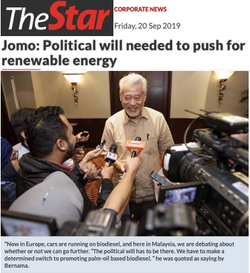
Political will needed to push for renewable energy

The Star 10July 2019

The Star 10July 2019

Malaysian businesses need boost

The Star 9 Oct 2019

The Star 9 Oct 2019

Subsidise public transport for bottom 40%

The Edge 26 Sept 2019

The Edge 26 Sept 2019

Call for measures to counteract global headwinds

The Edge 9 Oct 2019

The Edge 9 Oct 2019

Subsidise public transportation, not fuel

The Star 8 Oct 2019

The Star 8 Oct 2019

Subsidise public transportation for bottom 70%

TheEdge 2Oct 2019

TheEdge 2Oct 2019

"We need to counteract downward forces"

Fake News

PLEASE BEWARE OF MISREPRESENTATIONS OF IMAGES OF JOMO

Commercial and political misrepresentation of his image attributing to him to things which he never said or misrepresenting things he may have said is being circulated on websites such as those posted here. 


You should also be warned, in case you are not already aware, of ‘click bait’ i.e. using such images simply to attract your interest, and then to download your online information for abuse for a variety of ends.

Please inform us and provide a screenshot and weblink to enable further action, which is incredibly difficult. 

Thank you for reading this and for your help and cooperation.

This has also been flagged on his official Facebook page


JKS image ad2.jpg
JKS image Bitcoin ad on  Facebook.jpg
JKS - Fake News 2.jpg
Contact Me
JKS - Fake News 3.jpg
JKS fake news 1.jpg

Nadi Insan by the People's History Centre

Read all editions of #NadiInsan from 1979 to 1983 free of charge at the Peoples History Center website.


Containing writings on socio-political issues, film and cultural commentary, as well as in-depth interviews, Nadi Insan is motivated by community activists and intellectuals in Malaysia.

Happy reading!

Dapatkan kesemua siri majalah #NadiInsan dari tahun 1979 hingga 1983 secara percuma di laman Pusat Sejarah Rakyat.


Berisi tulisan memperihal sosio-politik, ulasan filem dan budaya sehinggalah wawancara yang rencam, Nadi Insan digerakkan oleh aktivis masyarakat dan intelektual di Malaysia.


Selamat membaca!

Contact Me

  • Facebook Social Icon
  • Twitter Social Icon

Thank you for reaching out!

bottom of page