top of page

Follow on Social Media

  • Facebook
  • Twitter
  • Screenshot 2022-09-18 at 5.20.40 PM

M'sia Developments
[on SubStack]

  • Screenshot 2022-09-18 at 5.20.40 PM

Jomo Kwame Sundaram


KATHMANDU, February 19, 2024 (IPS). Imperialism continues to dominate the world. Globalisation is losing to some of its anti-theses, but imperialism still rules, increasingly by law, albeit in changing even contradictory ways.

Hence, we live in challenging times. It is often difficult to see the main challenges we face as there seem to be so many. Also, the new or the unusual gains far more attention than what appears commonplace.


Power and empire

Our histories and cultures are often quite different despite our common, but varied experiences of foreign domination, even rule. Such power involves varied mixes of socioeconomic and political relations, involving governance and even the rule of law.

Our world has seen empires and imperialism for over two millennia, at least from before the time of Jesus Christ in Palestine, who had to deal with the satraps of the Roman empire then.

Half a millennium ago, when the Spanish conquistadors first reached the Philippines via the Pacific in 1521, the people of Mactan, led by Lapu-Lapu, resisted. Magellan had burnt down their villages after they ignored his demands for tribute as well as accepting his god and king.


Empires evolve

Imperialism has changed very significantly over time and will continue to change. It has combined in new ways with capital, capitalisms and existing socio-economic relations, especially after the mid-19th century.

A century and a half ago, at least two people from Asia began to criticise and oppose the emerging new imperialism. Sayyid Jamaluddin al-Afghani developed an Islamic critique of Western imperialism.

Dadabhai Naoroji, an Indian who became a Liberal Member of the English Parliament, was the other. Both analysed the impacts of imperialism in their own cultural idioms, condemning injustice and ‘drainage’ of the economic surplus.

They wrote decades before radical Western writers such as the English Liberal John Hobson and Social Democrats such as Rudolf Hilferding, Rosa Luxemburg and VI Lenin. All linked the new imperialism to ongoing capitalist transformation.


Imperial contradictions

However, successful resistance to imperialism does not overcome all injustices and may even make some worse. The US War of Independence against British colonialism strengthened American slaveowners and their business interests.

From thirteen colonies, the US expanded south and west, typically at the expense of indigenous communities, delaying inevitable pressure to go beyond the continent. Anticipated by the Monroe Doctrine in the early 19th century, US expansion abroad led to the Spanish-American War at its end.

Imperialist expansion abroad helped resolve some, but not all problems of capital accumulation. In the early 20th century, the Austro-Hungarian and Ottoman empires – both invoking religion – ended with help from rising nationalism.

Meanwhile, the Berlin Congress had mitigated inter-European imperial rivalries in Africa. Three decades later, the Treaty of Versailles purported to end the so-called First World War, mainly among rival European imperialists.

But, as Lenin and Keynes both observed – albeit somewhat differently – its inter-imperialist roots and Versailles’ terms only ‘kicked the can down the road’, thus sowing the seeds for the Second World War.

China had contributed immensely to the First World War effort. But instead of returning the Shantung peninsula to China, Versailles gave it to Japan after Germany surrendered it! This triggered widespread Chinese resentment of the West, triggering the 1919 May Fourth movement.


Imperialism without colonies

Recognising how rival colonial interests threatened the future of capitalism and imperialist interests, visionary US President Franklin Delano Roosevelt envisaged a new post-war world order, saving imperialism through decolonization.

This led to the birth of the United Nations and related multilateral institutions, including the International Monetary Fund and the International Bank for Reconstruction and Development, somewhat anticipating the Marshall Plan.

Now, with capitalism divided and weaker in some ways, but stronger militarily, modes of domination are still changing with significant consequences. For instance, until the 21st century, there was no explicit US African Command (Africom) to protect all Western and not only European interests there.

Another of Barack Obama’s ‘achievements’ after receiving the Nobel Peace Prize was overthrowing the Libyan regime. Despite giving up his nuclear programme at the request of the West, its leader Muammar Gaddafi, generally acknowledged as key to establishing the African Union, was humiliatingly murdered.


The significance of Gaza

The world is constantly being reshaped by imperialism, and developing countries need to continually update their understanding of its features. Such power remains the main, but not the only common challenge we face today, especially in the Global South.

Today, the tragedy of Gaza is the most brutal face of Western imperialism, historical and contemporary. It is not disputed that European failure to resolve its ‘Jewish problem’ from the 19thcentury contributed directly to the Nazi Holocaust.

And as Israel’s first Prime Minister David Ben-Gurion noted, “If I were an Arab leader, I would never sign an agreement with Israel. It is normal; we have taken their country. It is true God promised it to us, but how could that interest them? Our God is not theirs.

“There has been anti-Semitism, the Nazis, Hitler, Auschwitz, but was that their fault? They see but one thing: We have come and we have stolen their country. Why would they accept that?”

Ben-Gurion’s acknowledgement of the implications of creating Israel underscores the legitimacy of the ongoing Palestinian resistance to Israeli settler colonialism, fascism and apartheid, specifically its latest brutal massacre in Gaza.

Explicit Western support for Israel’s genocidal ethnic cleansing reminds the world that those who claim moral legitimacy from having been victims before are more than capable of perpetrating the same, if not worse, on others.

The Israeli occupation of Palestine is a cruel caricature and reminder of the threat to humanity, especially in the Global South, of one hard face of imperial power, loyally supported by the soft power of manufactured consent, digitised or otherwise.


* Revised from invited speech at the 2024 Kathmandu World Social Forum opening ceremony, 15 February 2024.


Selected IPS readings


KATHMANDU, Nepal, Feb 14 2024 (IPS) - A gathering ‘perfect storm’ – due to various developments, several quite deliberate – now threatens much devastation in the global South, likely to most hurt the poorest and most vulnerable.

Globalisation’s protracted declineThe age of globalization had mixed consequences, unevenly incorporating national markets for labour, goods and even some services. It ended gradually, with the trend far more pronounced following the protracted worldwide stagnation since the 2008 global financial crisis.


Sometimes still referred to as the Great Recession, Western central banks resorted to unconventional monetary policies, mainly ‘quantitative easing’, to keep their economies afloat. But easier credit enabled more financialization and indebtedness, rather than recovery, let alone sustainable development.


But the end of the era of globalization did not mean a simple return to the status quo ante. Most economies had been transformed irreversibly by economic liberalization, both nationally and internationally, with dire lasting consequences.

Market pressures for fiscal austerity were strengthened by conditionalities and advice from international financial institutions. This inevitably led to deep cuts in government spending, leaving little for public investments, which might contribute to the recovery of the real economy.


Interest rate hikes accelerate stagnationThe 2008 Wolfowitz doctrine, from late in the Bush Jr presidency, was revised by the Obama administration to launch the second Cold War. The COVID-19 pandemic and the last two years of war and sanctions have worsened supply-side disruptions exacerbating ‘cost-push’ inflation.


Some prices spiked due to opportunistic market manipulation by investors and speculators as well as deliberate disruptive interventions for political advantage. The rule of law – even once sacred property rights – has been sacrificed for political expediency, undermining trust, especially in states.


Hence, concerted interest rate hikes by influential Western central banks have proved to be an unnecessary, inappropriate and blunt demand-side tool to address contemporary inflation driven primarily by supply-side factors!

Instead of addressing inflation due to supply disruptions, higher interest rates have cut both private and government spending, resulting in less demand, jobs and incomes in much of the world.


In the US, successive presidents maintained full employment since Obama inherited the 2008 global financial crisis. Uniquely, its central bank, the US Fed, has a dual mandate to maintain full employment and financial stability.

All over the world, the deliberate and concerted interest rate hikes of 2022 and 2023 have proved to be both contractionary and biased against labour and jobs.


Global South’s hands tiedPolicymakers in the Global South are greatly constrained by their circumstances. Exposed to global markets and with limited fiscal and monetary policy instruments at their disposal, they are captive to pro-cyclical policy biases.


The International Monetary Fund and other international financial institutions tend to demand fiscal austerity conditionalities in return for any credit relief provided.


Thus, recipient governments are subject to spending constraints instead of providing relief. Worse, many legislatures have imposed unnecessary spending constraints on themselves, supposedly to enhance government fiscal credibility.

Supposedly independent central banks have further compounded monetary policy constraints. Such central banks are primarily responsive to international and national financial interests rather than national policy priorities.


Following monetary and financial liberalisation in recent decades, developing countries are much more exposed to debt crises worse than those experienced in the 1980s.


Then, governments in Latin America, Sub-Saharan Africa and elsewhere had borrowed heavily, mainly from US and UK commercial banks. After US Fed chair Paul Volcker raised interest rates sharply from 1980, severe fiscal and debt crises paralysed many of these governments for over a decade.


The debt exposure level is much higher and borrowed from varied sources, significantly more market-based and non-bank. Governments have also provided guarantees for state-owned enterprises to borrow heavily, but less accountably than with sovereign debt.


New divides in post-unipolar worldThe unipolar world moment after the end of the first Cold War briefly saw unchallenged US hegemony. The Organization for Economic Cooperation and Development developed policies for the global North in trade, investment, technology, finance, tax and other vital areas, typically at the expense of the South.

More recently, the ‘new Cold War’ or geopolitical policies, including illegal sanctions, have frustrated developing countries’ aspirations to reach the Sustainable Development Goals, adapt to global warming and its effects, and retrieve a fairer share of global corporate income tax revenue.


With most economies barely growing, and efforts by many governments to reduce imports, export opportunities have become more uncertain and constrained, ending a crucial premise for globalisation. With higher interest rates, even finance has abandoned developing countries in ‘flights to safety’ to the US.


Lacking the ‘exorbitant privilege’ of issuing the US dollar, still the world’s reserve currency, most developing countries lack monetary, fiscal and policy space. Unlike rich nations which borrow in their own currencies, most developing countries remain vulnerable to foreign exchange rate vagaries.


Poorest getting poorerWith Obama’s ‘Pivot to Asia’ launching US efforts to check China, its lending to developing countries, including in Sub-Saharan Africa, fell from around 2016.


Despite higher borrowing costs, many of the poorest countries turned to private creditors. But private market lending to poor nations dried up from 2022 as the US Fed raised interest rates sharply for almost two years.


As debt service costs soared, distress risks have risen sharply, especially in the poorest nations. While not obviously due to a conspiracy against the global South, there is little concern for the predicament of the worst off in the poorest countries.


Meanwhile, poverty in the poorest countries has not declined for over a decade.


With international disparities growing at the expense of the poorest people in the poorest nations, the desire to emigrate continues to rise although mainly unaffordable to the poorest.


Related IPS Articles

·                Onerous Debt Making Poorest Poorer

·                Rich Nations, IMF Deepen World Stagnation

·                Open Veins of Africa Bleeding Heavily

·                Inflation Phobia Hastens Recessions, Debt Crises

·                1980s’ Redux? New context, Old Threats

·                China Debt Traps in the New Cold War

·                North Ignores ‘Perfect Storm’ in Global South


KUALA LUMPUR, Malaysia, Jan 31 2024 (IPS) - Contractionary economic trends since 2008 and ‘geopolitical’ conflicts subverting international cooperation have worsened world conditions, especially in the poorest countries, mainly in Africa, leaving their poor worse off.


Conditions and prospects are so bad that two well-known globalisation cheerleaders have appealed to rich nations for urgent action. Former IMF Deputy Managing Director and World Bank Senior Vice-President, Professor Anne Krueger and influential Financial Times columnist Martin Wolf warn ominously of the dire consequences of inaction.


Deepening stagnationFollowing tepid growth after the 2008 global financial crisis, Covid-19 disrupted supply chains worldwide. Then, post-pandemic recovery was disrupted by wars in Ukraine and then Gaza.


Food and energy prices soared briefly, largely due to market manipulation by opportunistic investors. Invoking the price hikes as a pretext, the US Fed and European Central Bank raised interest rates, deepening economic stagnation worldwide.


Countries which borrowed heavily during the earlier decade of unconventional monetary policies – especially ‘quantitative easing’, offering easy credit – now have to cope with increasingly unbearable debt burdens, particularly in the global South.


Earlier modest progress in reducing poverty – now termed ‘extreme poverty’ – and food insecurity has slowed sharply, if not worse. For many of the world’s poorest, progress has not only stopped but even been reversed.


The World Bank currently defines the poor as those with daily per capita incomes under US$2.15 in 2017 prices. It estimated those deemed poor fell from 1.87bn – 31% of the world’s population – in 1998 to a forecast of 690mn (9%) in 2023.


The rate of decline of poverty has slowed sharply: global poverty is forecast to fall by a little over three percentage points during 2013-23 – very much less than the 14 percentage points in the decade before 2013.


Poorest mainly in poor countriesThe pace of poverty decline has slowed most in the world’s poorest nations. Wolf defines these countries as those deemed eligible for concessional loans from the World Bank Group’s soft-lending arm, the International Development Association (IDA).


Seventy-five countries are now considered eligible for IDA resources, including 39 in Africa. Some – e.g., Bangladesh, Nigeria and Pakistan – can also borrow on costlier terms from financial markets and the Group’s International Bank for Reconstruction and Development.


In IDA-eligible countries, those in extreme poverty fell from 48% in 1998 to 26% in 2023. But this only involved a single percentage point decline over 2013-23, compared to 14 percentage points in the decade before.


Extreme poverty has mainly declined in better-off middle-income countries, with 497 million poor in IDA-eligible countries. With 72% of the world’s total of 691 million poor in IDA-eligible nations, the remaining 193 million were in other countries.


The population share in extreme poverty in countries not IDA-eligible fell from a fifth in 1998 to 3% in 2023, falling by only four percentage points during 2013-23. Expecting modest overall growth, Wolf expects this 3% share will be largely eliminated by 2030.


Hence, he argues that extreme poverty can only end if attention and resources are focused on the world’s poorest countries, where poverty is most concentrated and deeply entrenched.


Unequal debt burdensGovernment debt is widespread, but especially debilitating in countries where the poor are most concentrated. The World Bank’s last International Debt Report notes such countries depend too much on unreliable and expensive funding.


The report acknowledges, “For the poorest countries, debt has become a nearly paralysing burden: 28 countries eligible to borrow from [IDA] are now at high risk of debt distress. Eleven are in distress.”


During 2012-21, the external debt share of IDA-eligible countries owed to private creditors jumped from 11.2% to 28.0%! Their debt service payments more than tripled from $26bn in 2012 to $89bn in 2022, as interest due jumped from $6.4bn to $23.6bn!


Meanwhile, the share of bondholders and other private lenders in total government debt fell from 37% in 2021 to 14% in 2022! As the US Fed raised interest rates sharply during 2022-23, investors dumped ‘high-risk’ poor borrowers, lending much less to those in most need.


With this ‘perfect storm’, debt distress should come as no surprise. The 2023 International Debt Report found 56% – over half – of IDA-eligible countries at risk of such distress.


Distress of the poorestWolf argues it is in rich nations’ interest and their obligation to provide poor countries with far more concessional finance. But such funding has actually declined in recent decades, especially with the end of the first Cold War over three decades ago.


The IDA is using its 20th replenishment for July 2022 to June 2025 to provide financing on concessional terms. The World Bank president has argued for a much bigger new replenishment ostensibly to accelerate growth, reduce poverty and address other challenges in the poorest countries.


IDA-eligible countries include many of the world’s worst-managed nations, often very fragile, vulnerable to shocks, and stuck in “hard to escape” poverty. But their problems have become pretexts to withhold or withdraw concessional finance from those most in need.


Much more concessional finance and other resources are needed for poor nations to develop sustainably. But reducing sustainable development to simply eliminating poverty, nowadays with climate action, will condemn the poorest developing countries to backwardness.


World financial arrangements have been crucial in undermining fair, sustainable development in poor countries. While it will be critical to enable these nations to overcome their current and imminent predicaments, far more fundamental reforms must quickly follow.


As the poorest developing countries are both weak and vulnerable, needed reforms are nowhere on the horizon. Instead, the ‘international community’ continues to kick the can down the road instead of undertaking bold reforms for the short and medium term.


Related IPS Articles

·                Rich Nations, IMF Deepen World Stagnation

·                Open Veins of Africa Bleeding Heavily

·                Inflation Phobia Hastens Recessions, Debt Crises

·                1980s’ Redux? New context, Old Threats

·                China Debt Traps in the New Cold War

·                Onerous Debt Making Poorest Poorer


Latest Videos

All Videos

All Videos

AN URGENT CALL: A PEOPLE"S VACCINE AGAINST COVID-19

00:00
9 June 2020: IHD-ILO-ISLE Virtual Conference - Day 2

9 June 2020: IHD-ILO-ISLE Virtual Conference - Day 2

05:08:34
Learning in Governance in times of COVID-19

Learning in Governance in times of COVID-19

46:30
Beyond the Lockdown: Towards the ‘New Normal’

Beyond the Lockdown: Towards the ‘New Normal’

59:10

About Jomo

Jomo Kwame Sundaram is Research Adviser, Khazanah Research Institute, Fellow, Academy of Science, Malaysia, and Emeritus Professor, University of Malaya. Previously, he was UN Assistant Secretary-General for Economic Development, Assistant Director General, Food and Agriculture Organization (FAO), Founder-Chair, International Development Economics Associates (IDEAs) and President, Malaysian Social Science Association. 

In The Media

TheStar 26 June 2020

TheStar 26 June 2020

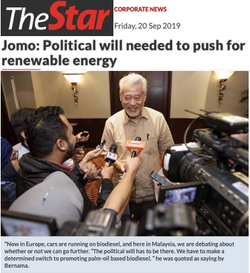
The Star 20 Sept 2019

The Star 20 Sept 2019

Political will needed to push for renewable energy

The Star 10July 2019

The Star 10July 2019

Malaysian businesses need boost

The Star 9 Oct 2019

The Star 9 Oct 2019

Subsidise public transport for bottom 40%

The Edge 26 Sept 2019

The Edge 26 Sept 2019

Call for measures to counteract global headwinds

The Edge 9 Oct 2019

The Edge 9 Oct 2019

Subsidise public transportation, not fuel

The Star 8 Oct 2019

The Star 8 Oct 2019

Subsidise public transportation for bottom 70%

TheEdge 2Oct 2019

TheEdge 2Oct 2019

"We need to counteract downward forces"

Fake News

PLEASE BEWARE OF MISREPRESENTATIONS OF IMAGES OF JOMO

Commercial and political misrepresentation of his image attributing to him to things which he never said or misrepresenting things he may have said is being circulated on websites such as those posted here. 


You should also be warned, in case you are not already aware, of ‘click bait’ i.e. using such images simply to attract your interest, and then to download your online information for abuse for a variety of ends.

Please inform us and provide a screenshot and weblink to enable further action, which is incredibly difficult. 

Thank you for reading this and for your help and cooperation.

This has also been flagged on his official Facebook page


JKS image ad2.jpg
JKS image Bitcoin ad on  Facebook.jpg
JKS - Fake News 2.jpg
Contact Me
JKS - Fake News 3.jpg
JKS fake news 1.jpg

Nadi Insan by the People's History Centre

Read all editions of #NadiInsan from 1979 to 1983 free of charge at the Peoples History Center website.


Containing writings on socio-political issues, film and cultural commentary, as well as in-depth interviews, Nadi Insan is motivated by community activists and intellectuals in Malaysia.

Happy reading!

Dapatkan kesemua siri majalah #NadiInsan dari tahun 1979 hingga 1983 secara percuma di laman Pusat Sejarah Rakyat.


Berisi tulisan memperihal sosio-politik, ulasan filem dan budaya sehinggalah wawancara yang rencam, Nadi Insan digerakkan oleh aktivis masyarakat dan intelektual di Malaysia.


Selamat membaca!

Contact Me

  • Facebook Social Icon
  • Twitter Social Icon

Thank you for reaching out!

bottom of page