top of page

Follow on Social Media

  • Facebook
  • Twitter
  • Screenshot 2022-09-18 at 5.20.40 PM

M'sia Developments
[on SubStack]

  • Screenshot 2022-09-18 at 5.20.40 PM

Updated: Jun 6, 2022

Anis Chowdhury and Jomo Kwame Sundaram


SYDNEY and KUALA LUMPUR, May 31 2022 (IPS) - US and allied economic sanctions against Russia for its illegal invasion of Ukraine have not achieved their declared objectives. Instead, they are worsening economic stagnation and inflation worldwide. Worse, they are exacerbating hunger, especially in Africa.


Sanctions cut both ways

Unless approved by the UN Security Council (UNSC), sanctions are not authorized by international law. With Russia’s veto in the UNSC, unilateral sanctions by the US and its allies have surged following the Ukraine invasion.

During 1950-2016, ‘comprehensive’ trade sanctions have cut bilateral trade between sanctioning countries and their victims by 77% on average. The US has imposed more sanctions regimes, and for longer periods, than any other country.

Unilateral imposition of sanctions has accelerated over the past 15 years. During 1990-2005, the US imposed about a third of sanctions regimes around the world, with the European Union (EU) also significant.

The US has increased using sanctions since 2016, imposing them on more than 1,000 entities or individuals yearly, on average, from 2016 to 2020 nearly 80% more than in 2008-2015. The one-term Trump administration raised the US share of all new sanctions to almost half from a third before.

During January-May 2022, 75 countries implemented 19,268 restrictive trade measures. Such measures on food and fertilizers (85%) greatly exceed those on raw materials and fuels (15%). Unsurprisingly, the world now faces less supplies and higher prices for fuel and food.

Monetary authorities have been raising interest rates to curb inflation, but such efforts do not address the main causes of higher prices now. Worse, they are likely to deepen and prolong stagnation, increasing the likelihood of ‘stagflation’.

Sanctions were supposed to bring Russia to its knees. But less than three months after the rouble plunged, its exchange rate is back to pre-war levels, rising from the ‘rouble rubble’ promised by Western economic warmongers. With enough public support, the Russian regime is in no hurry to submit to sanctions.


Sanctions pushing up food prices

War and sanctions are now the main drivers of increased food insecurity. Russia and Ukraine produce almost a third of world wheat exports, nearly 20% of corn (maize) exports and close to 80% of sunflower seed products, including oil. Related Black Sea shipping blockades have helped keep Russian exports down.

All these have driven up world prices for grain and oilseeds, raising food costs for all. As of 19 May, the Agricultural Price Index was up 42% from January 2021, with wheat prices 91% higher and corn up 55%.

The World Bank’s April 2022 Commodity Markets Outlook notes the war has changed world production, trade and consumption. It expects prices to be historically high, at least through 2024, worsening food insecurity and inflation.

Western bans on Russian oil have sharply increased energy prices. Both Russia and its ally, Belarus also hit by economic sanctions are major suppliers of agricultural fertilizers including 38% of potassic fertilizers, 17% of compound fertilizers, and 15% of nitrogenous fertilizers.

Fertilizer prices surged in March, up nearly 20% from two months before, and almost three times higher than in March 2021! Less supplies at higher prices will set back agricultural production for years.

With food agriculture less sustainable, e.g., due to global warming, sanctions are further reducing output and incomes, besides raising food prices in the short and longer term.


Sanctions hurt poor most

Even when supposedly targeted, sanctions are blunt instruments, often generating unintended consequences, sometimes contrary to those intended. Hence, sanctions typically fail to achieve their stated objectives.

Many poor and food insecure countries are major wheat importers from Russia and Ukraine. The duo provided 90% of Somalia’s imports, 80% of the Democratic Republic of Congo’s, and about 40% of both Yemen’s and Ethiopia’s.

It appears the financial blockade on Russia has hurt its smaller and more vulnerable Central Asian neighbours more: 4.5 million from Uzbekistan, 2.4 million from Tajikistan, and almost a million from Kyrgyzstan work in Russia. Difficulties sending remittances cause much hardship to their families at home.

Although not their declared intent, US measures during 1982–2011 hurt the poor more. Poverty levels in sanctioned countries have been 3.8 percentage points higher than in similar countries.

Sanctions also hurt children and other disadvantaged groups much more. Research in 69 countries found sanctions lowered infant weight and increased the likelihood of death before age three. Unsurprisingly, economic sanctions violate the UN Convention on the Rights of Children.

A study of 98 less developed and newly industrialized countries found life expectancy in affected countries reduced by about 3.5 months for every additional year under UNSC sanctions. Thus, an average five-year episode of UNSC approved sanctions reduced life expectancy by 1.2–1.4 years.


World hunger rising

As polemical recriminations between Russia and the US-led coalition intensify over rising food and fuel prices, the world is racing to an “apocalyptic” human “catastrophe”. Higher prices, prolonged shortages and recessions may trigger political upheavals, or worse.

The UN Secretary-General has emphasized, “We need to ensure a steady flow in food and energies through open markets by lifting all unnecessary export restrictions, directing surpluses and reserves to those in need and keeping a lead on food prices to curb market volatility”.

Despite declining World Bank poverty numbers, the number of undernourished has risen from 643 million in 2013 to 768 million in 2020. Up to 811 million people are chronically hungry, while those facing ‘acute food insecurity’ have more than doubled since 2019 from 135 million to 276 million.

With the onset of the Covid-19 pandemic, OXFAM warned, the “hunger virus” could prove even more deadly. The pandemic has since pushed tens of millions into food insecurity.

In 2021, before the Ukraine war, 193 million people in 53 countries were deemed to be facing ‘food crisis or worse’. With the war and sanctions, 83 million or 43% more are expected to be victims by the end of 2022.


Source: 2022 Global Report on Food Crises; 2022: projected


Economic sanctions are the modern equivalent of ancient sieges, trying to starve populations into submission. The devastating impacts of sieges on access to food, health and other basic services are well-known.

Sieges are illegal under international humanitarian law. The UNSC has unanimously adopted resolutions demanding the immediate lifting of sieges, e.g., its 2014 Resolution 2139 against civilian populations in Syria.

But veto-wielding permanent Council members are responsible for invading Ukraine and unilaterally imposing sanctions. Hence, the UNSC will typically not act on the impact of sanctions on billions of innocent civilians. No one seems likely to protect them against sanctions, today’s weapons of mass starvation.


Related IPS commentaries

Without Peace, Hunger Will Continue to Increase. 25 May 2022. http://www.ipsnews.net/2022/05/without-peace-hunger-will-continue-increase/

War or Peace, Barbarism or Hope. 29 March 2022. https://www.ipsnews.net/2022/03/war-peace-barbarism-hope/

Ukraine Incursion, World Stagflation. 15 March 2022. https://www.ipsnews.net/2022/03/ukraine-incursion-world-stagflation/


Anis Chowdhury and Jomo Kwame Sundaram


SYDNEY and KUALA LUMPUR. A class war is being waged in the name of fighting inflation. All too many central bankers are raising interest rates at the expense of working people’s families, supposedly to check price increases.

Forced to cope with rising credit costs, people are spending less, thus slowing the economy. But it does not have to be so. There are much less onerous alternative approaches to tackle inflation and other contemporary economic ills.

Short-term pain for long-term gain?

Central bankers are agreed inflation is now their biggest challenge, but also admit having no control over factors underlying the current inflationary surge. Many are increasingly alarmed by a possible “double-whammy” of inflation and recession.

Nonetheless, they defend raising interest rates as necessary “preemptive strikes”. These supposedly prevent “second-round effects” of workers demanding more wages to cope with rising living costs, triggering “wage-price spirals”.

In central bank jargon, such “forward-looking” measures convey clear messages “anchoring inflationary expectations”, thus enhancing central bank “credibility” in fighting inflation.

They insist the resulting job and output losses are only short-term – temporary sacrifices for long-term prosperity. Remember: central bankers are never punished for causing recessions, no matter how deep, protracted or painful.

But raising interest rates only makes recessions worse, especially when not caused by surging demand. The latest inflationary surge is clearly due to supply disruptions because of the pandemic, war and sanctions.

Raising interest rates only reduces spending and economic activity without mitigating ‘imported’ inflation, e.g., rising food and fuel prices. Recessions will further disrupt supplies, aggravating inflation and worsening stagflation.


Wage-price spirals?

Some central bankers claim recent instances of wage increases signal “de-anchored” inflationary expectations, and threaten ‘wage-price spirals’. But this paranoia ignores changed industrial relations and pandemic effects on workers.

With real wages stagnant for decades, the ‘wage-price spiral’ threat is grossly exaggerated. Over recent decades, most workers have lost bargaining power with deregulation, outsourcing, globalization and labour-saving technologies. Hence, labour shares of national income have declined in most countries since the 1980s.

Labour market recovery, even tightening in some sectors, obscures adverse overall pandemic impacts on workers. Meanwhile, millions of workers have gone into informal self-employment – now celebrated as ‘gig work’ – increasing their vulnerability.

Pandemic infections, deaths, mental health, education and other impacts, including migrant worker restrictions, have all hurt many. Contagion has especially hurt vulnerable workers, including youth, migrants and women.


Workers’ share of national income, 1970-2015


Ideological central bankers

Economic policies by supposedly independent and knowledgeable technocrats are presumed to be better. But such naïve faith ignores ostensibly academic, ideological beliefs.

Typically biased, albeit in unstated ways, policy choices inevitably support some interests over – even against – others. Thus, for example, an anti-inflation policy emphasis favours financial asset owners.

Politicians like the notion of central bank independence. It enables them to conveniently blame central banks for inflation and other ills – even “sleeping at the wheel” – and for unpopular policy responses.

Of course, central bankers deny their own role and responsibility, instead blaming other economic policies, especially fiscal measures. But politicians blaming central bankers after empowering them is simply shirking responsibility.

In the rich West, governments long bent on fiscal austerity left the heavy lifting for recovery after the 2008-2009 global financial crisis (GFC) to central bankers. Their ‘unconventional monetary policies’ involved keeping policy interest rates very low, enabling corporate shenanigans and zombie business longevity.

This enabled unprecedented increases in most debt, including private credit for speculation and sustaining ‘zombie’ businesses. Hence, recent monetary tightening – including raising interest rates – will trigger more insolvencies and recessions.


German social market economy

Inflation and policy responses inevitably involve social conflicts over economic distribution. In Germany’s ‘free collective bargaining’, trade unions and business associations engage in collective bargaining without state interference, fostering cooperative relations between workers and employers.

The German Collective Bargaining Act does not oblige ‘social partners’ to enter into negotiations. The timing and frequency of such negotiations are also left to them. Such flexible arrangements are said to have helped SMEs.

Although Germany’s ‘social market economy’ has no national tripartite social dialogue institution, labour unions, business associations and government did not hesitate to democratically debate crisis measures and policy responses to stabilize the economy and safeguard employment, e.g., during the GFC.


Dialogue down under

A similar ‘social dialogue’ approach was developed by Australian Labor Prime Minister Bob Hawke from 1983. This contrasted with the more confrontational approaches pursued in Margaret Thatcher’s UK and Ronald Reagan’s USA – where punishing interest rates inflicted long recessions.

Although Hawke had been a successful trade union leader, he began by convening a national summit of workers, businesses and other stakeholders. The resulting Prices and Incomes Accord between the government and unions moderated wage demands in return for ‘social wage’ improvements.

This consisted of better public health provisioning, pension and unemployment benefit improvements, tax cuts and ‘superannuation’ – involving required employees’ income shares and matching employer contributions to a workers’ retirement fund.

Although business groups were not formally party to the Accord, Hawke brought big businesses into other new initiatives such as the Economic Planning Advisory Council. This consensual approach helped reduce both unemployment and inflation.

Such consultations have also enabled difficult reforms – including floating exchange rates and reducing import tariffs. They also contributed to the developed world’s longest uninterrupted economic growth streakwithout a recession for nearly three decades, ending in 2020 with the pandemic.


Social partnerships

A variety of such approaches exist. For example, Norway’s kombiniert oppgjior, from 1976, involved not only industrial wages, but also taxes, salaries, pensions, food prices, child support payments, farm support prices, and more.

‘Social partnerships’ have also been important in Austria and Sweden. A series of political understandings – or ‘bargains’ – between successive governments and major interest groups enabled national wage agreements from 1952 until the mid-1970s.

Consensual approaches undoubtedly underpinned post-Second World War reconstruction and progress, of the so-called Keynesian ‘Golden Age’. But it is also claimed they have created rigidities inimical to further progress, especially with rapid technological change.

Economic liberalization in response has involved deregulation to achieve more market flexibilities. But this approach has also produced more economic insecurity, inequalities and crises, besides stagnating productivity.

Such changes have also undermined democratic states, and enabled more authoritarian, even ethno-populist regimes. Meanwhile, rising inequalities and more frequent recessions have strained social trust, jeopardizing security and progress.

Policymakers should consult all major stakeholders to develop appropriate policies involving fair burden sharing. The real need then is to design alternative policy tools through social dialogue and complementary arrangements to address economic challenges in more equitably cooperative ways.


Related IPS commentaries

When Saviours Are the Problem. 17 May 2022. https://www.ipsnews.net/2022/05/when-saviours-are-the-problem/

Deepening Stagflation: Out of the Frying Pan into the Fire. 5 April 2022. https://www.ipsnews.net/2022/04/deepening-stagflation-frying-pan-fire/

Stagflation Threat: Be Pragmatic, Not Dogmatic. 22 March 2022. https://www.ipsnews.net/2022/03/stagflation-threat-pragmatic-not-dogmatic/

Inflation Targeting Constrains Development. 8 March 2022. https://www.ipsnews.net/2022/03/inflation-targeting-constrains-development/

Inflation Targeting Voodoo. 1 March 2022. https://www.ipsnews.net/2022/03/inflation-targeting-voodoo/

Resist Inflation Phobia Coup. 8 February 2022. https://www.ipsnews.net/2022/02/resist-inflation-phobia-coup/


  • May 17, 2022
  • 5 min read

Anis Chowdhury and Jomo Kwame Sundaram


SYDNEY and KUALA LUMPUR: Central bank policies have often worsened economic crises instead of resolving them. By raising interest rates in response to inflation, they often exacerbate, rather than mitigate business cycles and inflation.


Neither gods nor maestros

US Federal Reserve Bank chair Jerome Powell has admitted: “Whether we can execute a soft landing or not, it may actually depend on factors that we don’t control.” He conceded, “What we can control is demand, we can’t really affect supply with our policies. And supply is a big part of the story here”.

Hence, decisionmakers must consider more appropriate policy tools. Rejecting ‘one size fits all’ formulas, including simply raising interest rates, anti-inflationary measures should be designed as appropriate. Instead of squelching demand by raising interest rates, supply could be enhanced.

Thus, Milton Friedman – whom many central bankers still worship – blamed the 1930s’ Great Depression on the US Fed. Instead of providing liquidity support to businesses struggling with short-term cash-flow problems, it squeezed credit, crushing economic activity.

Adverse impacts of the 1970s’ oil price shocks were worsened by the reactions of monetary policymakers, which caused stagflation. That is, US Fed and other central bank interventions caused economic stagnation without mitigating inflation.

Likewise, the longest US recession after the Great Depression, during the 1980s, was due to interest rate hikes by Fed chair Paul Volcker. A recent New York Times op-ed warned, “The Powell pivot to tighter money in 2021 is the equivalent of Mr. Volcker’s 1981 move” and “the 2020s economy could resemble the 1980s”.


Monetary policy for supply shocks?

Food prices surged in 2011 due to weather-related events ruining harvests in major food producing nations, such as Australia and Russia. Meanwhile, fuel prices soared with political turmoil in the Middle East.

Referring to Boston Fed research, he noted commodity price changes did not affect the long-run inflation rate. Other research has also concluded that commodity price shocks are less likely to be inflationary.

This reduced inflationary impact has been attributed to ‘structural changes’ such as workers’ diminished bargaining power due to labour market deregulation, technological innovation and globalization.

Hence, central banks are no longer expected to respond strongly to food and fuel price increases. Policymakers should not respond aggressively to supply shocks – often symptomatic of broader macroeconomic developments.

Instead, central banks should identify the deeper causes of food and fuel price rises, only responding appropriately to them. Wrong policy responses can compound, rather than mitigate problems.


Appropriate innovations

A former Philippines central bank Governor Amando M. Tetangco, Jr noted it had not responded strongly to higher food and fuel prices in 2004. He stressed, “authorities should ignore changes in the price of things that they cannot control”.

Tetangco warned, “the required policy response is not… straightforward… Thus policy makers will need to make a choice between bringing down inflation and raising output growth”. He emphasized, “a real sector supply side response may be more appropriate in addressing the pressure on prices”.

Thus, instead of restricting credit indiscriminately, financing constraints on desired industries (e.g., renewable energy) should be eased. Enterprises deemed inefficient or undesirablee.g., polluters or those engaged in speculation – should have less access to the limited financing available.

This requires designing macroeconomic policies to enable dynamic new investments, technologies and economic diversification. Instead of reacting with blunt interest rate policy tools, policymakers should know how fiscal and monetary policy tools interact and impact various economic activities.

Used well, these can unlock supply bottlenecks, promote desired investments and enhance productivity. As no one size fits all, each policy objective will need appropriate, customized, often innovative tools.


Lessons from China

China’s central bank, the People’s Bank of China (PBOC), developed “structural monetary policy” tools and new lending programmes to help victims of COVID-19. These ensured ample interbank liquidity, supported credit growth, and strengthened domestic supply chains.

Outstanding loans to small and micro businesses rose 25% to 20.8 trillion renminbi by March 2022 from a year before. By January, the interest rate for loans to over 48 million small and medium enterprises had dropped to 4.5%, the lowest level since 1978.

The PBOC has also provided banks with loan funds for promising, innovative and creditworthy companies, e.g., involved in renewable energy and digital technologies. It thus achieves three goals: fostering growth, maintaining debt at sustainable levels, and ‘green transformation’.

Defying global trends, China’s ‘factory-gate’ (or producer price) inflation fell to a one-year low in April 2022 as the PBOC eased supply chains and stabilized commodity prices. Although consumer prices have risen with COVID-19 lockdowns, the increases have remained relatively benign so far.

In short, the PBOC has coordinated monetary policy with both fiscal and industrial policies to boost confidence, promote desired investments and achieve stable growth. It maintains financial stability and policy independence by regulating capital flows, thus avoiding sudden outflows, and interest rate hikes in response.


Improving policy coordination

Central bankers monitor aggregate indicators, such as wages growth. However, before reacting to upward wage movements, the context needs to be considered. For example, wages may have stagnated, or the labour share of income may have declined over the long-term.

Moreover, wage increases may be needed for critical sectors facing shortages to attract workers with relevant skills. Wage growth itself may not be the problem. The issue may be weak long-term productivity growth due to deficient investments.

Input-output tables can provide information about sectoral bottlenecks and productivity, while flow-of-funds information reveals what sectors are financially constrained, and which are net savers or debtors.

Such information can helpfully guide design of appropriate, complementary fiscal and monetary policy tools. Undoubtedly, pursuing heterodox policies is challenging in the face of policy fetters imposed by current orthodoxies.

Central bank independence – with dogmatic mandates for inflation targeting and capital account liberalization – precludes better coordination, e.g., between fiscal and monetary authorities. It also undercuts the policy space needed to address both demand- and supply-side inflation.

Monetary authorities are under tremendous pressure to be seen to be responding to rising prices. But experience reminds us they can easily make things worse by acting inappropriately. The answer is not greater central bank independence, but rather, improved economic policy coordination.


Related IPS commentaries

Finance Drives World to Stagflation. 10 May 2022. https://www.ipsnews.net/2022/05/finance-drives-world-stagflation/

Deepening Stagflation: Out of the Frying Pan into the Fire. 5 April 2022. https://www.ipsnews.net/2022/04/deepening-stagflation-frying-pan-fire/

Stagflation Threat: Be Pragmatic, Not Dogmatic. 22 March 2022. https://www.ipsnews.net/2022/03/stagflation-threat-pragmatic-not-dogmatic/

Inflation Targeting Constrains Development. 8 March 2022. https://www.ipsnews.net/2022/03/inflation-targeting-constrains-development/

Inflation Targeting Voodoo. 1 March 2022. https://www.ipsnews.net/2022/03/inflation-targeting-voodoo/

Inflation Paranoia Threatens Recovery. 1 February 2022. https://www.ipsnews.net/2022/02/inflation-paranoia-threatens-recovery/

Inflation Bogey Blocking Recovery. 19 October 2021. https://www.ipsnews.net/2021/10/inflation-bogey-blocking-recovery/


Latest Videos

All Videos

All Videos

AN URGENT CALL: A PEOPLE"S VACCINE AGAINST COVID-19

00:00
9 June 2020: IHD-ILO-ISLE Virtual Conference - Day 2

9 June 2020: IHD-ILO-ISLE Virtual Conference - Day 2

05:08:34
Learning in Governance in times of COVID-19

Learning in Governance in times of COVID-19

46:30
Beyond the Lockdown: Towards the ‘New Normal’

Beyond the Lockdown: Towards the ‘New Normal’

59:10

About Jomo

Jomo Kwame Sundaram is Research Adviser, Khazanah Research Institute, Fellow, Academy of Science, Malaysia, and Emeritus Professor, University of Malaya. Previously, he was UN Assistant Secretary-General for Economic Development, Assistant Director General, Food and Agriculture Organization (FAO), Founder-Chair, International Development Economics Associates (IDEAs) and President, Malaysian Social Science Association. 

In The Media

TheStar 26 June 2020

TheStar 26 June 2020

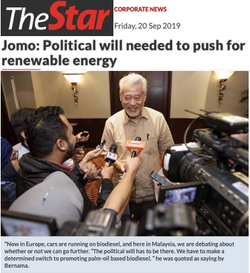
The Star 20 Sept 2019

The Star 20 Sept 2019

Political will needed to push for renewable energy

The Star 10July 2019

The Star 10July 2019

Malaysian businesses need boost

The Star 9 Oct 2019

The Star 9 Oct 2019

Subsidise public transport for bottom 40%

The Edge 26 Sept 2019

The Edge 26 Sept 2019

Call for measures to counteract global headwinds

The Edge 9 Oct 2019

The Edge 9 Oct 2019

Subsidise public transportation, not fuel

The Star 8 Oct 2019

The Star 8 Oct 2019

Subsidise public transportation for bottom 70%

TheEdge 2Oct 2019

TheEdge 2Oct 2019

"We need to counteract downward forces"

Fake News

PLEASE BEWARE OF MISREPRESENTATIONS OF IMAGES OF JOMO

Commercial and political misrepresentation of his image attributing to him to things which he never said or misrepresenting things he may have said is being circulated on websites such as those posted here. 


You should also be warned, in case you are not already aware, of ‘click bait’ i.e. using such images simply to attract your interest, and then to download your online information for abuse for a variety of ends.

Please inform us and provide a screenshot and weblink to enable further action, which is incredibly difficult. 

Thank you for reading this and for your help and cooperation.

This has also been flagged on his official Facebook page


JKS image ad2.jpg
JKS image Bitcoin ad on  Facebook.jpg
JKS - Fake News 2.jpg
Contact Me
JKS - Fake News 3.jpg
JKS fake news 1.jpg

Nadi Insan by the People's History Centre

Read all editions of #NadiInsan from 1979 to 1983 free of charge at the Peoples History Center website.


Containing writings on socio-political issues, film and cultural commentary, as well as in-depth interviews, Nadi Insan is motivated by community activists and intellectuals in Malaysia.

Happy reading!

Dapatkan kesemua siri majalah #NadiInsan dari tahun 1979 hingga 1983 secara percuma di laman Pusat Sejarah Rakyat.


Berisi tulisan memperihal sosio-politik, ulasan filem dan budaya sehinggalah wawancara yang rencam, Nadi Insan digerakkan oleh aktivis masyarakat dan intelektual di Malaysia.


Selamat membaca!

Contact Me

  • Facebook Social Icon
  • Twitter Social Icon

Thank you for reaching out!

bottom of page